

India Bangladesh consular dialogue has been postponed, adding a new complication since CBL’s August assessment of bilateral ties. The development is important for India’s neighbourhood relations because the meeting covered issues affecting citizens on both sides.
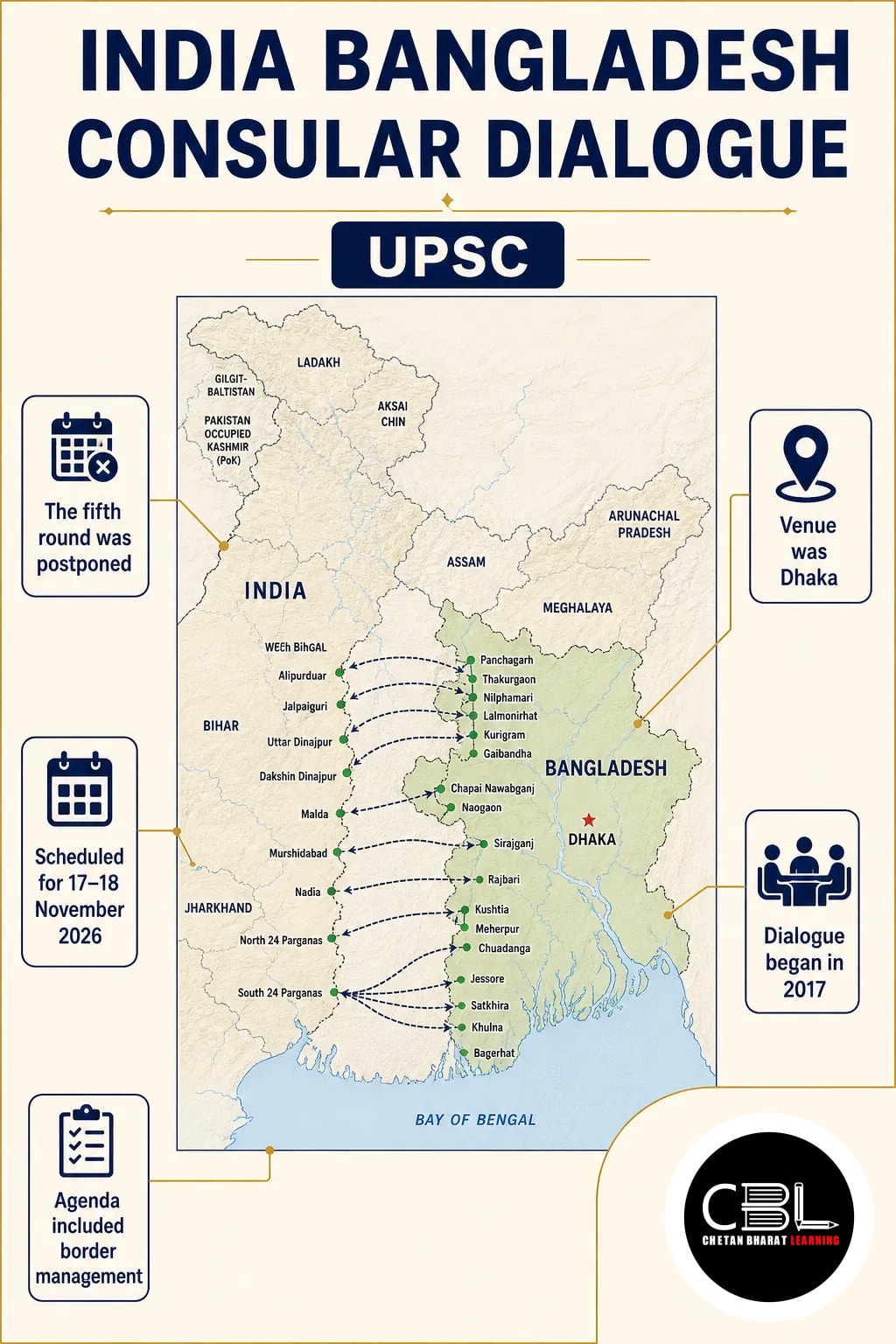
Quick answer: The fifth India Bangladesh consular dialogue, scheduled for 17–18 November 2026 in Dhaka, has been postponed. A diplomatic source linked the delay mainly to tensions over former Prime Minister Sheikh Hasina’s planned return to Bangladesh in December. The agenda included visas, border management and repatriation of detained citizens.
What happened to the India Bangladesh consular dialogue?
The two countries postponed their fifth consular meeting amid renewed political tensions. Foreign ministry officials at the director general level had planned to meet in Dhaka on 17 and 18 November.
A diplomatic source attributed the delay mainly to tensions arising from Hasina’s announcement that she would return to Bangladesh in December. The former prime minister took refuge in India on 5 August 2024, following the fall of her government during a youth-led uprising.
On 9 November 2026, her representatives requested a new Bangladeshi passport and national identity card from Bangladesh’s High Commission in New Delhi. However, Bangladesh’s Acting Foreign Minister Humayun Kabir said Dhaka would not issue her a passport and would seek her extradition through an acceptable prisoner exchange process.
The postponement is the latest development in a longer political dispute, not a decision on extradition. For background, see CBL’s analysis of the Hasina factor.
What was on the dialogue agenda?
The proposed agenda covered border management, visa procedures and repatriation of citizens detained on either side. The meeting would have been the first such round since the August 2024 uprising.
| Milestone | Fact |
|---|---|
| 2017 | The countries began the consular dialogue. |
| 29 May 2024 | The fourth round took place in New Delhi. |
| August 2024 | India sharply reduced visa issuance as tensions broke out. |
| 17–18 November 2026 | The fifth round was scheduled in Dhaka but postponed. |
The dialogue provides a regular channel for consular, visa and mutual legal assistance cooperation. In addition, the fourth round discussed visa matters, repatriation and cases under the Mutual Legal Assistance Treaty.
India has gradually increased visas for Bangladeshi travellers in recent months, especially after Tarique Rahman’s election as prime minister in February 2026. For context on India’s broader visa framework, see India’s visa categories.
Why does the postponement matter for India?
The delay matters because a political dispute has interrupted a channel dealing with practical cross-border cooperation. Its consequences should be assessed as risks, rather than assumed outcomes.
- People-to-people links: Visa procedures shape lawful travel, so predictable communication matters to applicants and authorities.
- Detained citizens: A dedicated meeting can help officials coordinate repatriation; a delay removes one scheduled opportunity for discussion.
- Border management: Since neighbours share a land boundary, officials need channels to address administrative and security concerns together.
- Institutional continuity: Regular working-level contact can preserve communication even when leaders disagree on a sensitive political issue.
For General Studies Paper II, the distinction between political relations and consular administration is central. They interact, but postponing a meeting does not establish that every other bilateral channel has stopped.
What are the main concerns?
The central concern is that a dispute over Hasina may make routine cooperation harder to sustain. However, the source does not specify a replacement date or quantify the effect on pending cases.
Political and legal sensitivities
Bangladesh’s stated position on extradition and Hasina’s request for identity documents concern distinct processes. Therefore, an aspirant should not treat a passport request, extradition demand and repatriation of other detained citizens as interchangeable.
Extradition concerns the transfer of a person sought for criminal proceedings or punishment, subject to applicable law and arrangements. By contrast, consular repatriation concerns the return of citizens and can arise in different administrative circumstances.
Administrative uncertainty
Without the planned meeting, officials lose a scheduled forum for reviewing visa and detention-related matters together. Nevertheless, the available report does not establish that individual applications or all bilateral work have ceased.
Both governments must also balance border oversight with accessible procedures for legitimate travel. Thus, a narrow security response without administrative coordination could make routine case management more difficult.
What is the way forward?
The immediate priority is to restore predictable communication while addressing sensitive disputes through appropriate legal channels.
- Reschedule the dialogue: Both foreign ministries could agree on a fresh date and retain the planned working-level agenda.
- Separate workstreams: Meanwhile, officials could handle visas and detained citizens without making progress on every issue conditional on resolving the Hasina dispute.
- Use established procedures: Any extradition issue should follow applicable legal processes; it should not be equated with routine consular repatriation.
- Track practical cases: In addition, designated officials could review pending documentation and repatriation matters through existing communication channels.
- Protect continuity: Finally, regular contact on border management and mutual legal assistance can reduce reliance on one meeting.
Overall, the episode illustrates a neighbourhood diplomacy challenge: governments must manage political disagreements without losing sight of citizens’ practical needs.
Source: The Hindu International, 13 November 2026
- India Bangladesh Ties: A Strategic Crossroads for UPSC (12 Aug 2026)
- India Bangladesh Relations: Hasina Factor Explained for UPSC (10 Aug 2026)
Asked in UPSC: Previous Year Questions
- UPSC CSE Mains 2020 (GS Paper III): Analyse internal security threats and transborder crimes along Myanmar, Bangladesh and Pakistan borders, including the Line of Control. Discuss the role of various security forces.
UPSC also tests the broader border-management dimension, although this question is not about the consular dialogue itself.
Punjab PCS and Haryana HCS General Studies can test this development under India’s relations with neighbouring countries. In addition, revise the distinction between visas, repatriation and extradition.
Prelims Practice Corner
Mains Practice Questions
Frequently Asked Questions
Why was the India–Bangladesh consular dialogue postponed?
Mainly because of tensions over Sheikh Hasina’s announced return to Bangladesh, according to a diplomatic source. The fifth meeting had been scheduled for 17–18 November 2026 in Dhaka.
When was the previous consular dialogue held?
The fourth round took place on 29 May 2024 in New Delhi. Therefore, the planned fifth round would have been the first since the August 2024 uprising.
What issues does the consular dialogue address?
It addresses consular, visa and mutual legal assistance cooperation. In addition, the postponed round’s agenda included border management and repatriation of detained citizens.
Is extradition the same as repatriation?
No, because extradition concerns a person sought for criminal proceedings or punishment, while repatriation is a broader return process. Consequently, the two should not be treated as interchangeable.
Related Current Affairs
Preparing for UPSC, PCS or HCS?
Talk to a mentor at Chetan Bharat Learning, Chandigarh. Free guidance on choosing the right exam and building a study plan.
Chat on WhatsAppCall 97793 53345UPSC / IAS / PCS coaching in Chandigarh · Trusted by aspirants across Punjab & Haryana









Leave a Reply
You must be logged in to post a comment.