
India retail inflation crossed the Reserve Bank of India’s upper tolerance limit in October 2026, raising questions about food prices and interest rates. For related context, explore CBL’s economy current affairs.
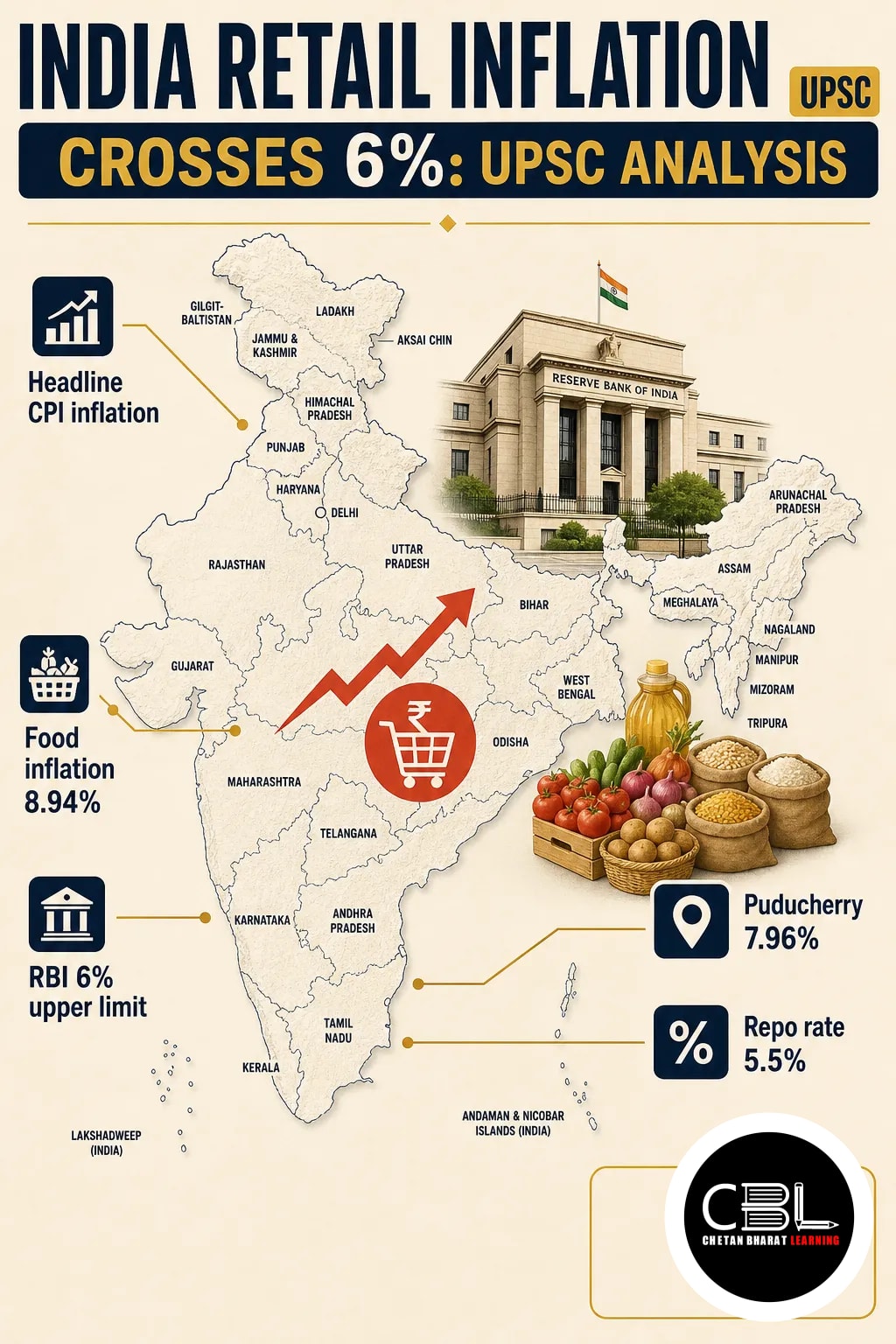
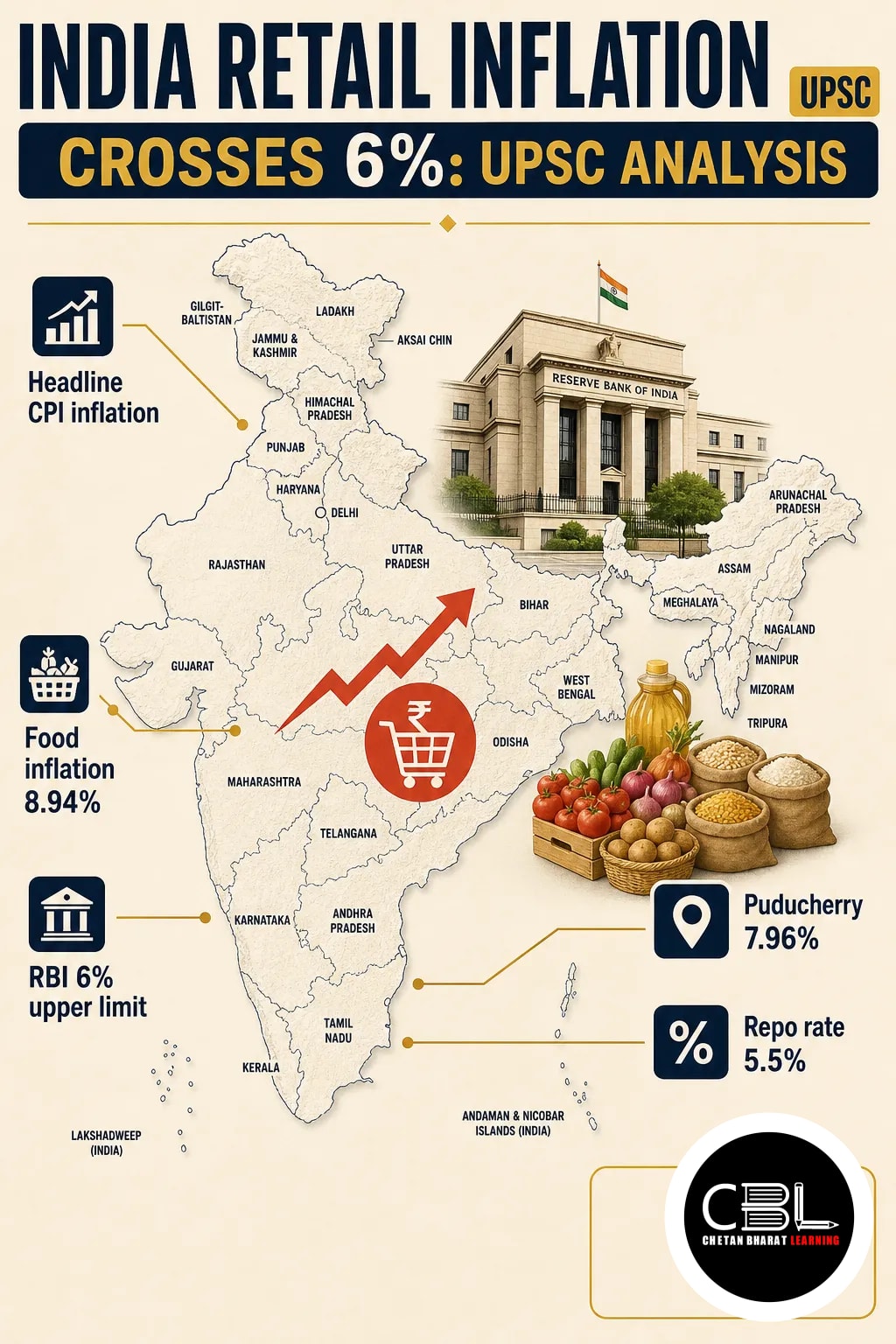
Quick answer: India retail inflation rose to 6.09% in October 2026 from 5.54% in September. Food inflation increased to 8.94%, while an unfavourable base effect also lifted the headline rate. The reading exceeded the Reserve Bank of India’s 6% upper tolerance limit and strengthened expectations of another policy rate increase.
What do the October inflation figures show?
The October data show faster price increases across the headline and food measures. The Ministry of Statistics and Programme Implementation released the figures based on the Consumer Price Index (CPI).
| Indicator | October 2026 reading |
|---|---|
| Headline CPI inflation | 6.09%, up from 5.54% in September |
| Food inflation | 8.94%, up from 7.74% |
| Overall month-on-month price change | 0.5% increase over September |
| Food month-on-month price change | Almost 1% increase over September |
Headline inflation rose for the 12th consecutive month and exceeded 6% for the first time since October 2024. Moreover, it remained above the 4% target for a fifth consecutive month. CBL’s August inflation coverage provides earlier context.
Why did India retail inflation rise?
Rising food prices and an unfavourable base effect pushed the annual headline rate higher. Food items with particularly high annual inflation included onion at 116%, garlic at 61%, ginger at 48% and lemon at 47%.
The base effect reflects the influence of the previous year’s price level on the annual inflation calculation. For example, a low comparison base can increase the measured annual rate even when the current price increase is moderate.
However, the base effect does not explain all the price pressure. Overall prices rose 0.5% from September, while food prices rose by almost 1%. Therefore, month-on-month changes indicate current price momentum alongside the annual comparison.
The report also identifies global shocks, seasonal clothing price increases and higher car prices as sources of broader pressure. For another food-price dimension, see CBL’s analysis of the sugar price rise and ethanol debate.
How did inflation vary across states and Union territories?
Puducherry recorded the highest headline inflation among the reported states and Union territories, at 7.96%. Meanwhile, 11 of the 36 recorded rates above 6%.
Only five recorded inflation below 4%: Andaman and Nicobar Islands, Meghalaya, Mizoram, Nagaland and the National Capital Territory of Delhi. Thus, the national figure conceals differences in local price pressures.
These differences matter for state administration because food availability, distribution and local market conditions can vary. A national interest rate, however, cannot respond separately to each state’s inflation rate.
What is the RBI’s inflation-targeting framework?
The Reserve Bank of India (RBI) targets 4% headline CPI inflation within a tolerance band of 2% to 6%. The framework is flexible because monetary policy also considers growth while pursuing price stability.
The Monetary Policy Committee (MPC) sets the policy repo rate, the rate at which banks borrow short-term funds from the RBI against eligible securities. A higher repo rate can raise borrowing costs and moderate demand. However, its effects take time and may not immediately resolve shortages of perishable foods.
A single monthly reading above 6% does not by itself constitute a formal failure of the inflation target. Under the statutory framework, failure is assessed using average inflation over three consecutive quarters outside the tolerance band. The RBI must then report to the central government on the reasons and remedial action.
What is the policy outlook for interest rates and growth?
The latest reading has increased expectations of another rate rise, but the MPC has not announced that decision. In October, it raised the repo rate by 25 basis points to 5.5%; one basis point equals one-hundredth of a percentage point.
Economists expect another increase at the December 2–4 meeting. Meanwhile, the RBI’s latest forecasts put average CPI inflation at 6% for October–December, 5.7% for January–March 2027 and 5.6% for April–June 2027. These are projections, not observed outcomes.
Strong growth gives policymakers room to consider inflation risks, although tighter credit can affect demand. Gross domestic product (GDP) grew 7.8% in April–June. For July–September, BofA Securities projected 7.7%, compared with the RBI’s 7.2% and the Finance Ministry’s 7.35%; these are forecasts, not final GDP data.
Higher rates can support price stability by curbing demand and inflation expectations. On the other hand, they may raise loan costs for households and firms. Moreover, external risks, including geopolitical effects on oil prices and El Niño, complicate the outlook.
What are the challenges and the way forward?
The central challenge is to contain persistent inflation without placing an excessive burden on growth. Food-led inflation requires monetary policy and supply-side measures to work together.
- Protect purchasing power: Food price increases reduce the real value of household incomes; low-income households may face particular pressure because food takes a larger share of their budgets.
- Improve supply response: Better storage, transport and market information can reduce losses and ease distribution bottlenecks. However, such measures take time to implement.
- Monitor price momentum: Policymakers should examine monthly changes, regional trends and the spread of increases beyond food. Thus, they can distinguish a temporary base effect from persistent pressure.
- Coordinate policy: The RBI can address demand and expectations, while governments can address food supply and targeted household support. Moreover, clear communication can explain the trade-off between inflation control and growth.
Inflation also affects public finances through expenditure linked to prices. CBL’s discussion of Punjab’s dearness allowance challenge illustrates this fiscal dimension.
Source: Indian Express Business, 12 November 2026
- Retail Inflation Rises: August 2026 Price Pressures (15 Sep 2026)
- Sugar price hike: Causes and ethanol debate (3 Sep 2026)
- Dearness allowance: Punjab’s fiscal challenge (2 Sep 2026)
Punjab PCS and Haryana HCS may link food inflation to agricultural markets, household budgets and state-level price monitoring. Moreover, dearness allowance provides a connection between inflation and state expenditure.
Prelims Practice Corner
Mains Practice Questions
Frequently Asked Questions
What was India’s retail inflation in October 2026?
It was 6.09%. Therefore, it exceeded the RBI’s 6% upper tolerance limit.
Why does the base effect matter for inflation?
It affects the annual inflation rate because that rate compares prices with the previous year. Moreover, a low comparison base can make current inflation look higher.
Does one month above 6% mean the RBI has failed its inflation target?
No, because formal failure is assessed over three consecutive quarters. Specifically, average inflation must remain outside the tolerance band in each of those quarters.
Will the RBI definitely raise the repo rate in December 2026?
No decision had been announced when the October data were reported. However, economists expected another increase at the December 2–4 meeting.
Related Current Affairs
Preparing for UPSC, PCS or HCS?
Talk to a mentor at Chetan Bharat Learning, Chandigarh. Free guidance on choosing the right exam and building a study plan.
Chat on WhatsAppCall 97793 53345UPSC / IAS / PCS coaching in Chandigarh · Trusted by aspirants across Punjab & Haryana









Leave a Reply
You must be logged in to post a comment.