
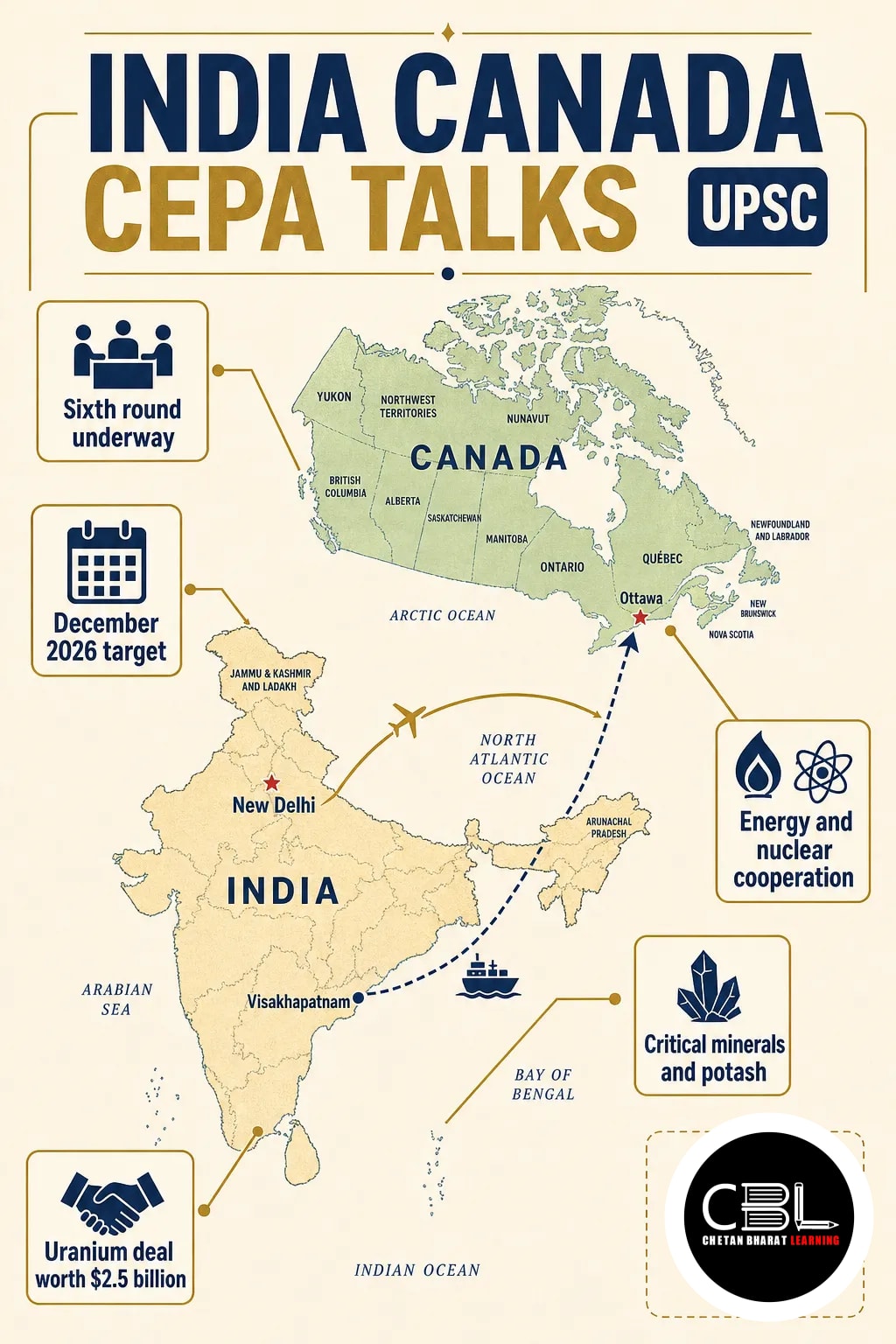
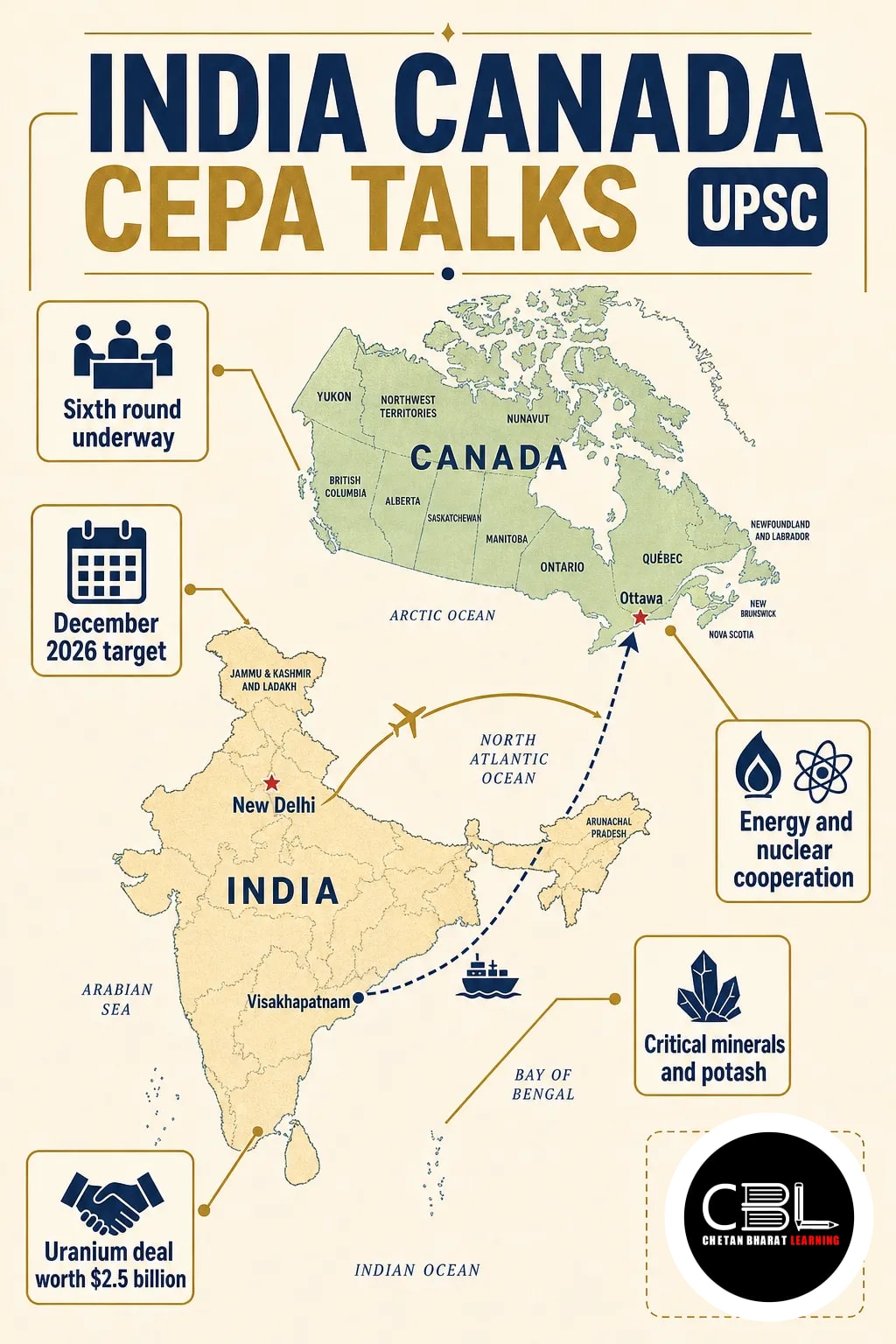
India Canada CEPA talks have entered their sixth round, with a possible conclusion by December 2026. The negotiations add a trade dimension to India’s wider international relations agenda.
Quick answer: India Canada CEPA talks are in their sixth round. On 12 November 2026, Canadian trade minister Maninder Sidhu said he hoped to conclude them by Prime Minister Narendra Modi’s expected December visit to Canada. At Visakhapatnam, he also highlighted potential cooperation in energy, critical minerals, agriculture and investment. No completed pact was announced.
What happened in the India Canada CEPA talks?
India and Canada are negotiating a Comprehensive Economic Partnership Agreement (CEPA), with their chief negotiators holding the sixth round. On 12 November, Sidhu said he hoped talks would finish by Modi’s expected visit to Canada the following month.
Sidhu spoke at the Confederation of Indian Industry (CII) Partnership Summit in Visakhapatnam. He also discussed the pact with India’s Commerce and Industry Minister Piyush Goyal; the ministers met in New Delhi on 11 November.
A CEPA is a framework for closer economic engagement between partners. It may address goods, services and other areas depending on the negotiated text. However, the source does not specify the proposed tariff cuts or chapters of the India-Canada pact. For a related example, revise the India-UAE economic partnership agreement.
What are the key developments?
The sixth round and the December target are the main negotiation updates; the sectoral proposals remain broader areas of cooperation.
| Area | Development |
|---|---|
| Trade pact | Sixth round underway; conclusion by December is a target, not an announced outcome. |
| Nuclear energy | Sidhu said a uranium deal worth roughly $2.5 billion was signed around 1 March 2026. |
| Critical minerals | Sidhu described discussions on minerals and more resilient supply chains. |
| Investment | Sidhu said Canadian institutional investors had invested over $100 billion in India collectively. |
The uranium agreement and investment figures provide context for the relationship. They should not be treated as outcomes of the ongoing CEPA negotiations.
Why does the partnership matter for India?
The proposed partnership links trade diplomacy with India’s energy, industrial and agricultural needs. Its eventual impact, however, will depend on the agreement’s terms and implementation.
Energy and nuclear cooperation
Sidhu highlighted Canadian liquefied natural gas (LNG) projects as a potential source of energy for India. He also said Canadian capacity could support India’s nuclear objectives. Such cooperation could diversify supply options; however, project completion, commercial terms and infrastructure will matter.
The SHANTI Act received presidential assent on 21 December 2025. According to the source, it permits private participation in specified nuclear activities, subject to a central government licence and safety authorisation by the Regulatory Board. Thus, any commercial opportunity remains subject to regulatory requirements.
Minerals, agriculture and investment
Canada’s critical minerals could offer additional sourcing options for industries such as electric-vehicle battery manufacturing. Moreover, diversified sourcing can reduce exposure to disruption, although access depends on commercial arrangements and processing capacity.
Sidhu also identified potash as a possible Canadian contribution to Indian agriculture. For context on domestic sourcing, see Punjab’s potash exploration. Canadian investors have additionally expressed interest in data centres, artificial intelligence (AI) and technology, he said.
These interests illustrate economic complementarity: one partner’s supply or investment capacity may meet the other’s demand. However, complementarity alone does not establish market access or guarantee affordable supplies.
What concerns require attention?
The main concern is how negotiators balance prospective gains with domestic sensitivities. The source does not identify settled provisions, so these are issues for assessment rather than confirmed disputes.
- Market access: Tariff concessions can benefit buyers and exporters; however, competing domestic producers may face adjustment pressures.
- Rules of origin: Clear criteria can help determine which goods qualify for preferences. Otherwise, businesses may face uncertainty about eligibility.
- Supply security: Additional suppliers can improve resilience; nevertheless, cost, transport and processing constraints may limit actual diversification.
- Regulatory oversight: Nuclear cooperation requires safety authorisation. Similarly, investment and commercial access must operate within applicable Indian rules.
What should India prioritise next?
India should assess any final text against measurable access, domestic adjustment needs and supply security. A negotiating deadline can focus attention; however, it should not substitute for a workable agreement.
- Test the terms: Examine product coverage, exclusions and implementation timelines once the text becomes available.
- Consult stakeholders: Include farmers, industry, service providers and state governments when assessing potential effects.
- Connect commitments to capacity: Pair supply opportunities with storage, transport and processing capabilities, where needed.
- Review implementation: Monitor whether businesses can use preferences and whether benefits reach intended sectors.
For comparison, the India-Japan trade agreement review offers another context for studying trade and investment links.
Source: The Hindu, 12 November 2026
Punjab and Haryana PCS candidates can connect potash supply options with agricultural input security. Moreover, state General Studies questions may test the difference between a negotiation target and a concluded agreement.
Prelims Practice Corner
Mains Practice Questions
Frequently Asked Questions
What is the status of the India Canada CEPA talks?
The talks are in their sixth round. However, the December 2026 conclusion is a target, not a completed agreement.
What does CEPA stand for?
CEPA stands for Comprehensive Economic Partnership Agreement. Depending on its negotiated terms, it can cover several areas of economic engagement.
Which sectors did Canada highlight for cooperation with India?
Energy, critical minerals, agriculture and investment were among the sectors highlighted. For example, Sidhu mentioned uranium, potash and battery supply chains.
Was the uranium deal concluded under the proposed CEPA?
The source does not identify the uranium deal as a CEPA outcome. Sidhu said it was signed around 1 March 2026; meanwhile, CEPA negotiations remain underway.
Related Current Affairs
Preparing for UPSC, PCS or HCS?
Talk to a mentor at Chetan Bharat Learning, Chandigarh. Free guidance on choosing the right exam and building a study plan.
Chat on WhatsAppCall 97793 53345UPSC / IAS / PCS coaching in Chandigarh · Trusted by aspirants across Punjab & Haryana









Leave a Reply
You must be logged in to post a comment.