
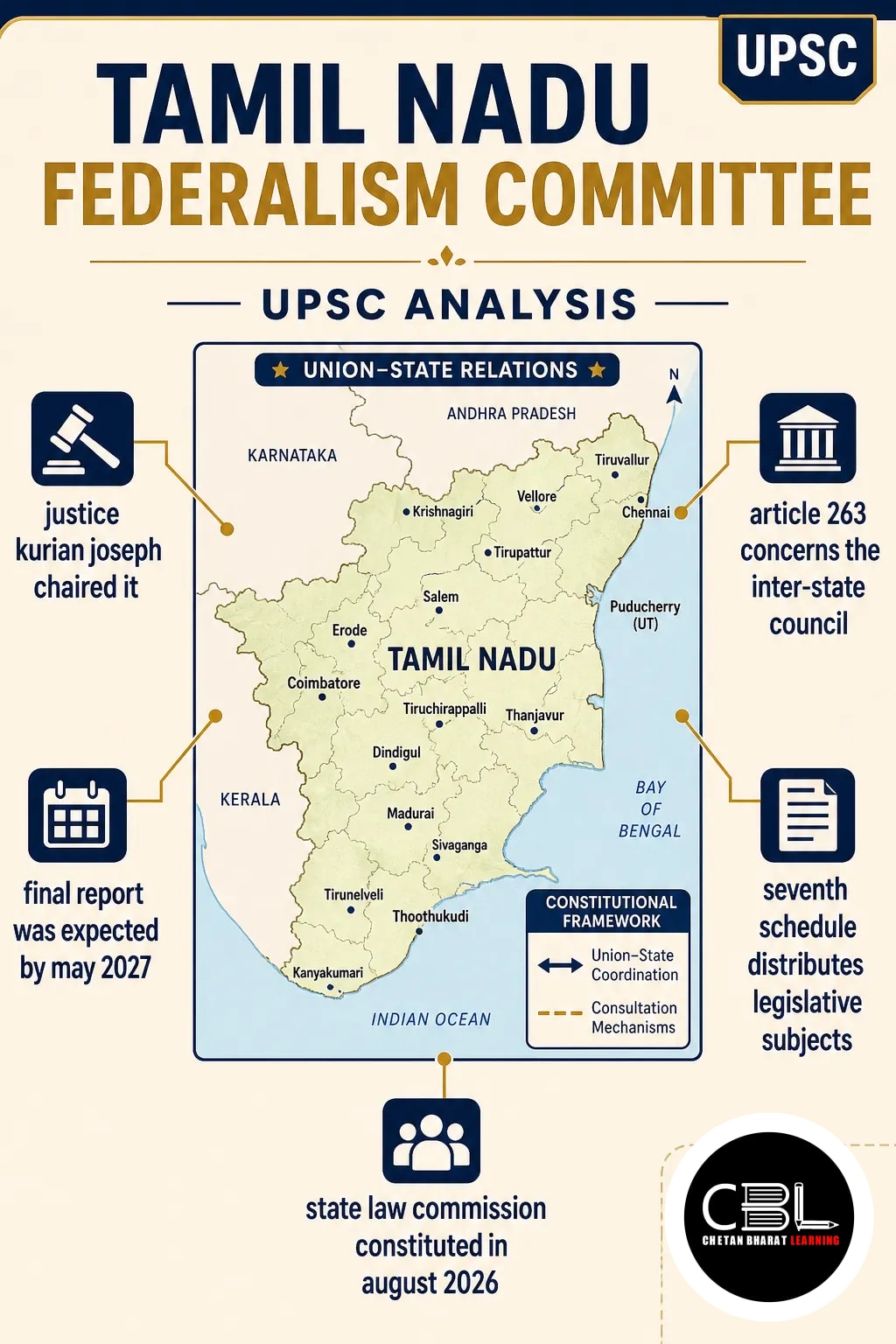

The Tamil Nadu federalism committee was disbanded before its final report, prompting a debate on State autonomy and continuity in policy research. The issue connects with wider constitutional and federalism debates.
Quick answer: The Tamil Nadu federalism committee, chaired by Justice Kurian Joseph, was disbanded before its final report, expected by May 2027. On 9 November 2026, former Chief Minister M.K. Stalin criticised the decision. He rejected the argument that its mandate overlapped with the Tamil Nadu State Law Commission, constituted in August 2026.
What was the Tamil Nadu federalism committee?
The High-Level Committee on Union-State Relations examined questions concerning relations between the Union and States. Justice Kurian Joseph chaired it, and K. Ashok Vardhan Shetty was a member.
Stalin said he constituted the committee while serving as Chief Minister. Its first report had already entered public debate; however, the final report was expected only by May 2027.
The source does not specify the committee’s detailed terms of reference or the recommendations in its first report. Therefore, aspirants should not attribute specific proposals to it without further evidence.
Why was its disbanding contested?
Stalin opposed the decision because he considered the committee’s work distinct from the State Law Commission’s mandate. In his letter of 9 November 2026, he addressed Justice Kurian Joseph and K. Ashok Vardhan Shetty.
According to Stalin, research for the second part of the report was nearly complete. He also argued that the first part had generated constructive debate and that disbanding the committee discarded accumulated expertise.
Stalin rejected the argument that the committee’s mandate overlapped with the Tamil Nadu State Law Commission, constituted in August 2026. However, the available source does not set out the government’s full reasoning or the commission’s detailed mandate; the alleged overlap cannot therefore be independently assessed here.
Stalin also invoked the Justice Rajamannar Committee as a milestone in the State autonomy debate. His comparison places the present dispute within a longer discussion about how States should participate in India’s federal framework.
How does the Constitution organise Union-State relations?
The Constitution distributes legislative, administrative and financial responsibilities while providing mechanisms for coordination and dispute resolution. Its federal structure therefore combines State authority with a strong Union.
| Provision | Relevance to federalism |
|---|---|
| Article 246 and Seventh Schedule | Allocate legislative subjects through Union, State and Concurrent Lists. |
| Article 263 | Permits the President to establish an Inter-State Council for specified coordination and inquiry functions. |
| Article 280 | Provides for a Finance Commission to recommend tax distribution and other matters referred to it. |
| Article 131 | Gives the Supreme Court original jurisdiction over specified Union-State and inter-State disputes. |
| Article 279A | Provides for the Goods and Services Tax Council, a forum for Union-State recommendations on the tax. |
These mechanisms serve different purposes: consultation, financial recommendations and adjudication. Consequently, a State-appointed research committee should not be confused with a constitutional body empowered to perform those functions.
Why does the dispute matter for federalism?
The dispute illustrates how State-level research can inform national debates, even though its recommendations need not bind the Union. It also raises questions about preserving institutional work across changes in government.
Legislative and administrative autonomy
The Seventh Schedule distributes subjects, but several policy areas require coordination across governments. For example, Concurrent List subjects permit legislation by both Parliament and State legislatures, subject to constitutional rules on repugnancy.
Therefore, assessments of State autonomy must examine both formal legislative powers and how governments consult each other during implementation. The existence of a committee alone does not resolve those constitutional questions.
Fiscal federalism and disputes
States need reliable resources to exercise their responsibilities, while national taxation requires coordination. The Tamil Nadu Goods and Services Tax collection debate provides a related context for examining fiscal federalism.
Similarly, disputes can involve more than one State as well as the Union. The Punjab river-water disputes illustrate why federal cooperation and dispute-resolution mechanisms matter.
Institutional continuity
Expert committees can consolidate evidence and offer options for elected governments. However, a change in institutional arrangements may interrupt research unless records, drafts and responsibilities are clearly transferred.
Equally, governments may reorganise advisory work to avoid duplication. Therefore, the relevant test is whether they explain the decision and preserve useful evidence, rather than assuming either continuity or reorganisation is always preferable.
What are the concerns and the way forward?
The immediate concern is the future of the committee’s unfinished research; the wider challenge is to convert federal dialogue into informed decisions.
- Clarify mandates: The State government can publish the relevant terms of reference, so any overlap can be assessed on evidence.
- Preserve research: Subject to applicable safeguards, authorities can catalogue completed work and identify how unfinished material will be handled.
- Strengthen consultation: The Union and States can use established forums, including the Inter-State Council, to discuss shared policy concerns.
- Improve accountability: Governments can explain which expert recommendations they accept or reject and provide reasons for their decisions.
Ultimately, federal cooperation requires both meaningful State participation and respect for constitutional institutions. Transparent treatment of research can support that goal without prejudging the merits of any recommendation.
Source: The Hindu, 10 November 2026
Asked in UPSC: Previous Year Questions
- UPSC CSE Mains 2026 (GS Paper II): How successfully has Indian federalism accommodated regional and cultural diversity? Highlight asymmetric federalism and suggest better dispute-resolution measures.
- UPSC CSE Mains 2025 (GS Paper II): Examine evolving Centre-State financial relations in planned development. How far have recent reforms affected fiscal federalism?
- UPSC CSE Mains 2024 (GS Paper II): What recent Union government changes concern Centre-State relations? Suggest measures to build trust and strengthen federalism.
UPSC connects federal institutions with fiscal relations, diversity and dispute resolution; therefore, revise both provisions and their practical implications.
Punjab PCS and Haryana HCS aspirants can connect federalism with inter-State river-water disputes and Union-State coordination. In addition, revise Articles 131 and 263 and distinguish adjudication from consultation.
Prelims Practice Corner
Mains Practice Questions
Frequently Asked Questions
Who chaired the Tamil Nadu committee on Union-State relations?
Justice Kurian Joseph chaired it. K. Ashok Vardhan Shetty was also a member.
Why did Stalin criticise the committee’s disbanding?
He said its mandate did not overlap with the Tamil Nadu State Law Commission’s work. In addition, he said research for the second part of its report was nearly complete.
When was the committee’s final report expected?
The final report was expected by May 2027. However, the State government disbanded the committee before that deadline.
Which constitutional provision concerns the Inter-State Council?
Article 263 concerns the Inter-State Council. It permits the President to establish the council for specified inquiry and coordination functions.
Related Current Affairs
Preparing for UPSC, PCS or HCS?
Talk to a mentor at Chetan Bharat Learning, Chandigarh. Free guidance on choosing the right exam and building a study plan.
Chat on WhatsAppCall 97793 53345UPSC / IAS / PCS coaching in Chandigarh · Trusted by aspirants across Punjab & Haryana

 Ananya RanaIAS · AIR 60
 Aditya SharmaIAS · AIR 70
 Ria Kaur SethiIPS · AIR 89
 Aman AloonIRS · AIR 295
 Sumer Singh VirkIRS · AIR 335
 Shivani PanchalIAS

Leave a Reply
You must be logged in to post a comment.