
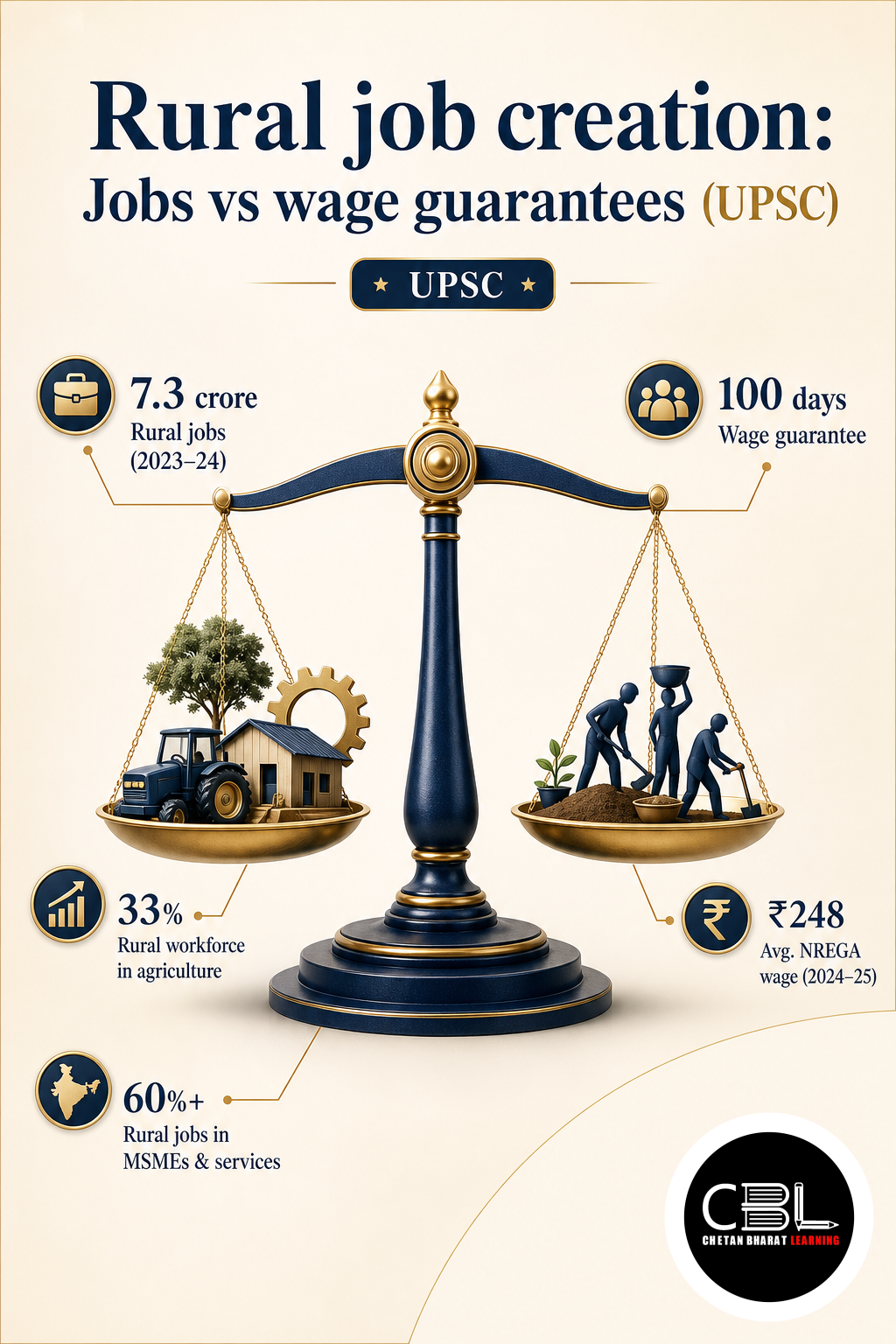

UPSC Mapping
| Important for | |
|---|---|
| Prelims | Economy (Employment, Rural Development) |
| Mains | GS Paper III (Inclusive Growth, Employment) |
| Law | MGNREGA (National Rural Employment Guarantee Act, 2005) |
|---|---|
| Implemented | 2006 onwards |
| Guarantee | At least 100 days wage employment per rural household per year |
| Nodal ministry | Ministry of Rural Development |
| Nature | Demand-driven programme with decentralised planning |
Article
What is rural job creation?
Rural job creation means expanding stable, productive, and reasonably paid work opportunities in villages and small towns, beyond seasonal farm labour. It includes non-farm work in manufacturing, construction, logistics, services, agro-processing, and care work, along with better-quality farm-linked livelihoods. UPSC expects you to distinguish it from pure wage transfers, because jobs raise income through productivity, not only through budgeted support.
In exam writing, link rural job creation to structural transformation, where labour gradually moves from low-productivity activities to higher-productivity sectors. When this shift slows, villages can face disguised unemployment, where many workers share limited work and earn less per person. A credible policy approach then combines short-run safety nets with long-run investments in skills, markets, and enterprises.
Why is rural job creation in News?
A public debate has highlighted the claim that rural India needs more jobs rather than expanding wage guarantees. The argument draws attention to the difference between wage employment programmes, which protect consumption during distress, and an economy that regularly creates enough work in farms, firms, and services. For UPSC, this becomes a GS-III question on how India can shift from relief-style interventions to growth that is employment-intensive.
The issue also stays relevant because MGNREGA demand tends to rise during rural stress, weak farm incomes, or slowdowns in informal employment. Aspirants should refresh the legal and operational basics of MGNREGA from official sources such as the Ministry of Rural Development portal, and then analyse what the programme can and cannot do for long-term employment outcomes.
Key Features
- Wage support versus durable livelihoods differ because public works stabilise income quickly, while private and local enterprise jobs sustain earnings through higher productivity and repeat demand.
- MGNREGA as a safety net provides a legal backstop for wage work, yet it is designed for temporary employment and cannot substitute for a dynamic rural economy.
- Productive employment focus means policy should prioritise jobs that build skills, raise output per worker, and integrate workers into value chains beyond daily wage cycles.
- Rural non-farm economy importance is rising, as transport, repairs, retail, construction, and small manufacturing often absorb workers leaving or supplementing agriculture.
- Structural transformation pathway requires faster growth of labour-intensive sectors, better credit and logistics, and improvements in education and vocational training in rural areas.
Challenges
- Low-paying, irregular work cycles persist because many rural jobs remain informal, seasonal, and tied to local demand that collapses during price or climate shocks.
- Disguised unemployment in agriculture can keep incomes low, since too many workers depend on limited land and short peak seasons for labour absorption.
- Enterprise constraints include small market size, weak cold chains, unreliable power, and limited formal credit, which restrict growth of rural MSMEs and agro-processing.
- Skills and matching gaps arise when training is not aligned with local industry needs, and women face extra barriers such as safety, care burdens, and mobility limits.
- MGNREGA design trade-offs appear when households rely on it as a main livelihood source, which signals weak non-farm opportunities and stresses timely payments and asset quality.
Way Forward
India can treat rural job creation as a package built on three levers: (i) raise farm and allied productivity, (ii) grow labour-absorbing rural non-farm sectors, and (iii) keep a credible safety net for downturns and climate shocks. That means better irrigation and storage, stronger agri-value chains, and targeted support for micro-enterprises through credit, compliance simplification, and local infrastructure. In parallel, MGNREGA can work best when it creates useful assets and supports water conservation and land development, improving the rural production base.
Policy must also expand pathways for women and youth into formal and semi-formal work through safe transport, childcare support, and skilling tied to local clusters such as food processing, textiles, tourism, construction, and care services. For legislative and programme design context relevant to Mains, aspirants can refer to curated explainers from PRS Legislative Research and then write balanced answers that treat wage guarantees as stabilisers, not substitutes, for long-run rural job creation.
Prelims Practice Corner
- MGNREGA is best described as:
(a) A universal basic income scheme (b) A legal guarantee of wage employment for rural households (c) A crop insurance programme (d) A price support scheme for wheat only
Answer: (b) - ‘Disguised unemployment’ in rural areas most closely means:
(a) Workers are employed only in government offices (b) More workers are engaged than needed, so marginal productivity is very low (c) Workers are paid only in kind (d) Jobs are available but workers refuse them
Answer: (b) - The ‘rural non-farm economy’ includes:
(a) Only crop cultivation (b) Only livestock rearing (c) Manufacturing and services located in rural areas (d) Only government subsidies
Answer: (c) - Structural transformation in development economics broadly refers to:
(a) Moving labour from low-productivity to higher-productivity sectors (b) Shifting all labour into agriculture (c) Replacing taxes with fees (d) Only digital payments adoption
Answer: (a) - Which is the best UPSC interpretation of wage guarantees like MGNREGA?
(a) A complete substitute for private job growth (b) A stabiliser that supports consumption and reduces distress migration (c) A measure that automatically raises productivity in all sectors (d) A scheme meant only for urban areas
Answer: (b)
Mains Practice Questions
- Distinguish between wage employment programmes and sustainable job creation in rural India. Use MGNREGA as a reference point. (10 marks)
Answer Structure: Intro: Define wage support vs productive jobs and link to inclusive growth. Body: (1) objectives/time horizon, (2) MGNREGA’s safety‐net function, (3) productivity and asset creation, (4) rural non‐farm pathways, (5) complementarities: safety net + enterprise growth. Conclusion: Argue for balanced policy: protect during shocks while building durable livelihoods.
- Rural labour markets in India face disguised unemployment and weak non‐farm opportunities. Discuss the constraints and propose a strategy for rural job creation. (15 marks)
Answer Structure: Intro: Frame the problem as low productivity plus high vulnerability to shocks. Body: (1) agriculture constraints, (2) MSME and credit bottlenecks, (3) skills mismatch and female barriers, (4) infrastructure and market access, (5) reforms: clusters, skilling, logistics, value chains, and better asset creation under public works. Conclusion: Emphasise productivity‐led inclusion and resilience, with safety nets as support systems.
FAQs on rural job creation
- Does MGNREGA reduce the need for private-sector jobs in rural areas?
- No. It mainly provides a legal safety net during distress and lean seasons. Long-term income growth still needs higher productivity and expanding rural enterprises.
- Why do economists stress the rural non-farm economy?
- Because agriculture cannot absorb all rural workers at rising wages. Non-farm activities can create steadier work and diversify incomes when farm output is volatile.
- How should I structure a UPSC Mains answer on this topic?
- Start with definitions and the safety-net role of wage programmes, then list constraints like low productivity, skills gaps, and enterprise bottlenecks. Conclude with a package: infrastructure, credit, skilling, value chains, and better-designed public works assets.
Related Current Affairs
Preparing for UPSC, PCS or HCS?
Talk to a mentor at Chetan Bharat Learning, Chandigarh. Free guidance on choosing the right exam and building a study plan.
Chat on WhatsAppCall 97793 53345UPSC / IAS / PCS coaching in Chandigarh · Trusted by aspirants across Punjab & Haryana
Leave a Reply
You must be logged in to post a comment.