
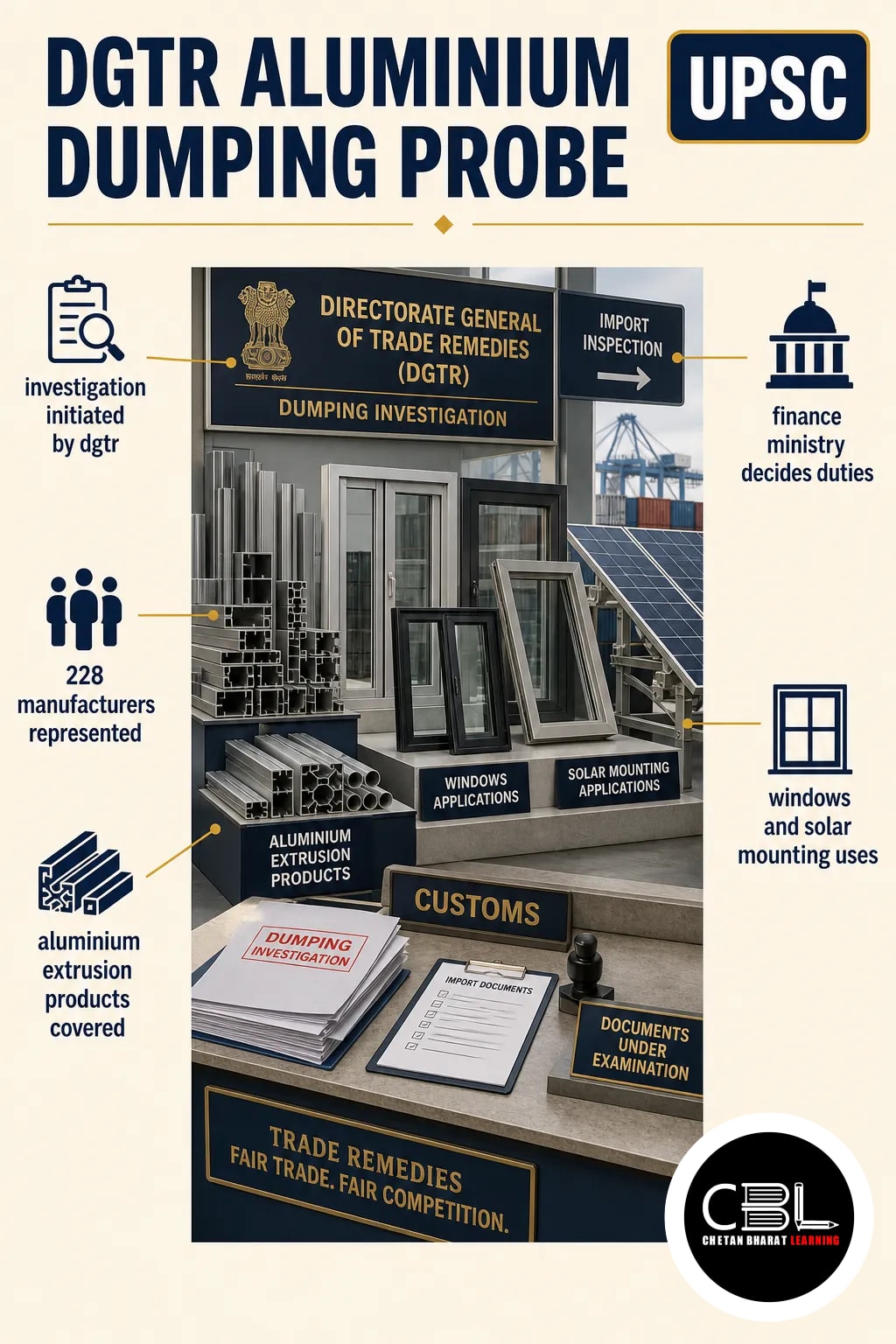
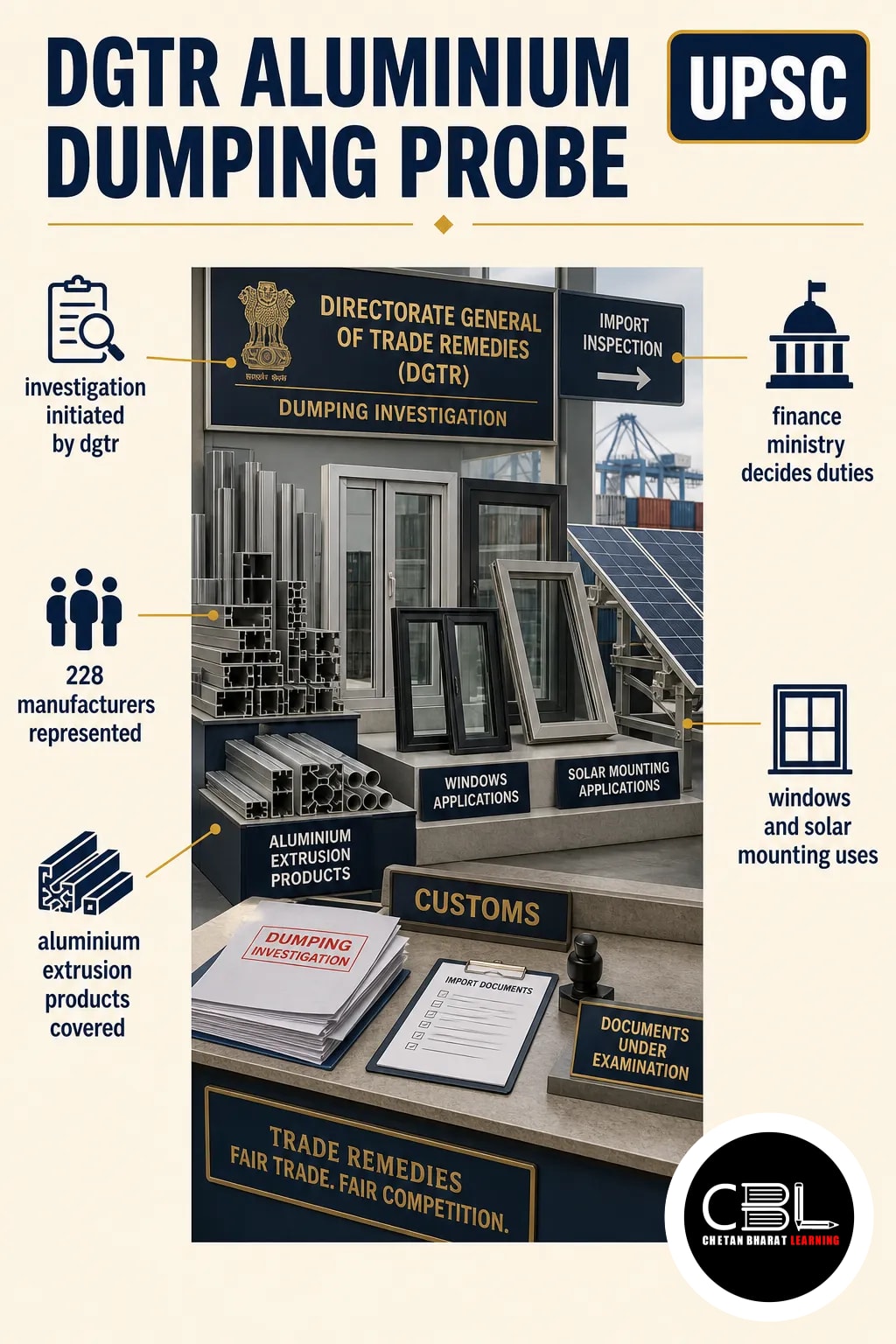
The DGTR aluminium dumping probe puts alleged low-priced imports under scrutiny. The Directorate General of Trade Remedies (DGTR) acted after representations from an association of 228 manufacturers. For related policy coverage, visit CBL’s economy current affairs hub.
Quick answer: The DGTR aluminium dumping probe began through a notification dated 9 November 2026. It covers alleged dumping of aluminium extrusion products. The source article names China, Malaysia, Vietnam and Thailand, although its headline names only the first three. DGTR will assess dumping and injury before recommending any duty.
What is the DGTR aluminium dumping probe?
The probe examines alleged dumping of aluminium extrusion profiles, structures and articles and its effect on Indian producers. DGTR initiated it suo motu, or on its own initiative, after receiving industry representations.
The source article’s body names China, Malaysia, Vietnam and Thailand; its headline omits Thailand. Therefore, aspirants should note the discrepancy rather than assume the headline gives the complete country list.
Initiation is not a finding of dumping or an announcement of duty. Instead, DGTR must examine the existence, degree and effect of the alleged dumping.
Why did DGTR initiate the investigation?
DGTR acted on information from the Aluminium Extrusion Manufacturers Association of India (ALEMAI) and its member producers. The association represents 228 manufacturers of the products under consideration.
The notification states that domestic industry suffers injury from a significant increase in dumped imports. However, the investigation must establish the relevant facts before DGTR can recommend a remedy.
Normally, domestic producers apply for an anti-dumping investigation. Fragmented industries may lack the expertise to prepare such applications; therefore, a suo motu inquiry can help address that access problem. This matters particularly for micro, small and medium enterprises (MSMEs).
What products and institutions are involved?
The inquiry concerns extruded aluminium products used across construction, transport and engineering. The table separates the product’s uses from the institutions’ roles.
| Item | Key fact |
|---|---|
| Product | Aluminium extrusion profiles, structures and articles |
| Applications | Windows, doors, solar mounting structures, furniture and bicycle parts |
| DGTR | Commerce Ministry investigation arm; examines dumping and injury |
| Finance Ministry | Makes the final decision on imposing duties |
Other uses include curtain walls, partitions, railings, lighting profiles, industrial framing and ladders. Consequently, the outcome may matter to both extrusion manufacturers and firms that use their products.
How do anti-dumping duties work?
Anti-dumping duties address injury caused by imports sold at a dumped price, subject to an investigation. Dumping generally means exporting a product below its normal value, commonly its comparable domestic-market price.
A low import price alone does not establish actionable dumping. Investigators must also assess material injury and the causal link between dumped imports and that injury. Thus, a rise in imports by itself does not settle the case.
The World Trade Organization (WTO) provides the multilateral framework for anti-dumping measures. In India, DGTR investigates and recommends a duty where warranted; the Finance Ministry decides whether to impose it. For the distinction between remedies, see CBL’s comparison of countervailing and anti-dumping duties.
A countervailing duty addresses injury from subsidised imports, whereas an anti-dumping duty addresses injurious dumping. Both are trade remedies, but their underlying grounds differ.
Why does the investigation matter for India?
The case tests how India balances domestic manufacturing interests with access to competitively priced inputs. Its significance extends beyond the producers seeking relief.
- Domestic capacity: If injurious dumping is established, a calibrated remedy can address unfair price pressure on Indian producers.
- Downstream costs: Duties may raise input costs for users of aluminium profiles; therefore, construction and engineering firms have an interest in the outcome.
- Small producers: Suo motu action can make trade remedies more accessible to fragmented industries that struggle with investigation procedures.
- Trade relations: Because the exporting countries are WTO members, transparent evidence and procedures matter for a rules-based response.
India can also use other import-policy tools, which operate differently from anti-dumping duties. For context, read CBL’s analysis of minimum import prices and PVC imports.
What are the challenges and the way forward?
The central challenge is to distinguish injurious dumping from competition that benefits Indian buyers. A remedy without a robust causal assessment risks protecting inefficiency or raising costs unnecessarily.
First, DGTR should assess price comparisons, import trends and industry injury using reliable evidence. It should also examine other possible causes of injury, so that harm is not attributed to imports without justification.
Second, producers, importers and downstream users should have a meaningful opportunity to present evidence. Finally, any recommended duty should address the established injury rather than serve as an automatic response to low prices.
Alongside trade remedies, industry can work on productivity and product quality. Thus, a proportionate investigation and stronger domestic competitiveness can support both fair competition and user interests.
Source: The Hindu, 10 November 2026
- Countervailing Duty and Anti-dumping Duty (26 Jun 2024)
- PVC Suspension Resin: MIP, Imports and UPSC Analysis (10 Aug 2026)
State PCS General Studies can test the difference between anti-dumping and countervailing duties. Aspirants can also examine how central trade policy affects producers and downstream manufacturers within states.
Prelims Practice Corner
Mains Practice Questions
Frequently Asked Questions
Has India imposed a duty in the DGTR aluminium dumping probe?
No, the source describes an investigation, not a duty imposed in this case. DGTR must first examine the evidence and may recommend a duty if warranted.
What does suo motu initiation mean?
It means DGTR initiated the investigation on its own initiative. In this case, it acted after receiving information from ALEMAI and its member producers.
Who imposes anti-dumping duties in India?
The Finance Ministry makes the final decision on imposing them. DGTR investigates and, where warranted, recommends a duty.
Which countries does the source name in the aluminium investigation?
The article’s body names China, Malaysia, Vietnam and Thailand. However, its headline names only China, Malaysia and Vietnam.
Related Current Affairs
Preparing for UPSC, PCS or HCS?
Talk to a mentor at Chetan Bharat Learning, Chandigarh. Free guidance on choosing the right exam and building a study plan.
Chat on WhatsAppCall 97793 53345UPSC / IAS / PCS coaching in Chandigarh · Trusted by aspirants across Punjab & Haryana

 Ananya RanaIAS · AIR 60
 Aditya SharmaIAS · AIR 70
 Ria Kaur SethiIPS · AIR 89
 Aman AloonIRS · AIR 295
 Sumer Singh VirkIRS · AIR 335
 Shivani PanchalIAS

Leave a Reply
You must be logged in to post a comment.