
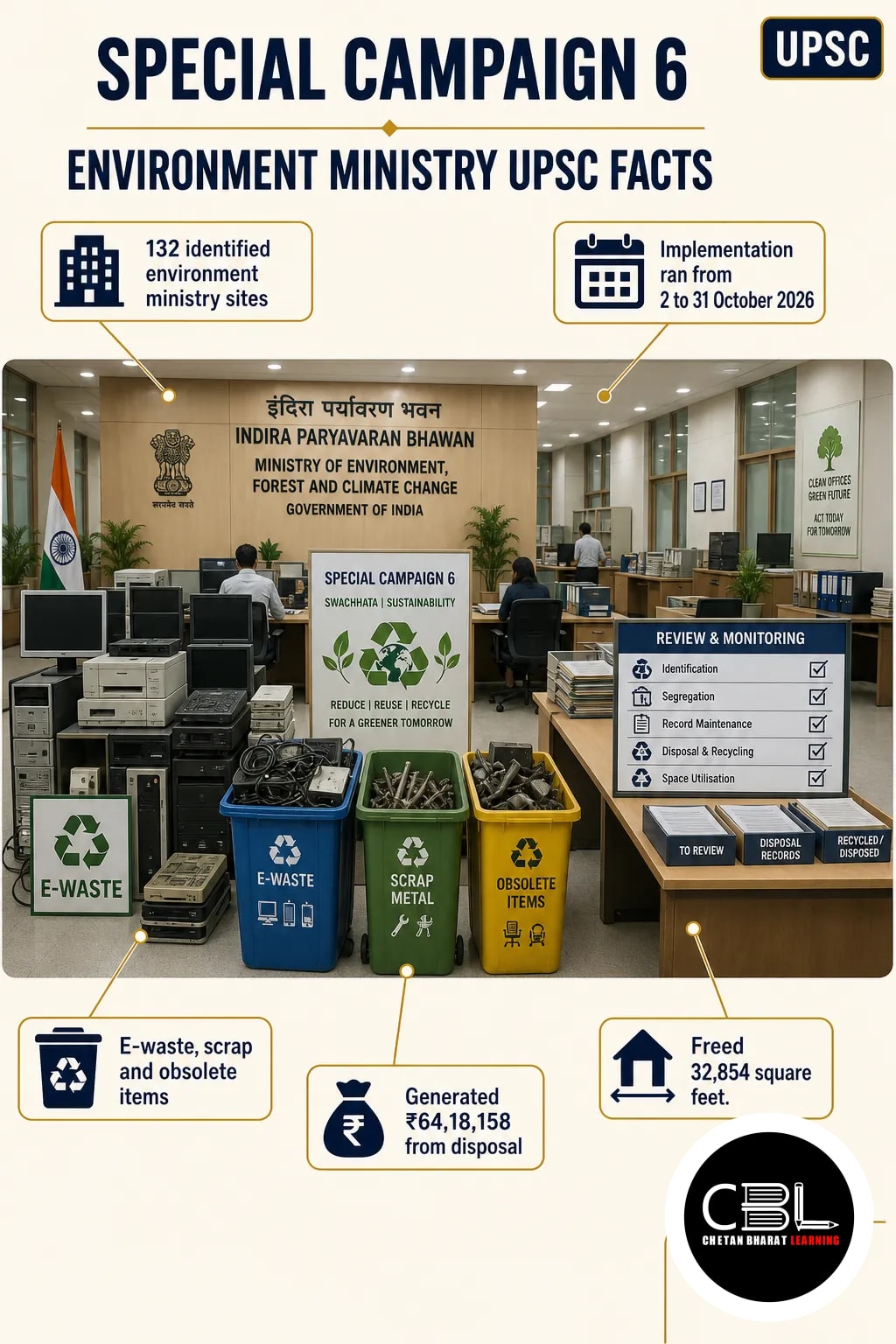

Special Campaign 6 concluded across the Ministry of Environment, Forest and Climate Change and its organisations, with a focus on electronic waste. The exercise connects environmental management with administrative efficiency.
Quick answer: Special Campaign 6 covered 132 identified environment ministry sites across India. Its implementation ran from 2 to 31 October 2026, emphasising cleanliness, pending matters and e-waste disposal. Disposal of e-waste, scrap and obsolete items generated ₹64,18,158 and freed 32,854 square feet of office space.
What is Special Campaign 6?
Special Campaign 6 is an administrative exercise for office cleanliness and reducing pending matters. This year’s campaign placed particular emphasis on collecting, segregating and disposing of e-waste, or discarded electrical and electronic items.
The Department of Administrative Reforms and Public Grievances (DARPG) issued its guidelines on 13 August 2026. The cleanliness campaign began in 2021 under DARPG’s directions and has since become a continuing institutional process.
Campaign timeline and coverage
The ministry conducted the campaign at all 132 identified locations, including subordinate offices and autonomous bodies. Its preparation and implementation phases followed the schedule below.
| Stage or milestone | Date |
|---|---|
| DARPG guidelines | 13 August 2026 |
| Preparation phase | 16–30 September 2026 |
| Implementation phase | 2–31 October 2026 |
What did the ministry achieve?
The ministry reported cleanliness activities at all 132 identified sites. It also reported 100% disposal of identified state government references, public grievance appeals and Prime Minister’s Office references.
In addition, it met its review targets for physical files and electronic files. Disposal revenue and space freed covered e-waste, scrap and obsolete items together; they were not figures for e-waste alone.
How was e-waste handled?
The ministry emphasised collection, segregation and disposal under the applicable guidelines and standard operating procedure. During implementation, its secretary reviewed accumulated materials at Indira Paryavaran Bhawan, New Delhi.
The secretary directed safe, scientific disposal through recyclers, refurbishers and producers registered with the Central Pollution Control Board (CPCB). Consequently, the exercise linked office clearance with responsible waste handling.
Why does the campaign matter?
The campaign combines better record management and disposal of pending cases with cleaner government workplaces. Moreover, its e-waste focus gives aspirants a concrete example of environmental considerations in public administration.
Source: Press Information Bureau, 1 November 2026
State PCS General Studies can test the campaign’s institutions, dates and e-waste focus. Aspirants can also connect its objectives to record management and cleanliness in public offices.
Prelims Practice Corner
Mains Practice Questions
Frequently Asked Questions
What was the main waste-management focus of Special Campaign 6?
E-waste collection, segregation and disposal were the main focus. The campaign also addressed scrap and obsolete items.
How much revenue did the environment ministry generate from disposal?
The ministry generated ₹64,18,158. This figure covers e-waste, scrap and obsolete items together.
Which department issued the campaign guidelines?
The Department of Administrative Reforms and Public Grievances issued them. It released the guidelines on 13 August 2026.
Related Current Affairs
Preparing for UPSC, PCS or HCS?
Talk to a mentor at Chetan Bharat Learning, Chandigarh. Free guidance on choosing the right exam and building a study plan.
Chat on WhatsAppCall 97793 53345UPSC / IAS / PCS coaching in Chandigarh · Trusted by aspirants across Punjab & Haryana

 Ananya RanaIAS · AIR 60
 Aditya SharmaIAS · AIR 70
 Ria Kaur SethiIPS · AIR 89
 Aman AloonIRS · AIR 295
 Sumer Singh VirkIRS · AIR 335
 Shivani PanchalIAS

Leave a Reply
You must be logged in to post a comment.