
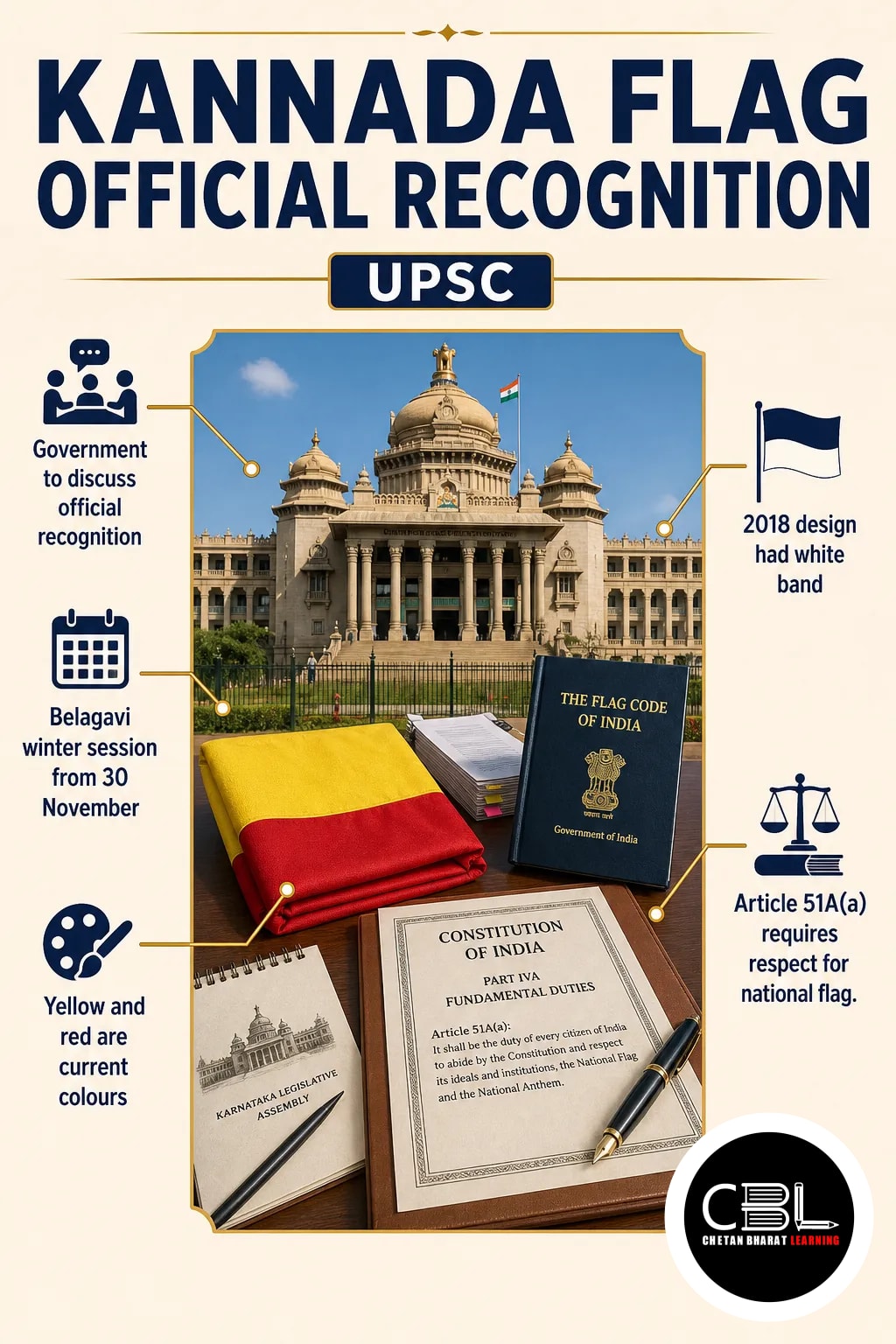

Kannada flag official recognition is back on Karnataka’s agenda after Chief Minister D.K. Shivakumar outlined plans for a legislative debate. The proposal connects regional identity with constitutional and federal questions.
Quick answer: On 1 November 2026, Karnataka Chief Minister D.K. Shivakumar said the government was considering Kannada flag official recognition. The issue will be discussed in the Belagavi winter legislative session, scheduled from 30 November. Meanwhile, an order is planned to enable private institutions to fly the flag; compulsory display in government-supported institutions remains under consideration.
What has Karnataka proposed?
Karnataka is considering official recognition for the existing yellow-and-red Kannada flag, but has not yet completed the process. Shivakumar made the announcement during the 71st Rajyothsava celebrations and in remarks to reporters on 1 November.
He said the government would revisit the matter in the Cabinet and discuss it during the winter legislature session at Belagavi. It also plans a resolution and legislation to provide official status and legal protection, while exploring compliance with national flag rules.
Meanwhile, the Chief Minister said the Kannada flag would be hoisted in all government offices. An order is planned in November to enable private institutions to fly it; mandatory display in government-supported institutions is still being considered. These announcements should not be confused with a published order or an enacted law.
How does the current proposal differ from 2018?
The current proposal retains the yellow-and-red flag, whereas the 2018 design added a white band and the state emblem. The distinction matters because the two proposals do not describe the same flag.
| Aspect | Position |
|---|---|
| 2018 design | Horizontal yellow, white and red bands with the Gandaberunda emblem at the centre |
| 2018 process | An expert committee recommended the design; the state approved it and sent the proposal to the Centre |
| Central response | The Ministry of Home Affairs turned down the earlier proposal, according to the source |
| 2026 approach | Shivakumar favoured the existing yellow-and-red flag without additions |
The Gandaberunda is a mythical bird and Karnataka’s state emblem. The earlier proposal was sent to the Centre because it was considered to require a change to the Flag Code. However, the precise legal route for the present proposal remains under examination.
Which constitutional and legal provisions matter?
The debate brings together respect for the national flag, freedom of expression and protection of cultural diversity. However, these provisions do not by themselves settle the validity of a particular state flag proposal.
| Provision | Relevance |
|---|---|
| Article 51A(a) | Makes respect for the Constitution, its ideals and institutions, the National Flag and the National Anthem a fundamental duty. |
| Article 19(1)(a) | Protects freedom of speech and expression, subject to restrictions permitted under Article 19(2). |
| Article 29(1) | Protects the right of a section of citizens with a distinct language, script or culture to conserve it. |
| Flag Code of India, 2002 | Provides guidance on display of the national flag, including its position alongside other flags. |
| Prevention of Insults to National Honour Act, 1971 | Addresses specified acts of insult to national symbols, including the national flag. |
The state must therefore examine any proposed display rules against the applicable national flag framework. Recognition of a state symbol and compliance with rules governing the national flag are distinct questions.
Why does the proposal matter for federalism?
The proposal tests how a state can express cultural identity while observing common national obligations. Shivakumar presented the flag as a symbol of Kannada knowledge, culture and heritage within India’s federal structure.
First, an official symbol can give institutional expression to a regional identity. Second, clear national flag rules help maintain a shared framework across states. Therefore, the policy challenge is not simply choosing between regional and national identities; it is designing a lawful relationship between their symbols.
Language policy raises related questions about regional identity and constitutional rules. For context, see the discussion on Tamil and High Court language. However, language use in courts and recognition of a flag involve different legal provisions.
What concerns should the government address?
The main concerns are legal clarity, consistent implementation and inclusive public participation. In particular, a proposed permission for private institutions differs from a possible obligation on government-supported institutions.
- Legal pathway: The government should clarify whether its intended measures need legislation, an executive order or coordination with the Centre.
- Display protocol: Any instructions should explain how institutions can respect national flag rules when displaying both flags.
- Scope of obligations: If compulsory display is proposed, the government should specify which institutions it covers and how compliance would work.
- Social inclusion: The Chief Minister asked activists not to engage in moral policing; therefore, implementation should avoid coercive actions against individuals or businesses.
What is the way forward?
Karnataka should publish a clear proposal after legal review and legislative discussion. It can then distinguish the flag’s design and status from the separate rules for its display.
In addition, consultation with institutions and the public can identify practical concerns before any mandate is finalised. A reasoned framework would help support Kannada cultural expression while preserving respect for the national flag and applicable law.
Source: The Hindu, 1 November 2026
State PCS General Studies may test the relationship between regional cultural identity and national symbols. Also revise the fundamental duties and the constitutional protection available to linguistic and cultural groups.
Prelims Practice Corner
Mains Practice Questions
Frequently Asked Questions
Has the Kannada flag received official recognition?
No, the government was still considering recognition as of 1 November 2026. The Chief Minister said the issue would be discussed in the winter legislative session.
What colours are in the Kannada flag currently favoured by Karnataka?
Yellow and red are the colours of the flag favoured by the Chief Minister. In contrast, the 2018 proposal had yellow, white and red bands and an emblem.
Will private institutions have to fly the Kannada flag?
No general mandate for private institutions was announced. Instead, the government planned an enabling order, while considering compulsory display in government-supported institutions.
What is the Gandaberunda?
The Gandaberunda is a mythical bird and Karnataka’s state emblem. It appeared at the centre of the flag design approved by the state in 2018.
Related Current Affairs
Preparing for UPSC, PCS or HCS?
Talk to a mentor at Chetan Bharat Learning, Chandigarh. Free guidance on choosing the right exam and building a study plan.
Chat on WhatsAppCall 97793 53345UPSC / IAS / PCS coaching in Chandigarh · Trusted by aspirants across Punjab & Haryana

 Ananya RanaIAS · AIR 60
 Aditya SharmaIAS · AIR 70
 Ria Kaur SethiIPS · AIR 89
 Aman AloonIRS · AIR 295
 Sumer Singh VirkIRS · AIR 335
 Shivani PanchalIAS

Leave a Reply
You must be logged in to post a comment.