
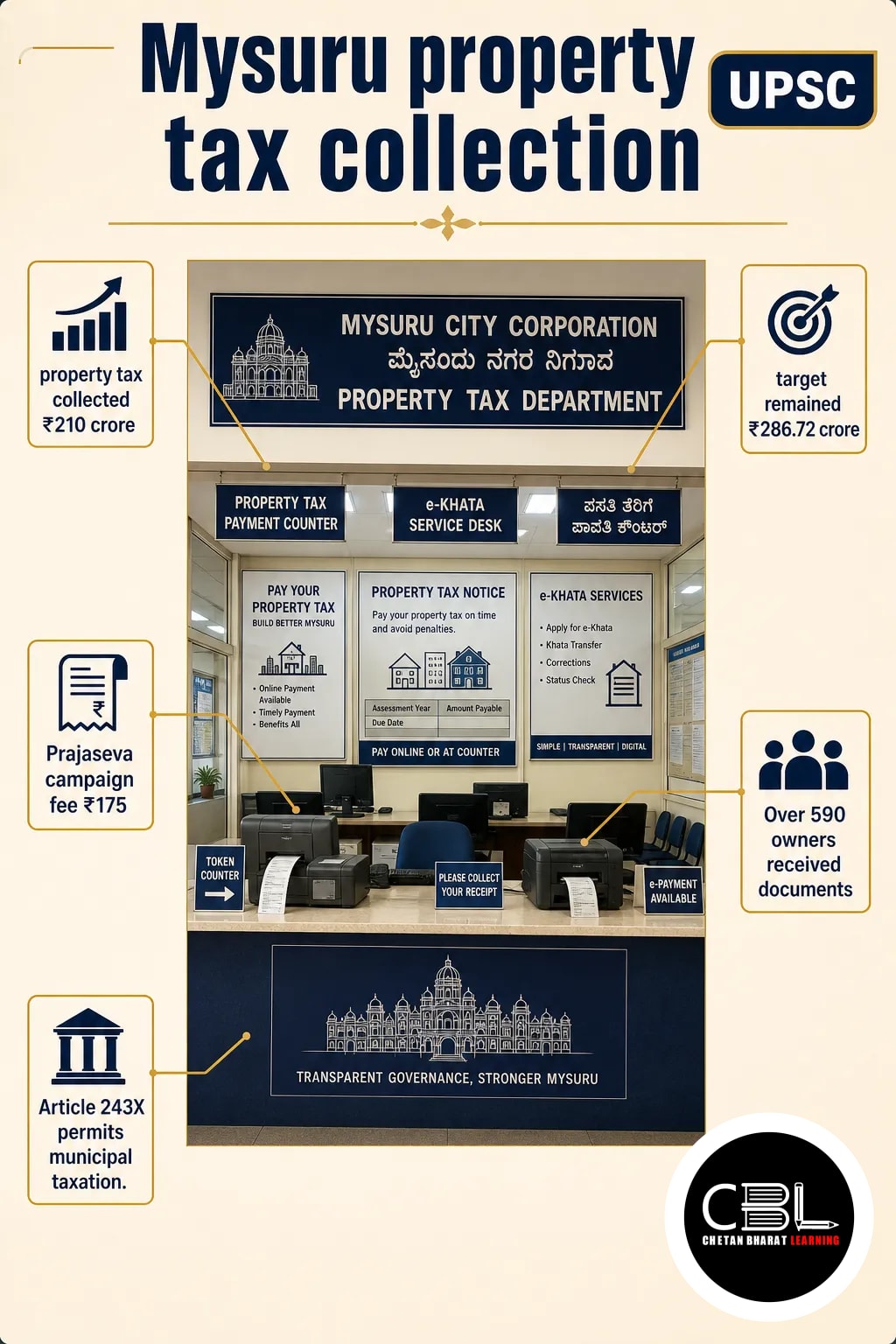

Mysuru property tax collection reached ₹210 crore in 2026-27, according to district in-charge minister Yathindra Siddaramaiah. The figures offer a starting point for revising municipal governance and constitutional provisions.
Quick answer: Mysuru property tax collection stood at ₹210 crore against a ₹286.72 crore target for 2026-27. Yathindra Siddaramaiah announced the figure in Mysuru on 1 November 2026. He also described the Prajaseva e-Khata campaign, under which over 590 owners received documents within 72 hours of applying.
What are the Mysuru property tax collection figures?
Mysuru City Corporation (MCC) collected ₹210 crore towards its 2026-27 property tax target. Yathindra Siddaramaiah announced the figure during his Rajyothsava Day address on 1 November 2026. The collection therefore represented approximately 73.2% of the target, leaving ₹76.72 crore to reach it.
| Indicator | Figure or detail |
|---|---|
| Property tax collected | ₹210 crore |
| 2026-27 target | ₹286.72 crore |
| Target achieved | Approximately 73.2%, calculated |
| Balance to target | ₹76.72 crore, calculated |
| Announcement | 1 November 2026, Mysuru |
What was the Prajaseva e-Khata campaign?
MCC organised Prajaseva as a special e-Khata campaign with a ₹175 fee. Under it, over 590 property owners received e-Khata documents within 72 hours of submitting applications.
The minister also said MCC had issued around 78,000 A and B Khatas so far. These are the categories named in the announcement; the source does not explain their legal differences. For a related registration reform, see Tamil Nadu registration hubs.
How does the Constitution address municipal finance?
The Constitution allows state legislatures to provide for municipal taxation through law. In particular, Article 243X permits a state legislature to authorise municipalities to levy, collect and appropriate specified taxes, duties, tolls and fees.
Moreover, Article 243Y provides for the State Finance Commission to review municipal finances and make recommendations. The 74th Constitutional Amendment introduced Part IXA on municipalities. Separately, Entry 49 of the State List covers taxes on lands and buildings.
Why does this matter for urban governance?
Property tax is a potential source of revenue for municipal functions. Therefore, Mysuru property tax collection provides an example for studying the link between local revenues and urban administration.
The Constitution’s Twelfth Schedule lists functions that states may entrust to municipalities, including urban planning and water supply. For broader context, see Karnataka’s urban growth.
Source: The Hindu, 1 November 2026
- Tamil Nadu Registration Hubs: Reforms for UPSC (30 Oct 2026)
Punjab PCS and Haryana HCS may test municipal finance and the constitutional framework for urban local bodies. Therefore, revise Articles 243X and 243Y alongside state governance.
Prelims Practice Corner
Mains Practice Questions
Frequently Asked Questions
How much property tax has Mysuru collected in 2026-27?
MCC collected ₹210 crore so far in 2026-27. Therefore, it had reached approximately 73.2% of its ₹286.72 crore target.
What was the fee under Mysuru’s Prajaseva e-Khata campaign?
The campaign fee was ₹175. In addition, over 590 owners received documents within 72 hours of applying.
Which constitutional article deals with municipal taxation?
Article 243X deals with municipal taxation. It permits a state legislature to authorise municipalities to levy specified taxes and other charges by law.
Related Current Affairs
Preparing for UPSC, PCS or HCS?
Talk to a mentor at Chetan Bharat Learning, Chandigarh. Free guidance on choosing the right exam and building a study plan.
Chat on WhatsAppCall 97793 53345UPSC / IAS / PCS coaching in Chandigarh · Trusted by aspirants across Punjab & Haryana

 Ananya RanaIAS · AIR 60
 Aditya SharmaIAS · AIR 70
 Ria Kaur SethiIPS · AIR 89
 Aman AloonIRS · AIR 295
 Sumer Singh VirkIRS · AIR 335
 Shivani PanchalIAS

Leave a Reply
You must be logged in to post a comment.