
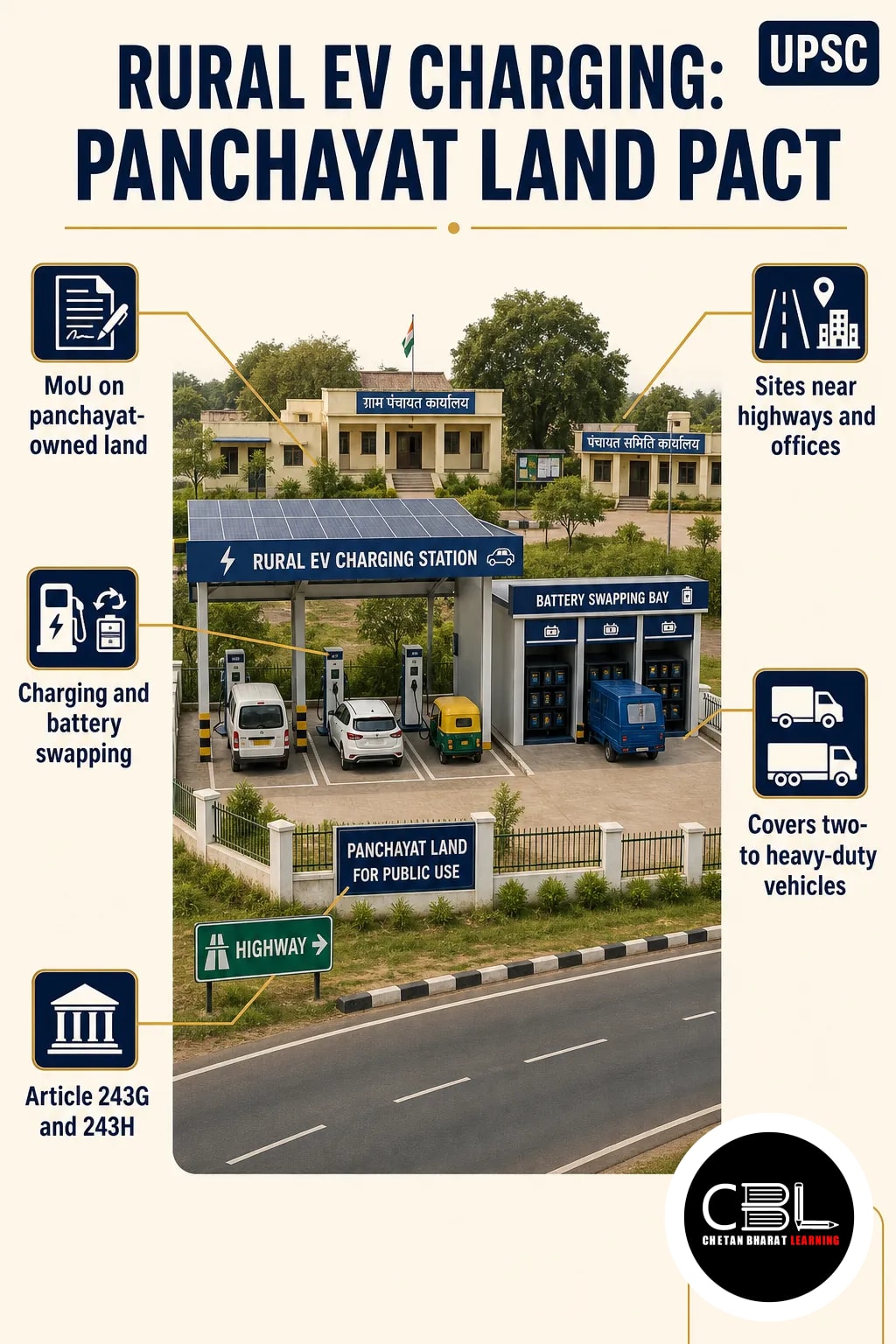
Rural EV charging could expand through panchayat-owned land under a new partnership between the Union government and Convergence Energy Services Limited. The proposal links rural infrastructure with local body revenue and cleaner transport.
Quick answer: The Ministry of Panchayati Raj and Convergence Energy Services Limited have agreed to explore rural EV charging and battery-swapping facilities on panchayat land across India. Their memorandum of understanding covers potential sites near panchayat offices and highways. It aims to extend electric mobility beyond cities and create additional local revenue.
What is the rural EV charging proposal?
The proposal explores charging stations and battery-swapping facilities on land owned by Gram Panchayats across India. A memorandum of understanding (MoU) between the Ministry of Panchayati Raj and Convergence Energy Services Limited (CESL) provides the basis for cooperation.
CESL is a wholly owned subsidiary of Energy Efficiency Services Limited (EESL), under the Ministry of Power. The partners exchanged the MoU in New Delhi. However, the source describes an exploratory partnership, not a completed network or a guaranteed revenue arrangement.
An electric vehicle (EV) charging station supplies electricity to a vehicle battery. Battery swapping, by contrast, replaces a depleted battery with a charged one, where the vehicle and batteries are compatible.
Why is the partnership in the news?
The Centre and CESL have joined hands to take electric mobility infrastructure beyond metropolitan and urban centres. The initiative also seeks an additional income source for rural local bodies and supports climate action.
Mukta Shekhar, Joint Secretary in the Ministry of Panchayati Raj, and Akhilesh Kumar Dixit exchanged copies of the MoU. The source identifies possible facilities across rural and semi-urban areas; it does not specify a project budget or a station target.
Key features of the proposed network
The proposed network combines local public land with charging and battery-swapping services for several vehicle categories.
| Feature | What the source says |
|---|---|
| Sites | Panchayat land along State and National Highways and near Gram Panchayat offices |
| Services | Charging stations and battery-swapping facilities |
| Vehicles | Two-, three- and four-wheelers, plus medium and heavy-duty vehicles |
| Intended benefits | Wider clean mobility and additional panchayat revenue |
Highway locations can serve passing vehicles, while sites near panchayat offices may also serve local users. Therefore, site selection should consider both kinds of demand. For a related rural connectivity context, see PMGSY-IV and rural roads.
Why does the proposal matter for local governance?
The initiative could turn an existing public asset into a source of services and income for a panchayat. However, actual income would depend on agreements, demand and operating costs; the source does not specify a revenue-sharing formula.
Article 243G allows state legislatures to endow panchayats with powers and responsibilities for local plans and specified schemes. In addition, Article 243H allows a state legislature to authorise panchayats to levy specified taxes, duties, tolls and fees, and provides for other financial arrangements.
These provisions frame the broader question of local autonomy. They do not themselves establish the commercial terms of this MoU. For another aspect of local institutions, see panchayat elections in Rajasthan.
What are the economic and environmental implications?
More accessible charging can reduce a practical barrier to EV use outside cities. In particular, facilities near highways could support journeys through rural areas as well as local travel.
Battery swapping can offer an alternative to waiting for a battery to charge. However, its usefulness depends on compatible batteries and an effective system for keeping charged batteries available.
The proposal also seeks lower carbon emissions. Nevertheless, the overall climate benefit depends on factors including the electricity used for charging and the vehicles displaced. Therefore, a charging point alone does not guarantee a particular emissions reduction.
What implementation challenges need attention?
Financial viability, electricity access and accountable use of public land will shape implementation.
- Demand and costs: Low use at a site could limit revenue; therefore, operators must assess likely users against installation and maintenance costs.
- Electricity supply: Charging needs a reliable connection, while different vehicle types can have different power requirements.
- Land governance: Panchayats need clear terms for land use, duration and responsibilities; otherwise, disputes can undermine public trust.
- Service compatibility: Charging equipment and swapping arrangements must suit the vehicles they intend to serve.
- Environmental safeguards: Safe battery handling and end-of-life management matter alongside the shift to electric mobility.
What should guide implementation?
Implementation should start with transparent site selection and commercially realistic agreements, rather than assume that every panchayat site will earn income.
First, partners should assess traffic, local vehicle demand and electricity capacity before choosing sites. Second, written agreements should clarify investment, maintenance, user charges and the panchayat’s share of any revenue.
Moreover, Gram Panchayats should make land-use decisions through applicable state procedures and communicate the terms locally. Finally, monitoring uptime, use and finances would help distinguish a viable public asset from an underused installation. These are policy considerations, not announced terms of the MoU.
Source: The Hindu, 31 October 2026
Asked in UPSC: Previous Year Questions
- UPSC CSE Mains 2018 (GS Paper II): Apart from government grants, what sources can Panchayats look to for funding?
UPSC connects local government functions with the financial resources needed to perform them.
Punjab PCS and Haryana HCS may test the proposal through panchayat finance, public land use and rural infrastructure. In addition, revise how state laws shape the powers and finances of local bodies.
Prelims Practice Corner
Mains Practice Questions
Frequently Asked Questions
Who are the partners in the rural EV charging proposal?
The Ministry of Panchayati Raj and CESL are the partners. CESL is also a wholly owned subsidiary of EESL under the Ministry of Power.
Where could the proposed facilities be located?
They could be located on panchayat-owned land near highways and Gram Panchayat offices. The proposal also covers both rural and semi-urban areas.
Does the MoU guarantee income for every panchayat?
No, because the source identifies additional revenue as an objective, not a guaranteed amount. It also does not specify a revenue-sharing formula.
Related Current Affairs
Preparing for UPSC, PCS or HCS?
Talk to a mentor at Chetan Bharat Learning, Chandigarh. Free guidance on choosing the right exam and building a study plan.
Chat on WhatsAppCall 97793 53345UPSC / IAS / PCS coaching in Chandigarh · Trusted by aspirants across Punjab & Haryana

 Ananya RanaIAS · AIR 60
 Aditya SharmaIAS · AIR 70
 Ria Kaur SethiIPS · AIR 89
 Aman AloonIRS · AIR 295
 Sumer Singh VirkIRS · AIR 335
 Shivani PanchalIAS

Leave a Reply
You must be logged in to post a comment.