
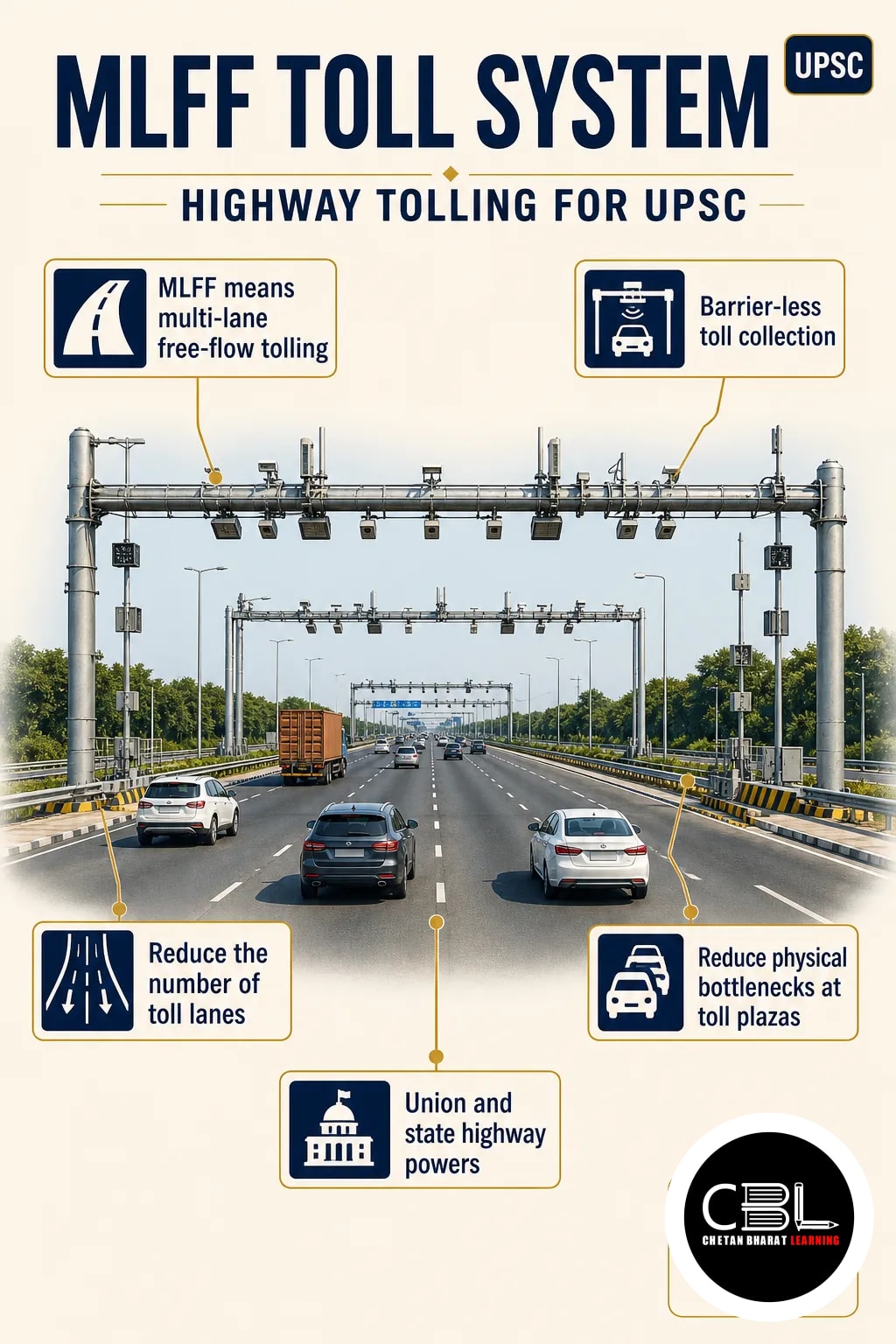
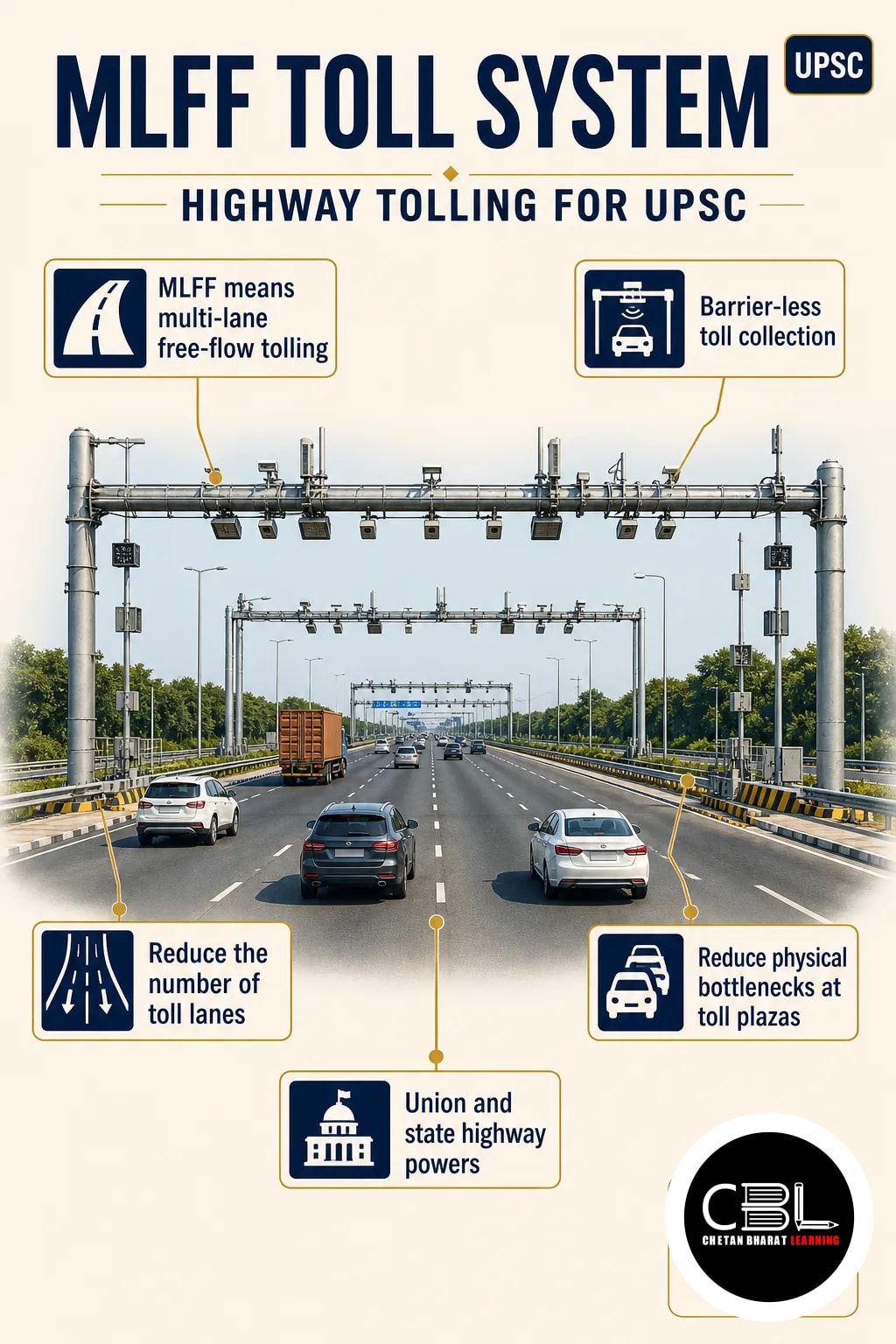
The MLFF toll system is being introduced to reduce toll lanes on new highways. The reform is relevant to infrastructure and transport policy for UPSC.
Quick answer: The MLFF toll system refers to multi-lane free-flow tolling, a barrier-less approach to collecting highway charges. According to the source, the system is being introduced on new highways to reduce toll lanes and physical bottlenecks at plazas. However, the available source text does not specify a rollout schedule or technology.
What is the MLFF toll system?
Multi-lane free-flow tolling allows toll collection without conventional physical barriers across toll lanes. Therefore, barrier-less tolling concerns how a charge is collected, not whether a charge exists.
In principle, a free-flow design allows vehicles to pass without stopping at a barrier. However, the available source material does not explain the proposed collection or enforcement method.
Why is barrier-less tolling in the news?
The reported reform seeks fewer toll lanes on new highways and less physical bottlenecking at toll plazas. The following facts summarise the available source material.
| Aspect | Key fact |
|---|---|
| Roads concerned | New highways |
| Design approach | Barrier-less toll collection |
| Lane objective | Reduce the number of toll lanes |
| Traffic objective | Reduce physical bottlenecks at toll plazas |
The source does not provide a highway-wise list, launch date or toll rates. Consequently, aspirants should not assume these details from the headline.
Which constitutional provisions cover highways?
The Seventh Schedule distributes legislative subjects concerning highways between the Union and the states.
- Union List, Entry 23: Parliament can declare highways to be national highways by law.
- State List, Entry 13: Roads and bridges generally fall here, subject to specified Union List matters.
Thus, the distinction concerns legislative subjects; it does not by itself establish the operating arrangements for the new toll system.
Why does the reform matter?
The reform targets the physical bottleneck associated with conventional toll lanes. In addition, it illustrates the difference between collecting a road-user charge and requiring vehicles to stop at a barrier.
For Prelims, distinguish the stated objective from an established outcome: the available material does not quantify any reduction in delays.
Source: Indian Express Business, 31 October 2026
Punjab PCS and Haryana HCS may test highway infrastructure alongside the Seventh Schedule. Therefore, revise the distinction between national highways and roads under the State List.
Prelims Practice Corner
Mains Practice Questions
Frequently Asked Questions
What does MLFF mean in highway tolling?
MLFF means multi-lane free-flow tolling. It is a barrier-less approach to collecting highway tolls.
Does barrier-less tolling mean toll-free travel?
No, because removing a physical barrier does not remove the toll itself. Instead, it changes the collection arrangement.
Why is barrier-less tolling being introduced on new highways?
It aims to reduce toll lanes and physical bottlenecks. However, the available source does not quantify the expected reduction in delays.
Related Current Affairs
Preparing for UPSC, PCS or HCS?
Talk to a mentor at Chetan Bharat Learning, Chandigarh. Free guidance on choosing the right exam and building a study plan.
Chat on WhatsAppCall 97793 53345UPSC / IAS / PCS coaching in Chandigarh · Trusted by aspirants across Punjab & Haryana






Leave a Reply
You must be logged in to post a comment.