
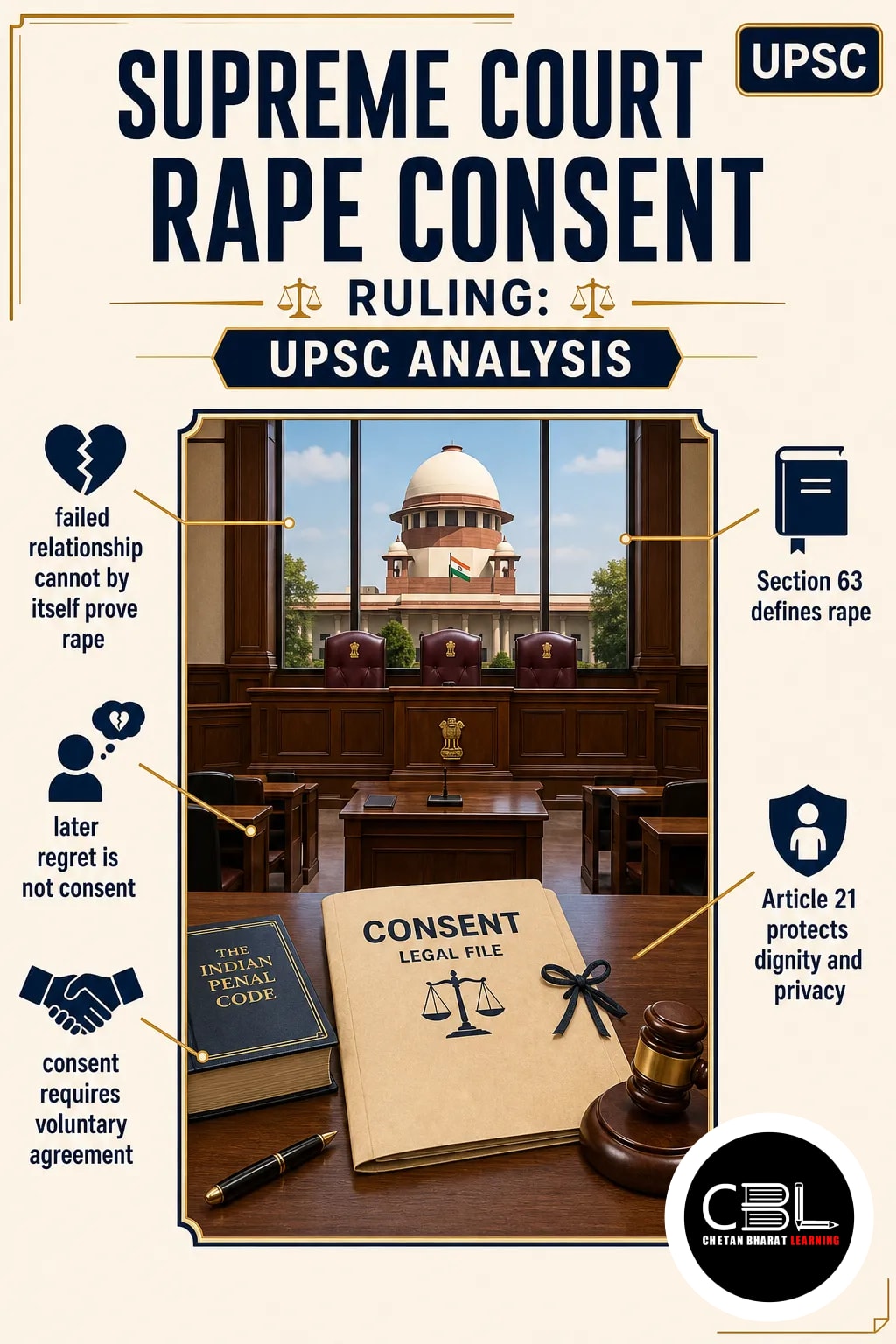

Supreme Court rape consent ruling on 30 October 2026 distinguished consensual intimacy from sexual acts involving manipulated consent. The judgment raises questions about bodily autonomy and criminal justice; explore more polity and constitutional developments.
Quick answer: In the Supreme Court rape consent ruling, Justice B.V. Nagarathna said a failed relationship alone cannot turn consensual sex into rape. The 30 October 2026 judgment concerned a seven-year relationship in Kerala. However, the Court distinguished later regret from consent obtained through deception and stressed that genuine sexual assault cases require vigorous pursuit.
What did the Supreme Court hold on rape and consent?
The Court held that a relationship ending cannot, by itself, make previously consensual sexual acts rape. However, it drew a distinction between regret after a relationship and absence of consent because of deception.
Justice Nagarathna cautioned against retrospectively treating intimacy as criminal merely because a relationship soured. At the same time, the judgment recognised rape as an under-reported offence that affects a woman’s dignity and bodily autonomy. Therefore, its reasoning must be read alongside its call to pursue genuine sexual violence cases.
The judgment does not establish that every allegation arising from a failed relationship is false. Rather, its distinction requires attention to whether consent existed and whether coercion or manipulation affected it.
What was the background of the Kerala case?
The case involved allegations of repeated rape during a relationship lasting seven years. The complainant said the man had concealed that he was married and had two children from an earlier marriage.
After the relationship ended, the case reached the Supreme Court. The Court’s discussion focused on the difference between consent allegedly affected by deception and later regret over intimacy. However, the supplied report does not specify the procedural disposal or reproduce the complete judgment.
| Case detail | Reported fact |
|---|---|
| Location | Kerala |
| Relationship | Seven years |
| Complainant’s allegation | Repeated rape and concealment of the man’s marriage and children |
| Judgment date | 30 October 2026 |
Which constitutional and legal provisions matter?
Constitutional rights and criminal-law definitions provide the framework for examining autonomy, consent and fair treatment. The following provisions offer syllabus context; the source report does not identify the provisions applied in this particular case.
| Article or law | Relevance |
|---|---|
| Article 14 | Guarantees equality before the law and equal protection of the laws. |
| Article 21 | Protects life and personal liberty; judicial interpretation includes dignity and privacy. |
| Bharatiya Nyaya Sanhita, 2023, Section 63 | Defines rape and explains consent as an unequivocal voluntary agreement communicated by words, gestures or other verbal or non-verbal communication. |
| Bharatiya Nyaya Sanhita, 2023, Section 69 | Addresses sexual intercourse through specified deceitful means, where the intercourse does not amount to rape. |
Section 63 also says that lack of physical resistance alone does not establish consent. Moreover, Section 69 is a separate provision: it must not be treated as interchangeable with the definition of rape. For broader context, read the overview of the Bharatiya Nyaya Sanhita.
What are the implications for criminal justice?
The ruling places the quality of consent, rather than the relationship’s outcome alone, at the centre of analysis.
- Bodily autonomy: A relationship does not erase the need to assess consent to sexual activity. Therefore, investigators must consider the circumstances of the alleged acts.
- Deception and coercion: Allegations of manipulated consent require factual scrutiny; a breakup alone neither proves nor disproves them.
- Fair treatment: The Court warned that criminal accusations can cause serious stigma and injustice. Consequently, authorities must assess evidence without assuming guilt.
- Access to justice: The Court also acknowledged under-reporting. Thus, concern about misuse must not deter complainants or replace investigation with stereotypes.
A related but distinct constitutional debate concerns the marital rape exception. The Kerala ruling should not be read as deciding that separate issue.
What concerns and safeguards should guide investigations?
Investigations must protect complainants’ dignity while testing allegations fairly and without pre-judging either party.
Avoid assumptions about relationships
Prior intimacy does not automatically establish consent to every later act. Equally, a relationship’s failure does not automatically establish that earlier consensual acts were rape. Investigators should therefore examine each allegation in its factual context.
Support evidence-based decisions
Police and prosecutors should record accounts sensitively and assess relevant evidence rather than rely on assumptions about behaviour. In addition, privacy protection and fair procedures can reduce harm to both complainants and accused persons. Courts must then apply the relevant law to the facts before them.
For a General Studies answer, the central balance is not between believing every allegation and dismissing every complaint. Instead, it is between enabling genuine complaints and ensuring an impartial assessment of consent and evidence.
Source: The Hindu, 31 October 2026
Asked in UPSC: Previous Year Questions
- UPSC CSE Prelims 2024 (GS Paper I): Under which Article of the Constitution has the Supreme Court placed the right to privacy?
UPSC tests the constitutional basis of privacy, which also provides context for bodily autonomy.
Punjab PCS and Haryana HCS can test consent, fundamental rights and criminal-law distinctions in General Studies. For state governance answers, connect the ruling to sensitive police investigations and fair treatment of all parties.
Prelims Practice Corner
Mains Practice Questions
Frequently Asked Questions
What did the Supreme Court say about consent after a relationship ends?
A breakup alone cannot turn previously consensual sex into rape. However, the Court distinguished later regret from consent affected by deception.
Does a relationship establish consent to every sexual act?
No, a relationship does not automatically establish consent to every act. Therefore, the circumstances of each allegation require examination.
What were the facts of the Kerala case?
The case concerned a seven-year relationship and allegations of repeated rape. The complainant also alleged that the man concealed his marriage and two children.
Which provision defines rape in the Bharatiya Nyaya Sanhita?
Section 63 defines rape. It also explains consent as an unequivocal voluntary agreement communicated through words, gestures or other verbal or non-verbal communication.
Related Current Affairs
Preparing for UPSC, PCS or HCS?
Talk to a mentor at Chetan Bharat Learning, Chandigarh. Free guidance on choosing the right exam and building a study plan.
Chat on WhatsAppCall 97793 53345UPSC / IAS / PCS coaching in Chandigarh · Trusted by aspirants across Punjab & Haryana

 Ananya RanaIAS · AIR 60
 Aditya SharmaIAS · AIR 70
 Ria Kaur SethiIPS · AIR 89
 Aman AloonIRS · AIR 295
 Sumer Singh VirkIRS · AIR 335
 Shivani PanchalIAS

Leave a Reply
You must be logged in to post a comment.