
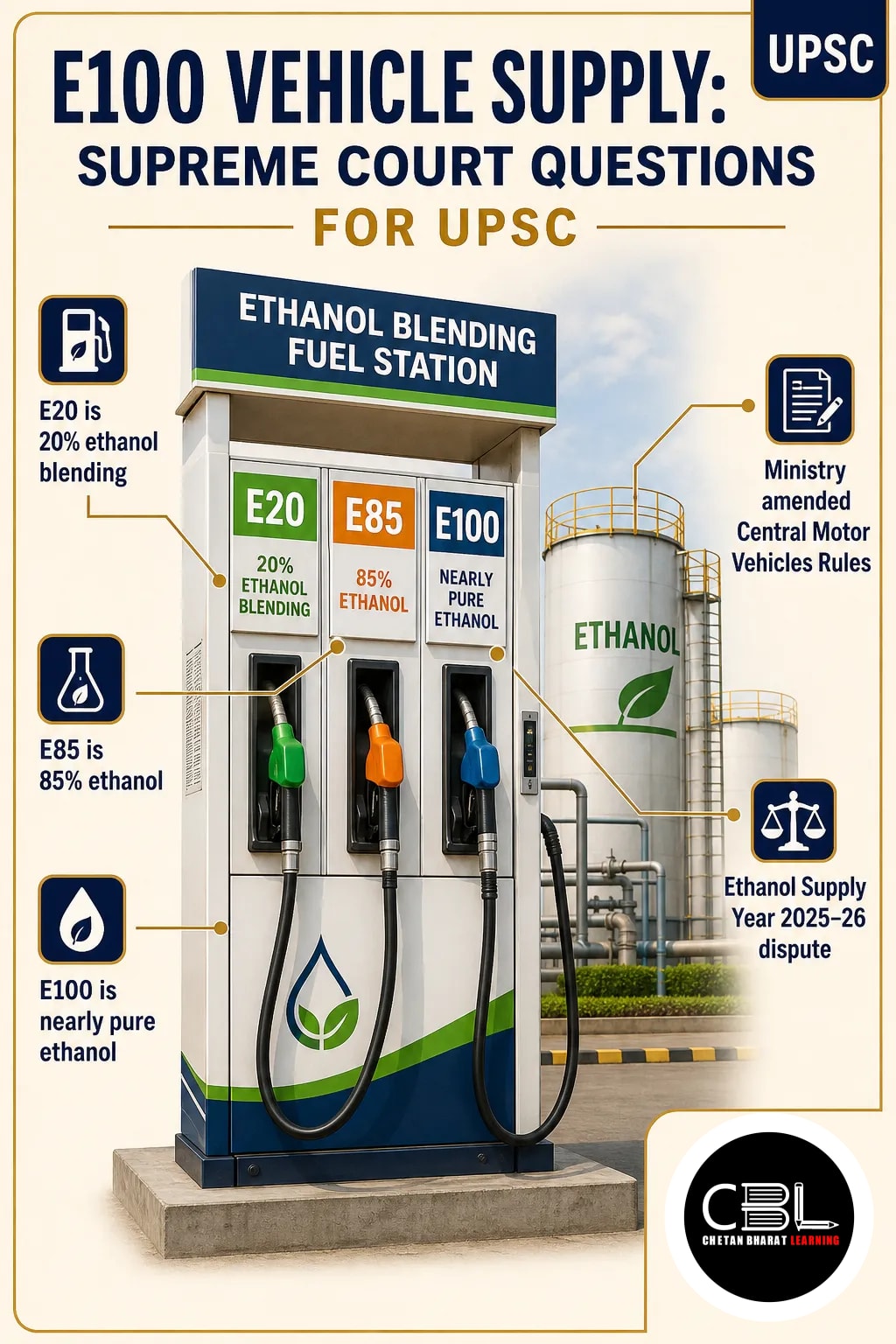

E100 vehicle supply has become a Supreme Court concern following the recent flex-fuel rule change. Since CBL’s earlier coverage of the E100 rule, the Court has asked how fuel would reach such vehicles. The issue also links energy policy and the economy.
Quick answer: On 29 October 2026, the Supreme Court asked the Union Government how it would arrange E100 vehicle supply. The question arose during an ethanol allocation dispute, days after a rule change included E100 in vehicle emission certification. The Bench also highlighted farmer empowerment, public interest and environmental considerations.
What did the Supreme Court ask?
The Supreme Court asked how the Government would supply fuel if vehicles running on nearly pure ethanol received permission. On 29 October, Justices M.M. Sundresh and Prasanna B. Varale raised the question while hearing ethanol allocation pleas.
Attorney General R. Venkataramani said large-scale manufacturing rearrangements would be necessary. The Bench also sought attention to farmer empowerment, environmental considerations and the larger public interest.
The Court posed a question; it did not decide an E100 supply plan in the account provided. Therefore, the hearing should not be confused with a final judgment on the new vehicle rule.
What is the background to the allocation case?
The case concerns ethanol allocation for Ethanol Supply Year (ESY) 2025–26, not a direct challenge to the E100 certification amendment.
The Karnataka High Court directed Bharat Petroleum Corporation Limited, Hindustan Petroleum Corporation Limited and Indian Oil Corporation Limited to consider a dedicated manufacturer’s request for enhanced allocation. It held that dedicated plants supplying exclusively to oil marketing companies could not be denied the preferential allocation contemplated under a long-term offtake agreement.
However, an oil marketing company argued before the Supreme Court that the direction would destabilise the national 20% blending policy. On 30 June 2026, the Supreme Court ordered status quo on the High Court direction. The dispute therefore brings contractual expectations and policy-wide allocation into the same proceeding.
How do E20, E85 and E100 differ?
The three labels distinguish ethanol concentrations, while vehicle compatibility depends on the applicable design and certification.
| Fuel or rule | Key fact |
|---|---|
| E20 | Petrol with 20% ethanol blending; the Centre has no immediate plan to increase the level, the Petroleum Minister said on 27 October. |
| E85 | A blend of 85% ethanol and 15% petrol, usable by suitably designed flex-fuel vehicles. |
| E100 | Nearly pure ethanol; the 26 October amendment expressly included it alongside E85 in emission certification provisions. |
| Governing rules | The Ministry of Road Transport and Highways amended the Central Motor Vehicles Rules, 1989. |
Thus, permitting certification for an E100-capable vehicle differs from increasing the ethanol share in ordinary petrol. It also does not, by itself, establish a fuel distribution network.
Why does E100 vehicle supply matter for policy?
Supply planning determines whether vehicle permission can translate into dependable fuel access without undermining existing commitments.
Production, allocation and distribution
First, higher-concentration vehicles create a potential demand alongside the existing petrol-blending programme. Policymakers must therefore assess available production against both uses rather than assume that certification guarantees supply.
Second, manufacturers and oil marketing companies need clarity on allocations and long-term offtake commitments. Furthermore, fuel must reach locations where compatible vehicles operate; production alone does not resolve storage, transport or retail availability.
Farmers, food and the environment
Farmers may benefit when feedstock demand creates remunerative and reliable markets. However, the size and distribution of those gains depend on procurement arrangements and how value moves through the supply chain. The Bench specifically asked that farmer empowerment receive attention.
Moreover, an environmental assessment must consider the full production and use cycle, including feedstock cultivation, water, processing and transport. An ethanol label alone cannot establish the net environmental outcome. For the broader trade-off, see CBL’s analysis of ethanol blending and food security.
What are the concerns and possible responses?
The main challenge is to coordinate fuel demand, producer commitments and public-interest safeguards before expanding use.
- Supply assessment: The Government could map production, existing blending obligations and prospective E100 demand. This would make potential gaps visible before distribution commitments expand.
- Allocation clarity: Transparent criteria could help reconcile policy objectives with applicable contracts, subject to the Court’s decision. Therefore, producers and purchasers would have a clearer basis for planning.
- Farmer participation: Procurement arrangements should make payment terms and market access clear. In addition, policymakers should examine whether benefits reach cultivators rather than stop at intermediaries.
- Environmental safeguards: Lifecycle assessment should compare emissions, water use and feedstock choices. Moreover, food availability and local resource pressures should inform sourcing decisions.
- Phased delivery: Vehicle rollout and fuel availability should be planned together. Otherwise, drivers may have compatible vehicles without convenient access to the intended fuel.
Overall, the policy test is not merely whether an engine can use E100. It is whether supply, farmer benefits and environmental outcomes can support its use alongside existing blending obligations.
Source: The Hindu, 30 October 2026
- E100 Flex Fuel Rule: Key Facts for UPSC (29 Oct 2026)
- Ethanol Blending Policy: Food vs Fuel for UPSC (1 Sep 2026)
- Global Biofuel Alliance: Clean Energy Push (7 Sep 2026)
Asked in UPSC: Previous Year Questions
- UPSC CSE Prelims 2020 (GS Paper I): Under the National Policy on Biofuels, which of these can be biofuel raw materials: cassava, damaged wheat, groundnut seeds, horse gram, rotten potatoes and sugar beet?
UPSC tests biofuel feedstocks; therefore, revise raw materials alongside blending policy.
State PCS questions can connect biofuel feedstocks with agricultural procurement and resource management. In addition, candidates should examine how state-level farming interests interact with national fuel policy.
Prelims Practice Corner
Mains Practice Questions
Frequently Asked Questions
What did the Supreme Court ask about E100 vehicles?
It asked how the Government would arrange fuel supply for them. The Bench raised the question during an ethanol allocation hearing on 29 October 2026.
Does the E100 rule increase ethanol blending in petrol?
No, because the E100 certification change is separate from the petrol-blending level. The Petroleum Minister said on 27 October that there was no immediate plan to increase blending beyond 20%.
What is the ethanol allocation dispute about?
It concerns allocation for Ethanol Supply Year 2025–26. In particular, an oil marketing company challenged the implications of a Karnataka High Court direction concerning a dedicated manufacturer.
Related Current Affairs
Preparing for UPSC, PCS or HCS?
Talk to a mentor at Chetan Bharat Learning, Chandigarh. Free guidance on choosing the right exam and building a study plan.
Chat on WhatsAppCall 97793 53345UPSC / IAS / PCS coaching in Chandigarh · Trusted by aspirants across Punjab & Haryana
Leave a Reply
You must be logged in to post a comment.