
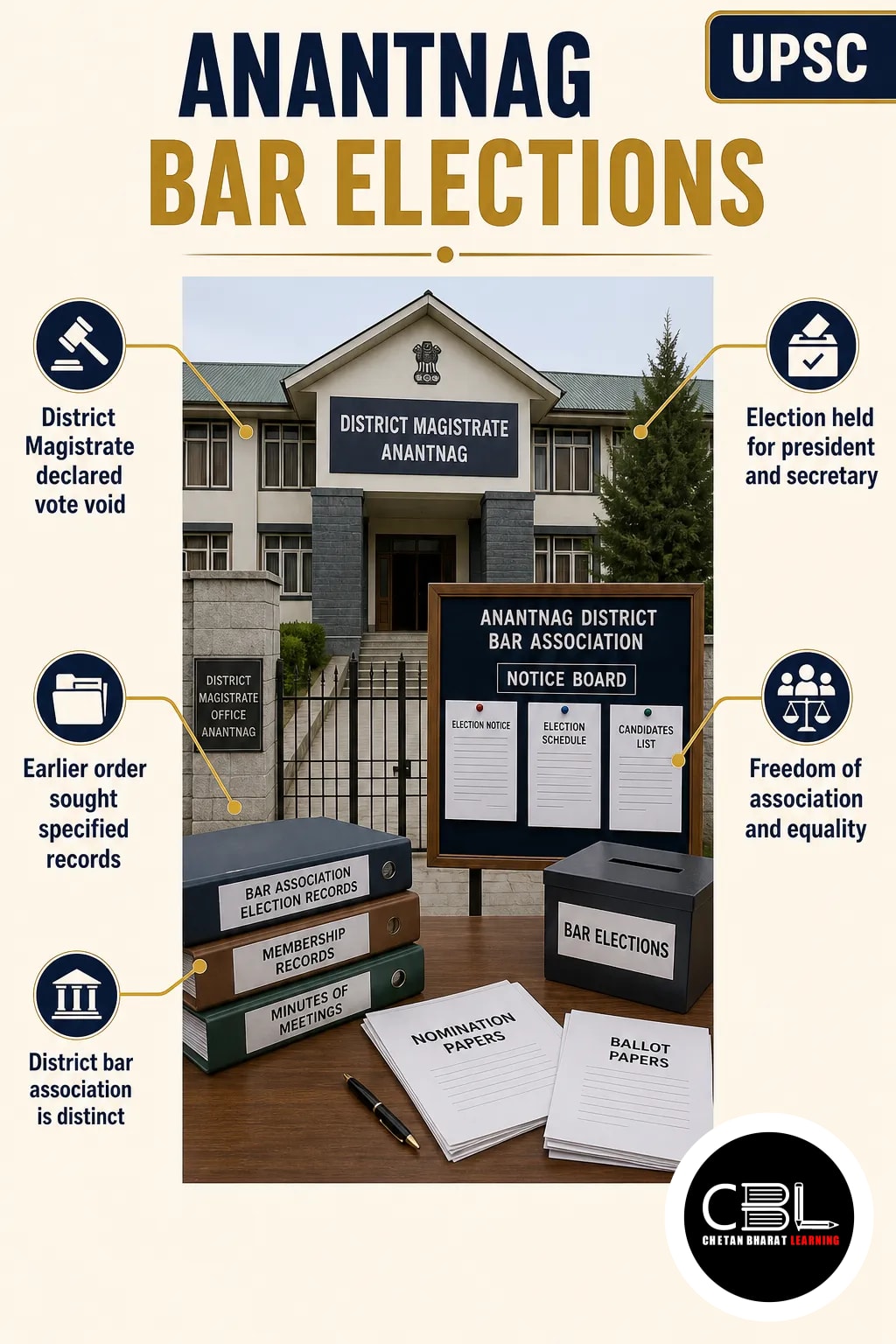

Anantnag bar elections have triggered a dispute between the district administration and lawyers over the validity of an association vote. The case raises questions about administrative powers and freedom of association relevant to UPSC polity and governance.
Quick answer: The District Magistrate declared the Anantnag bar elections of 27 October 2026 null and void, citing breaches of official orders and unmet requirements. The south Kashmir association held polls for president and secretary. However, lawyers disputed the order, saying the vote had the necessary permission and was peaceful.
What did the District Magistrate order?
The District Magistrate declared the association election void from the outset, citing violations of earlier official directions. The order also described the vote as having no legal existence.
According to the administration, the association did not fulfil prior conditions or notify the office before voting. Moreover, the order said the association lacked permission from that office.
The administration cited the Societies Registration Act, 1860, as applicable in Jammu and Kashmir, and the Indian Trusts Act, 1882. However, the source does not identify the specific provisions invoked. The order is an executive decision, not a court judgment; its legal basis remains a matter of dispute.
What led to the dispute?
An earlier district order had prohibited the election process pending submission of specified organisational records. The following timeline separates that requirement from the later contested vote.
| Date or fact | Significance |
|---|---|
| 2 January 2025 | District order prohibited the election process pending specified records. |
| 27 October 2026 | The association held elections for president and secretary. |
| Around 700 lawyers | Approximate number enrolled in the Anantnag Bar, according to the source. |
The earlier order sought a registration certificate, constitution or memorandum of association, and governing bye-laws. In addition, it required details of current executives and members from the previous ten years, including addresses and mobile numbers.
The district also requested detailed accounts, a transaction summary and relevant banking details. Anantnag, in south Kashmir, has a sizeable legal community; the source places it after Jammu and Srinagar among major districts by this measure.
What did the lawyers say?
Lawyers interviewed by the source contested both the administration’s account and its authority to invalidate the vote. One senior lawyer said the election had proper permission and official observation; another said it was peaceful and breached no prohibitory order.
Moreover, one lawyer questioned whether non-registration alone could justify the decision. A lawyer also cited association elections in Kulgam, Shopian and Bandipora while alleging unequal treatment. These are the lawyers’ claims, not findings established by a court in the source.
Which constitutional and legal principles matter?
The dispute engages freedom of association, equality and the limits of executive action, alongside the laws cited in the order. Their application depends on the facts and the applicable legal provisions.
| Provision or law | Relevance |
|---|---|
| Article 19(1)(c) | Protects citizens’ right to form associations or unions, subject to constitutional limitations. |
| Article 19(4) | Permits reasonable restrictions by law on specified grounds, including public order and morality. |
| Article 14 | Guarantees equality before the law and equal protection of the laws. |
| Societies Registration Act, 1860 and Indian Trusts Act, 1882 | The District Magistrate cited both; the reported order does not specify particular sections. |
A district bar association is distinct from a statutory Bar Council. Bar Councils have functions under the Advocates Act, 1961, including professional regulation. Therefore, the association’s internal election should not be confused with an election to a statutory Bar Council.
What are the governance implications?
The case illustrates the tension between organisational accountability and the autonomy of a lawyers’ association. It also raises distinct questions about the procedure and legal authority behind administrative intervention.
- Authority: An executive decision needs a legal basis; therefore, identifying the enabling provision is central to assessing the order.
- Fair procedure: Notice, an opportunity to respond and reasons can help make consequential decisions accountable.
- Association autonomy: Lawyers need space to choose representatives; however, an association may also have to meet applicable legal requirements.
- Equality: Claims of different treatment across districts require comparison of their legal and factual circumstances.
- Privacy: Requests for addresses, phone numbers and financial records should be assessed for relevance and appropriate safeguards.
These are analytical questions, not conclusions that either side has breached the law. The source does not establish whether a court has reviewed the order or resolved the disputed claims.
What is the way forward?
A transparent resolution would clarify the applicable law, the records required and the status of the disputed permission. First, the administration could specify the statutory provisions and reasons supporting its decision.
Second, the association could present its documents and account of the election process. Meanwhile, an appropriate legal forum could examine contested authority and procedure if the matter is brought before it.
Finally, clear, consistently applied requirements would help associations comply without unnecessary interference. Such an approach would also protect accountability while respecting lawful collective activity.
Source: The Hindu, 30 October 2026
Punjab PCS and Haryana HCS may test this issue through district administration, freedom of association and administrative accountability. Additionally, candidates should distinguish local bar associations from statutory Bar Councils.
Prelims Practice Corner
Mains Practice Questions
Frequently Asked Questions
Why were the Anantnag bar elections declared void?
The District Magistrate cited violations of official orders and unmet requirements. However, lawyers disputed the administration’s account of permission and compliance.
When were the elections held and for which posts?
The association held the elections on 27 October 2026 for president and secretary. The earlier district order, meanwhile, dated from 2 January 2025.
Did a court invalidate the vote?
No; the reported decision was an order of the District Magistrate. Moreover, the source does not establish that a court reviewed the order.
Is a district bar association the same as a Bar Council?
No; a district bar association is distinct from a statutory Bar Council. The latter has professional regulatory functions under the Advocates Act, 1961.
Related Current Affairs
Preparing for UPSC, PCS or HCS?
Talk to a mentor at Chetan Bharat Learning, Chandigarh. Free guidance on choosing the right exam and building a study plan.
Chat on WhatsAppCall 97793 53345UPSC / IAS / PCS coaching in Chandigarh · Trusted by aspirants across Punjab & Haryana
Leave a Reply
You must be logged in to post a comment.