
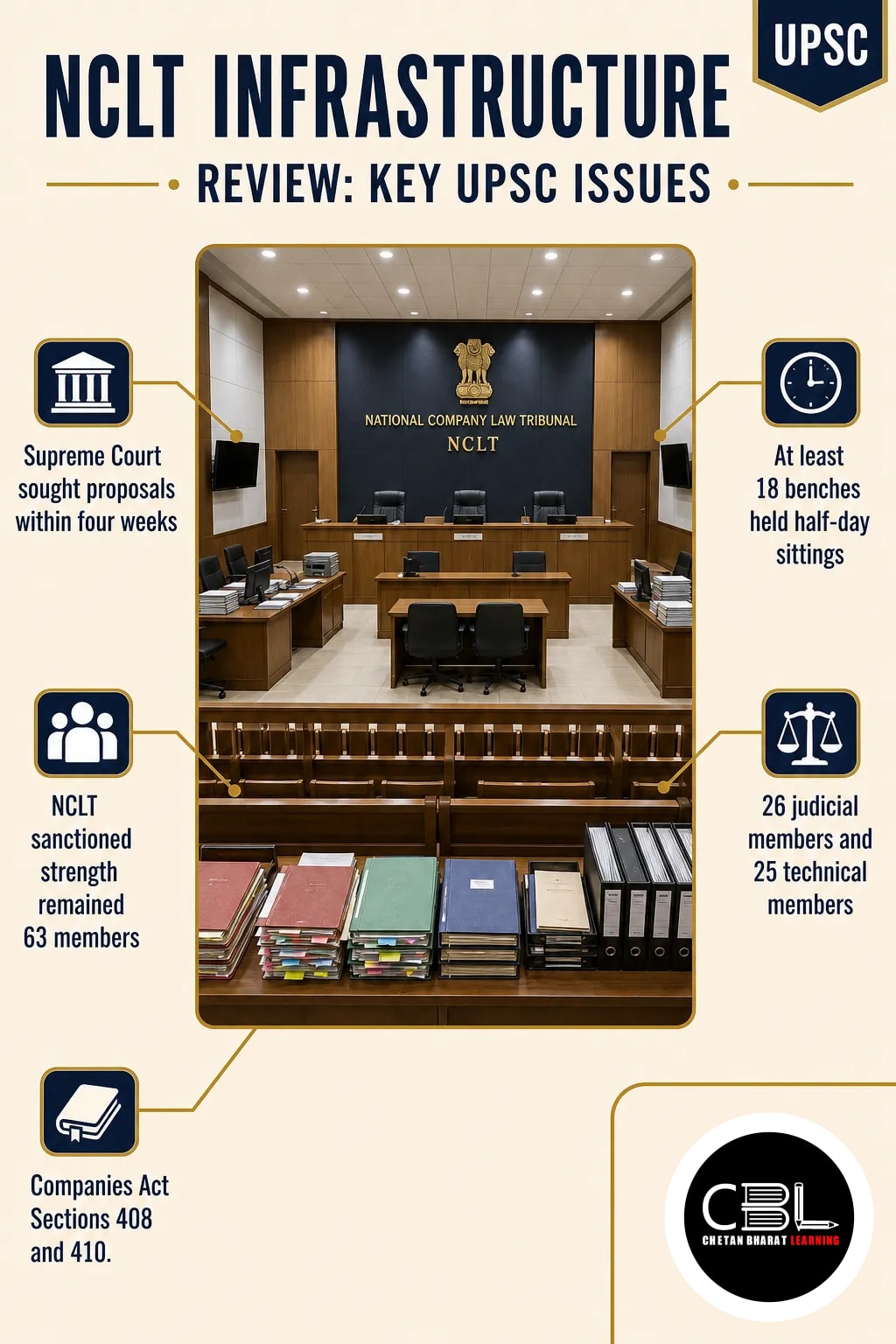

NCLT infrastructure is under Supreme Court scrutiny after concerns over court buildings, staffing and shortened sittings. The review also matters for insolvency proceedings, as explained in CBL’s coverage of insolvency safeguards and resolution risks.
Quick answer: On 29 October 2026, the Supreme Court sought NCLT infrastructure and staffing proposals from the presidents of both the company law tribunal and its appellate tribunal within four weeks. The NCLT Bar Association had said at least 18 benches hold half-day sittings because of member shortages.
What did the Supreme Court direct?
The Court directed the tribunal presidents to submit comprehensive proposals on buildings, infrastructure and staffing within four weeks. It also asked the Centre to meet the concerned stakeholders to identify priorities.
The direction covers the National Company Law Tribunal (NCLT) and the National Company Law Appellate Tribunal (NCLAT). Chief Justice Surya Kant and Justices Joymalya Bagchi and V Mohana constituted the Bench.
In addition, the NCLT must consider whether each bench needs a Deputy or Joint Registrar to maintain judicial records. Attorney General R Venkataramani proposed a joint meeting with tribunal leaders and the Bar; the Court also asked him to impress upon the Union the need for basic amenities.
Why is the Court reviewing tribunal capacity?
The review arose in a case the Supreme Court took up on its own concerning member appointments and inadequate infrastructure. The Court had earlier asked the Centre to identify urgent amenities in consultation with the NCLT president.
The Court was told that two floors at the NCLT Principal Bench had shut and courts were functioning at half strength. Meanwhile, the Principal Bench Bar Association had been asked to compile infrastructure data from regional benches in a table.
The NCLT Bar Association also linked shorter sittings to a shortage of members. Its application said the tribunal’s jurisdiction had expanded substantially after the Insolvency and Bankruptcy Code (IBC), while sanctioned strength remained at 63.
| Indicator | Position stated in the source |
|---|---|
| NCLT sanctioned strength | 63 members |
| Judicial members | 26 as of 30 June 2026 |
| Technical members | 25 as of 30 June 2026; the total includes the president |
| Half-day sittings | At least 18 benches, according to the Bar Association |
The figures add up to 51 members, or 12 fewer than the sanctioned aggregate. However, the figures alone do not establish the vacancy distribution across individual benches.
Which legal provisions govern the tribunals?
The Companies Act, 2013 establishes the company law tribunals, while the IBC assigns them insolvency functions. Together, these laws place both corporate disputes and insolvency adjudication within the tribunal framework.
| Provision | What it says |
|---|---|
| Companies Act, Section 408 | Provides for constitution of the NCLT by the Central Government. |
| Companies Act, Section 410 | Provides for constitution of the NCLAT to hear appeals against NCLT orders. |
| Companies Act, Section 424 | Guides the tribunals by principles of natural justice, subject to the Act and relevant rules. |
| IBC, Sections 60–61 | Identify the NCLT as adjudicating authority for corporate persons and provide for appeals to the NCLAT. |
| IBC, Section 62 | Provides for an appeal to the Supreme Court on a question of law arising from an NCLAT order. |
What are the implications for governance and insolvency?
Tribunal capacity affects the practical delivery of company law and insolvency adjudication. Therefore, the review links physical facilities with appointments, records and access to hearings.
- Hearing capacity: Shorter sittings leave less time for proceedings; therefore, member availability matters alongside courtroom space.
- Insolvency resolution: Tribunal capacity can influence the pace of decisions under the IBC and, consequently, the predictability of the process for stakeholders.
- Judicial records: Registrar-level support can help organise records and assist bench administration; however, its desirability remains for the NCLT to assess.
- Access across regions: Bench-wise data can reveal local differences; thus, a national aggregate alone cannot guide every infrastructure decision.
For GS Paper II, the issue illustrates the relationship between institutional design and implementation. For GS Paper III, it connects tribunal capacity with the legal framework for resolving corporate insolvency.
What concerns remain and what can be done?
The immediate challenge is to convert identified needs into coordinated decisions on appointments, facilities and support staff. The Court has sought proposals; it has not yet approved a specific staffing or construction plan.
- Bench-wise assessment: First, compare sitting hours, available members, facilities and staff at each location.
- Prioritisation: Next, use the proposed stakeholder meeting to distinguish urgent basic amenities from longer-term building needs.
- Staffing and records: In addition, assess registrar support alongside judicial and technical member requirements.
- Follow-through: Finally, track decisions against the proposals so that infrastructure and personnel measures reinforce each other.
Overall, more members without adequate facilities may not fully restore capacity. Similarly, improved buildings need functioning benches and administrative support to deliver their intended benefits.
Source: The Hindu, 29 October 2026
- IBC Fraud Risks: Haircuts, Section 29A and PMLA (17 Sep 2026)
- Personal Guarantors: IBBI Proposes Tighter Safeguards (16 Sep 2026)
Punjab PCS and Haryana HCS may test the NCLT–NCLAT distinction and the statutory basis of tribunals in General Studies. In addition, the review offers an example for questions on administrative capacity and access to justice.
Prelims Practice Corner
Mains Practice Questions
Frequently Asked Questions
What did the Supreme Court ask the NCLT and NCLAT presidents to submit?
It asked for comprehensive infrastructure and staffing proposals within four weeks. The proposals may also cover land and buildings.
How many NCLT benches were holding half-day sittings?
At least 18 benches, according to the NCLT Bar Association. It attributed the shorter sittings to member shortages.
What is the difference between NCLT and NCLAT?
The NCLT adjudicates specified company law and insolvency matters, while the NCLAT hears appeals from NCLT orders. Both tribunals derive their institutional basis from the Companies Act, 2013.
How many NCLT members were in place on 30 June 2026?
There were 51 members: 26 judicial and 25 technical, including the president. The stated sanctioned strength was 63.
Related Current Affairs
Preparing for UPSC, PCS or HCS?
Talk to a mentor at Chetan Bharat Learning, Chandigarh. Free guidance on choosing the right exam and building a study plan.
Chat on WhatsAppCall 97793 53345UPSC / IAS / PCS coaching in Chandigarh · Trusted by aspirants across Punjab & Haryana
Leave a Reply
You must be logged in to post a comment.