
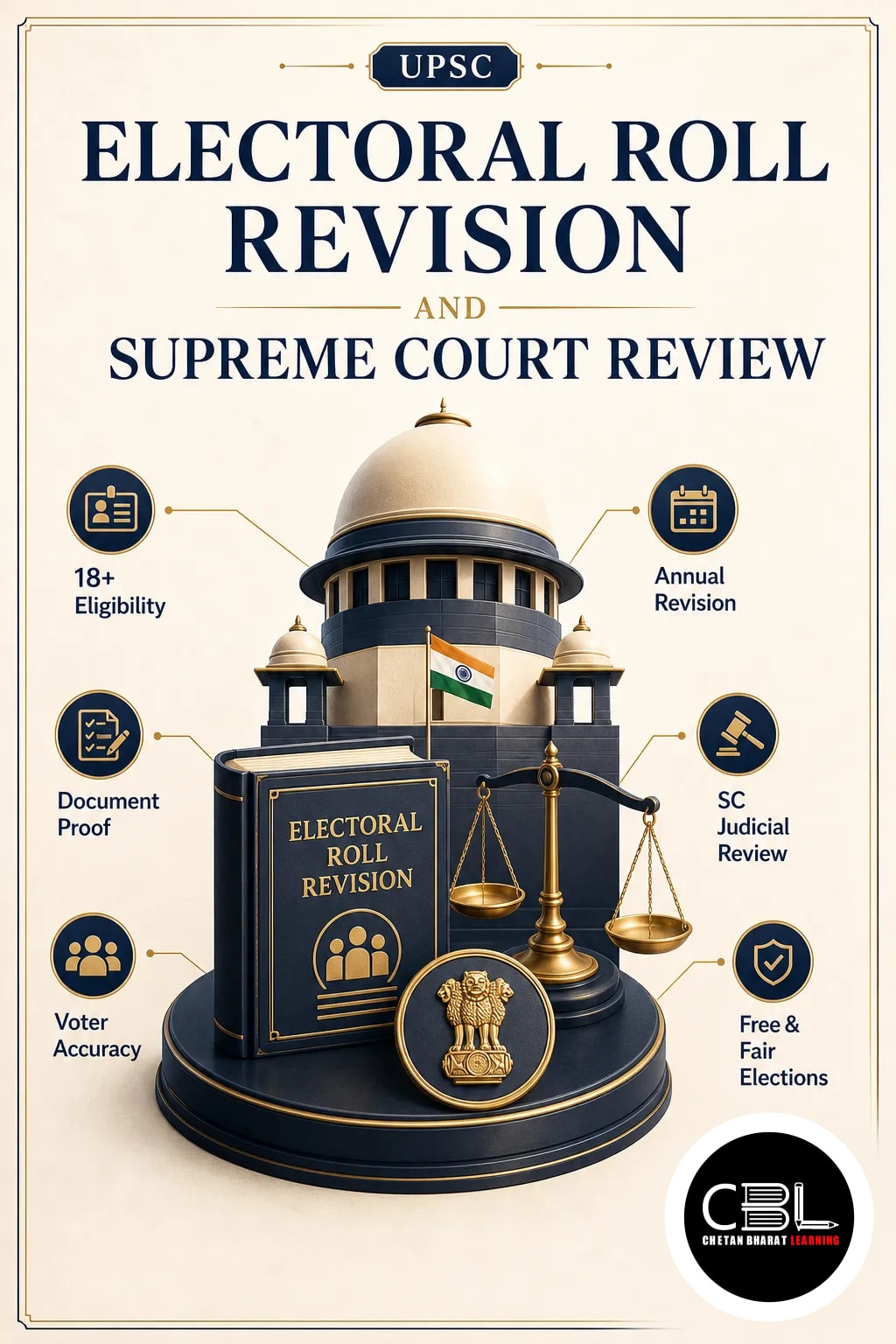

Electoral roll revision has returned to focus after the Supreme Court’s scrutiny of election administration and the Election Commission’s affidavit claiming unanimous decision-making. The issue matters because voter lists sit at the core of free and fair elections.
What is electoral roll revision?
Electoral roll revision is the legal process of updating the list of eligible voters before elections. It includes adding new voters, deleting ineligible names, and correcting entries such as age, address, and spelling.
Under the Representation of the People Act, 1950, the electoral roll supports the franchise under Article 326. The Election Commission supervises this process to keep the voters’ list accurate and inclusive.
Why in News?
The Election Commission informed the Supreme Court that it acted unanimously on the electoral roll revision orders. The affidavit seeks to show that the process followed institutional approval rather than individual preference.
The matter has policy significance because electoral roll updates affect voter registration, exclusion risks, and the credibility of the polling process. Any dispute over revision methods can shape wider debates on electoral reforms.
Key Features
- Core electoral function: Revision ensures that only eligible citizens remain on the voter list.
- Institutional role: The Election Commission oversees preparation, correction, and publication of rolls.
- Constitutional link: Article 326 makes adult suffrage the foundation of voting rights.
- Legal framework: The Representation of the People Act, 1950 and related rules govern enrolment and revision.
- Judicial oversight: The Supreme Court can test whether the process respects legality, fairness, and natural justice.
Challenges
- Exclusion errors: Genuine voters can be left out if verification is too strict or poorly implemented.
- Inclusion errors: Ineligible names may remain if field verification is weak.
- Process opacity: Voters may find it difficult to understand how decisions on revisions are made.
- Administrative burden: Large-scale revisions require staff, data checks, and time-sensitive coordination.
- Litigation risk: Disputes may reach courts when parties question the fairness of the revision exercise.
Way Forward
The Commission should keep the revision process transparent, easy to access, and well documented. Public notices, local verification, and grievance redress can reduce avoidable disputes.
Digital tools can help, but they must remain backed by field-level checks and appeal mechanisms. A balanced process protects both electoral integrity and the right to vote.
Source: Indian Express India, 2026-10-26
- Current Affairs Archive (ongoing)
This topic is useful for state PCS questions on the Election Commission, voter registration, and constitutional bodies. It also fits governance sections on how transparent electoral rolls support democratic legitimacy at the state level.
FAQ
Who updates the electoral roll in India?
The Election Commission supervises the electoral roll, with local election machinery handling revision work on the ground. The process must follow the constitutional and statutory framework.
Why does the Supreme Court get involved in such matters?
The Court can examine whether the revision process follows law, fairness, and constitutional principles. It acts when a dispute raises concerns about exclusion, procedure, or institutional authority.
How is this relevant for UPSC?
It links constitutional bodies, election law, and democratic process. The topic is useful for both Prelims and GS Paper II, especially in questions on electoral reforms.
Related Current Affairs
Preparing for UPSC, PCS or HCS?
Talk to a mentor at Chetan Bharat Learning, Chandigarh. Free guidance on choosing the right exam and building a study plan.
Chat on WhatsAppCall 97793 53345UPSC / IAS / PCS coaching in Chandigarh · Trusted by aspirants across Punjab & Haryana
Leave a Reply
You must be logged in to post a comment.