

UPSC Mapping
| Prelims | Infrastructure, PPP and BOOT model |
|---|---|
| Mains | GS Paper III – Infrastructure and Investment |
Quick Facts
| Framework | 1997 BOOT model |
|---|---|
| Pipavav | Concession ends in 2028 |
| Mundra | Concession ends in 2031 |
| New shipyards | Waterfront concessions up to 50 years |
What are Gujarat Port Concessions?
Gujarat port concessions refer to the long-term operating rights granted to private developers for developing and managing port infrastructure under the state’s port policy framework. Gujarat opened its coastline to private investment in the late 1990s, using the Build-Own-Operate-Transfer approach to attract private capital into a capital-intensive sector.
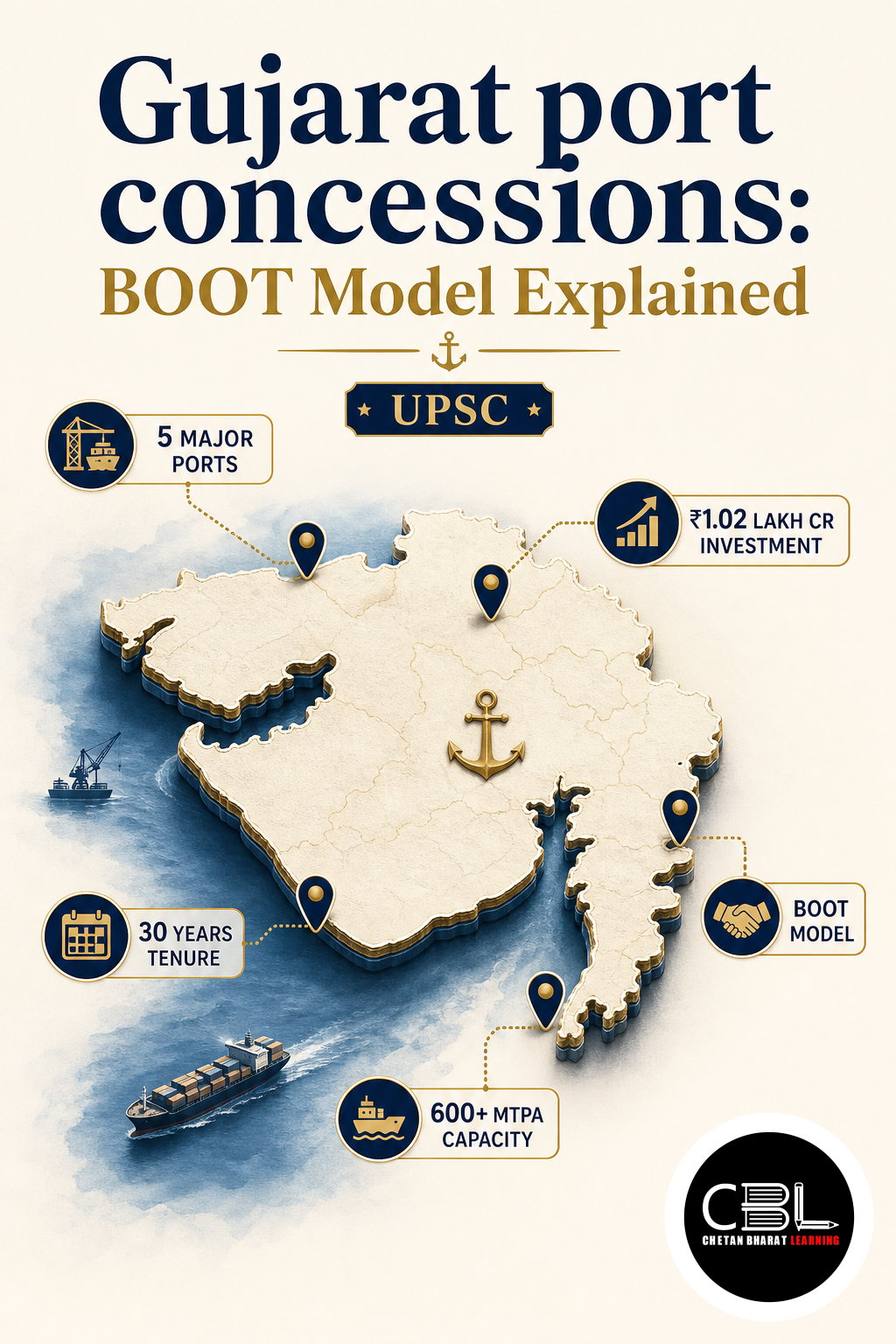
Under this arrangement, private developers received rights to build and operate ports for an initial period of 30 years. The model allowed investors to recover construction and operating costs over the concession period, while the underlying strategic asset would eventually revert to the government unless the relevant agreement was extended. The approach helped Gujarat expand its maritime infrastructure and attract significant private investment.
Why are Gujarat Port Concessions in News?
Gujarat port concessions have gained attention because Pipavav and Mundra, two pioneering privately developed ports, are approaching the end of their original concession periods. Pipavav’s 30-year BOOT concession, signed in 1998, is scheduled to end on September 29, 2028, while Mundra’s concession expires on February 16, 2031.
The absence of a formal extension framework has created a question over long-term investment certainty. Port development requires recurring expenditure on dredging, mechanisation, deeper berths, rail connectivity and cargo-handling systems. A developer may be less willing to make investments with long payback periods if its future operating rights remain uncertain. The October 2025 non-binding investment memorandum involving APM Terminals Pipavav and the Gujarat government illustrates why concession clarity matters for future capital commitments. For official government developments, aspirants should track the PIB releases and relevant ministry announcements.
Key Features
- Long-term private participation: Private developers finance, construct and operate infrastructure during a defined concession period.
- BOOT structure: The developer holds ownership during the concession period before the asset ultimately transfers back to the government.
- Revenue recovery: Investors recover costs and seek returns through user charges, tariffs, tolls or other project revenues.
- Strategic public ownership: The eventual transfer mechanism allows the state to retain long-term control over strategically important infrastructure.
- Investment certainty: A predictable concession period can support financing decisions and encourage continuous investment in asset quality and capacity.
In a conventional BOT arrangement, the emphasis is on building, operating and transferring the asset. The BOOT variant additionally recognises an ownership phase for the private developer during the concession period. This distinction is important when examining the allocation of investment risk and commercial rights.
Challenges for Gujarat Port Concessions
The next phase of Gujarat port concessions must balance investor confidence with public interest, competition and the long-term management of strategic maritime infrastructure.
- Policy uncertainty: The absence of a clearly announced extension framework can complicate long-term investment planning for existing operators.
- Capital-intensive upgrades: Ports require continuing expenditure on dredging, mechanisation, berths, connectivity and cargo-handling capacity.
- Concession design: The state must determine concession duration and extension conditions without weakening competitive bidding or public value.
- Asset transition: Any future framework needs clarity on valuation, ownership, operating rights and the treatment of investments made near concession expiry.
- Competitive positioning: Gujarat must remain attractive relative to states offering longer concession horizons for new and existing maritime infrastructure.
The comparison with other states also matters. Andhra Pradesh projects such as Gangavaram and Krishnapatnam have adopted concession structures extending up to 50 years, while Kerala’s Vizhinjam project provides a horizon of up to 60 years. Odisha’s Dhamra concession also provides a longer initial period than Gujarat’s original 30-year framework. These examples show how concession duration can become an element of inter-state competition for infrastructure investment. Aspirants can connect this issue with the broader UPSC economy and infrastructure topic cluster.
Way Forward
Gujarat port concessions require a transparent and predictable policy framework that provides sufficient certainty for long-term investment while protecting the public interest. The state can establish clear principles for extension, renewal, bidding, asset transfer and investment commitments before existing concessions reach their expiry dates.
Gujarat’s new shipbuilding policy provides an important indication of the direction of travel. Waterfront concessions for new shipyards can extend up to 50 years, compared with the earlier 30-year tenure. The planned greenfield ports at Nana Layja, Vadhera, Vadodra Jhala, Damka, Lakhanka and Bhogat are also expected to follow the BOOT model, with concession periods potentially ranging from 30 to 50 years depending on bidding outcomes. A consistent approach can strengthen maritime infrastructure investment while preserving competitive and accountable concession design. Relevant policy announcements should be tracked through official Gujarat government and maritime authorities.
Prelims Practice Corner
Q1. Consider the following statements about the BOOT model:
1. A private developer builds and operates the infrastructure.
2. The private developer retains ownership permanently after the concession ends.
3. The asset is ultimately transferred to the government under the model.
Which of the statements given above is/are correct?
- (a) 1 and 2 only
- (b) 1 and 3 only
- (c) 2 and 3 only
- (d) 1, 2 and 3
Answer: (b) The BOOT model includes private development, operation and ownership during the concession period, followed by transfer.
Q2. Pipavav Port’s original 30-year BOOT concession, according to the current affairs brief, is scheduled to end in:
- (a) 2026
- (b) 2027
- (c) 2028
- (d) 2031
Answer: (c) The concession is scheduled to end on September 29, 2028.
Q3. Which of the following best explains why concession certainty matters for port infrastructure?
- (a) Ports require no recurring capital expenditure
- (b) Port investments often have long payback periods
- (c) Concessions eliminate all investment risk
- (d) Private operators cannot invest in ports
Answer: (b) Long payback periods make predictable operating rights important for investment decisions.
Q4. Which one of the following states is associated with the Vizhinjam port project mentioned in the brief?
- (a) Kerala
- (b) Gujarat
- (c) Odisha
- (d) Andhra Pradesh
Answer: (a) Vizhinjam is located in Kerala and the cited concession horizon can extend up to 60 years.
Q5. Under the BOOT model, what is the principal distinction from a standard BOT description?
- (a) Government builds the asset without private participation
- (b) Private ownership exists during the concession period
- (c) No transfer occurs
- (d) The project has no revenue model
Answer: (b) BOOT explicitly includes an ownership phase for the private developer during the concession period.
Mains Practice Questions
Q1. Explain the BOOT model and examine the importance of policy certainty for long-term investment in port infrastructure. (10 marks)
Answer Structure:
- Intro: Define BOOT as a PPP model involving private construction, ownership and operation followed by transfer.
- Body: Explain concession economics, risk allocation, infrastructure financing, Gujarat’s port experience, concession expiry and the importance of predictable extension rules.
- Conclusion: Emphasise transparent concession policy that combines investor confidence with public interest.
Q2. Longer concession periods can influence competition among Indian states for maritime infrastructure investment. Discuss with reference to Gujarat and other states. (15 marks)
Answer Structure:
- Intro: Port projects require large upfront capital and long investment horizons, making concession design economically significant.
- Body: Compare Gujarat’s original 30-year model with longer structures in Andhra Pradesh, Kerala and Odisha; discuss financing certainty, capacity expansion, competitive bidding, public ownership, strategic infrastructure and safeguards against excessive concession duration.
- Conclusion: India needs predictable, transparent and competitively designed concessions to support maritime growth without compromising public value.
FAQs on Gujarat Port Concessions
What are Gujarat port concessions?
They are long-term rights granted to private developers to develop and operate port infrastructure in Gujarat. The state’s original private-port framework used the BOOT model with an initial 30-year concession period.
What is the BOOT model in infrastructure?
BOOT stands for Build-Own-Operate-Transfer. A private developer finances, builds, owns and operates an infrastructure asset for a defined period before the asset transfers back to the government.
When does the Pipavav concession expire?
According to the supplied current affairs brief, the 30-year Pipavav BOOT concession signed in 1998 is scheduled to end on September 29, 2028. This makes it an important near-term test for Gujarat’s concession policy.
Related Current Affairs
Preparing for UPSC, PCS or HCS?
Talk to a mentor at Chetan Bharat Learning, Chandigarh. Free guidance on choosing the right exam and building a study plan.
Chat on WhatsAppCall 97793 53345UPSC / IAS / PCS coaching in Chandigarh · Trusted by aspirants across Punjab & Haryana
Leave a Reply
You must be logged in to post a comment.