

UPSC Mapping
| Exam Area | Relevance |
|---|---|
| Prelims | Himalayan Wildlife, IUCN Red List, CITES, Wildlife Protection Act |
| Mains | GS Paper 3: Biodiversity, Environment and Conservation |
Article
Cheer Pheasant conservation in Himachal Pradesh has recorded significant progress, with the reported survival rate of reintroduced birds increasing from 11.11% in 2019-20 to 100% in 2024-25. The improvement follows a scientifically managed captive-breeding and reintroduction programme designed to restore populations of this threatened Himalayan species. The development is particularly relevant for UPSC current affairs preparation under biodiversity, wildlife conservation and environmental governance.
The programme combines parent-rearing, gradual release into natural habitats and monitoring through radio transmitters and camera traps. The reported survival figures concern monitored reintroduced birds and should not be interpreted as proof that the entire wild population has recovered.
Quick Facts
| Parameter | Details |
|---|---|
| Scientific Name | Catreus wallichii |
| IUCN Status | Vulnerable |
| Wildlife Protection | Schedule I |
| CITES | Appendix I |
Location and Key Features
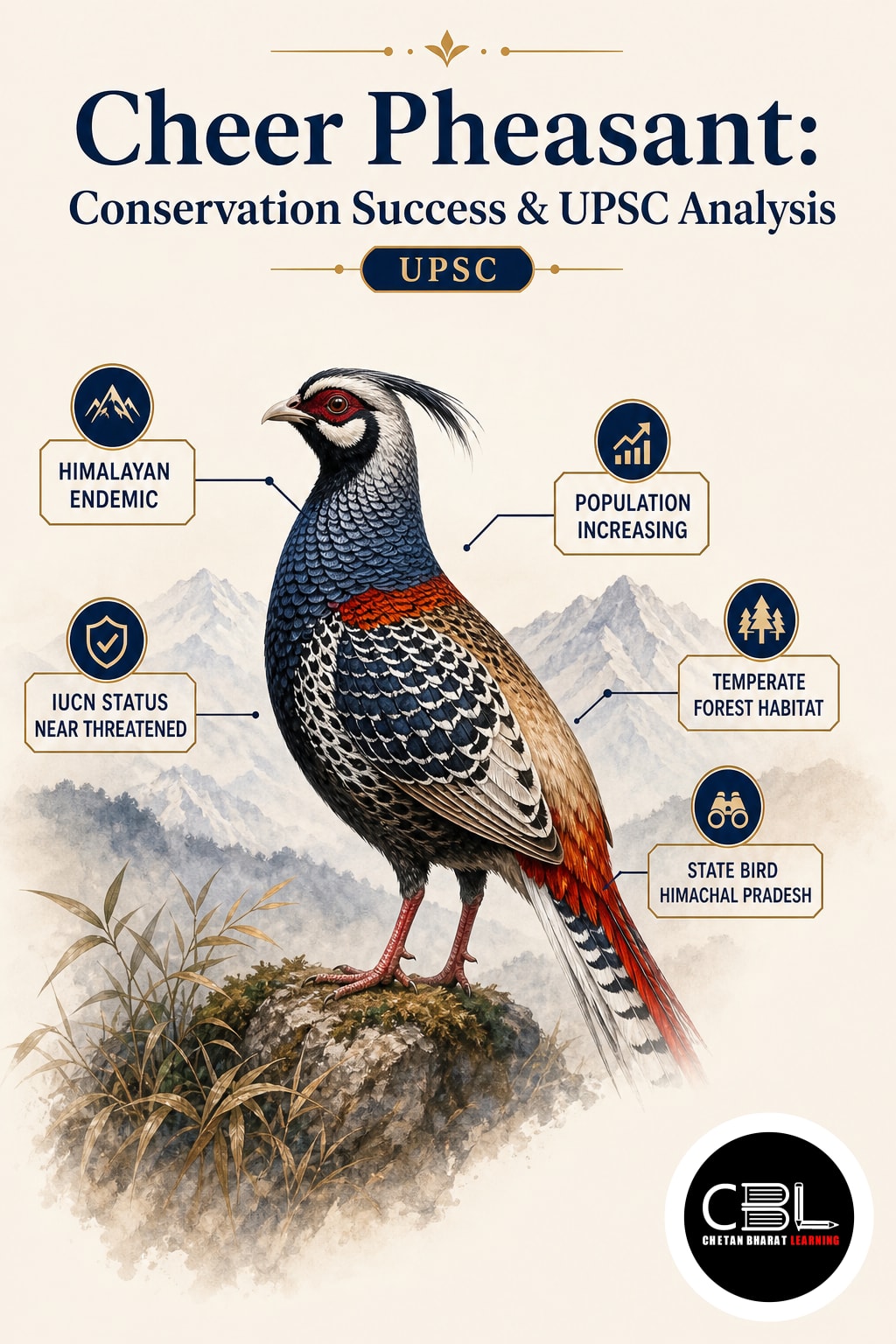
The Cheer Pheasant, also known as Wallich’s pheasant or Chir Tittar, is a Himalayan bird belonging to the family Phasianidae. Its scientific name is Catreus wallichii, and it is the only living species within the genus Catreus.
Its distribution extends from northern Pakistan through the western Himalayas of India to Nepal. Within India, the species is associated with Himachal Pradesh, Jammu and Kashmir, and Uttarakhand.
- Habitat: The bird occupies steep, rocky Himalayan slopes with grass, shrubs, scattered trees and patches of open woodland.
- Altitude: Its reported elevational range extends approximately from 1,500 to 3,500 metres above sea level.
- Appearance: It has buff-brown plumage marked with black and grey barring, providing camouflage against its natural surroundings.
- Head: The species has a distinctive crest, giving it a recognisable appearance.
- Tail: Its long, comparatively untidy tail is another prominent identification feature.
- Behaviour: It generally remains on the ground and may run towards cover when threatened.
- Diet: The species feeds on roots, tubers, bulbs, seeds and other plant material, along with small invertebrates.
- Breeding: It nests on the ground in concealed vegetation, making suitable grassland cover important for reproductive success.
Why in News?
Himachal Pradesh’s conservation-breeding programme has reported a substantial improvement in the survival of captive-bred Cheer Pheasants released into natural habitats.
According to reports published in October 2026, monitored survival increased from 11.11% in 2019-20 to 100% in 2024-25. The improvement has been linked to scientific breeding practices, parent-rearing and gradual release methods.
During Wildlife Week 2026, authorities released 12 captive-bred birds near Koti in Shimla district. The group comprised two adult males, two adult females and eight chicks.
The birds came from the Khadiyun Cheer Pheasant Breeding Centre at Chail in Solan district. The facility operates under the Himachal Pradesh Zoo Conservation and Breeding Society.
The programme suspended releases during 2025-26 to consolidate its conservation efforts. Continued monitoring remains necessary to determine long-term survival, reproduction and integration into wild populations.
Conservation Status of Cheer Pheasant
The species receives protection through national wildlife legislation and international conservation frameworks.
| Conservation Framework | Status |
|---|---|
| IUCN Red List | Vulnerable |
| CITES | Appendix I |
| Wild Life (Protection) Act, 1972 | Schedule I |
The Vulnerable classification indicates that the species faces a high risk of extinction in the wild under IUCN assessment criteria.
CITES Appendix I generally covers species threatened with extinction and imposes stringent restrictions on international commercial trade. Schedule I of India’s wildlife legislation provides a high level of statutory protection.
Ecological Significance
1. Importance of Himalayan Grasslands
The species depends on open mountain slopes containing grasses, shrubs and scattered trees. These habitats offer food, nesting cover and protection from predators.
The bird’s ecological requirements demonstrate that grasslands are important wildlife habitats, not merely degraded forests awaiting afforestation.
2. Indicator of Habitat Quality
The species depends on suitable vegetation structure and relatively undisturbed breeding locations. Its presence can therefore provide information about habitat conditions.
Population monitoring also helps conservationists understand the effects of habitat fragmentation and changing land-use practices.
3. Importance for Himalayan Biodiversity
Conserving this pheasant contributes to protecting the biodiversity of the western Himalayas. Habitat protection can also benefit other species using similar grassland and scrub ecosystems.
Threats to Cheer Pheasant
- Habitat destruction: Loss and fragmentation of Himalayan grasslands reduce suitable feeding and nesting areas.
- Forest and grassland fires: Increasing fire incidents can destroy vegetation cover, nests and essential habitat.
- Human disturbance: Activities such as grazing, vegetation cutting and excessive disturbance can affect breeding conditions.
- Hunting pressure: Illegal hunting presents additional risks to small and fragmented populations.
- Population fragmentation: Isolated groups may face difficulties maintaining viable breeding populations.
- Reintroduction challenges: Captive-bred birds must learn to locate food, avoid predators and survive natural weather conditions.
Conservation and Policy Measures
Conservation Breeding
The Khadiyun breeding centre uses scientifically managed captive breeding to support restoration efforts. The programme increasingly emphasises parent-rearing, allowing chicks to acquire natural behavioural skills.
This approach can improve preparedness for survival outside captivity. The centre also follows approved conservation-breeding protocols.
Soft Release into Natural Habitats
Soft release involves gradually introducing captive-bred animals into suitable natural surroundings. It allows a period of adjustment before the animals become fully independent.
The October 2026 release near Koti followed this approach. The programme seeks to help released birds integrate into existing wild populations.
Scientific Monitoring
Conservation teams use VHF radio transmitters and camera traps to monitor released birds. These technologies help assess movement, survival and adaptation after release.
Monitoring results can guide future decisions about breeding and release strategies.
Habitat Protection
Long-term conservation also requires protection of grasslands from excessive disturbance and destructive fires. Preventing habitat degradation is essential because successful breeding alone cannot guarantee population recovery.
Way Forward
- Continue post-release monitoring: Assess long-term survival, reproduction and integration into natural populations.
- Protect grassland ecosystems: Improve fire prevention and reduce avoidable habitat disturbance.
- Strengthen genetic management: Maintain appropriate breeding records to support healthy and genetically diverse populations.
- Expand scientific research: Study habitat preferences, reproductive success and the causes of mortality.
- Encourage community participation: Involve local communities in habitat protection and conservation awareness.
- Evaluate population recovery: Measure breeding success and wild population trends rather than relying only on short-term survival rates.
Prelims Package
Q1. What is the scientific name of the Cheer Pheasant?
(a) Lophophorus impejanus (b) Catreus wallichii (c) Tragopan melanocephalus (d) Pavo cristatus
Answer: (b). Catreus wallichii is the scientific name of the Cheer Pheasant.
Q2. What is the IUCN Red List status of the Cheer Pheasant?
(a) Least Concern (b) Near Threatened (c) Vulnerable (d) Critically Endangered
Answer: (c). The species is classified as Vulnerable on the IUCN Red List.
Q3. Which of the following best describes the natural habitat of the Cheer Pheasant?
(a) Tropical mangroves (b) Himalayan grassland and scrub slopes (c) Coastal salt marshes (d) Hot desert dunes
Answer: (b). The species inhabits Himalayan grassy slopes with shrubs and scattered trees.
Q4. Consider the following statements: 1. Cheer Pheasant belongs to the family Phasianidae. 2. It is listed in Appendix I of CITES. 3. It receives Schedule I protection under the Wild Life (Protection) Act, 1972. Which statements are correct?
(a) 1 and 2 only (b) 2 and 3 only (c) 1 and 3 only (d) 1, 2 and 3
Answer: (d). All three statements correctly describe its classification and conservation status.
Q5. Which method is used in Himachal Pradesh’s Cheer Pheasant reintroduction programme?
(a) Parent-rearing and soft release (b) Exclusive artificial incubation without monitoring (c) Permanent confinement of all birds (d) Introduction into coastal wetlands
Answer: (a). The programme uses parent-rearing, gradual release and scientific post-release monitoring.
Mains Package
Q1. Examine the ecological characteristics and conservation challenges of the Cheer Pheasant in the western Himalayas. (150 words, 10 marks)
Answer Structure
Intro: Identify the species, distribution and conservation status.
Body: Explain Himalayan grassland habitats, ecological requirements, habitat fragmentation, fires and hunting pressures.
Conclusion: Emphasise habitat restoration and coordinated species protection.
Q2. Captive breeding and reintroduction can support the recovery of threatened wildlife, but cannot replace habitat conservation. Critically examine with reference to Himachal Pradesh’s Cheer Pheasant conservation programme. (250 words, 15 marks)
Answer Structure
Intro: Explain conservation breeding and reintroduction as species recovery strategies.
Body: Discuss improved survival, parent-rearing, soft release, radio monitoring and scientific management. Analyse habitat loss, genetic concerns, long-term adaptation and limitations of captive-breeding programmes.
Conclusion: Recommend combining scientific breeding with habitat restoration and long-term population monitoring.
FAQs
- Where is the Cheer Pheasant found? The species inhabits parts of the western Himalayas, from northern Pakistan through India to Nepal. In India, it occurs in areas including Himachal Pradesh, Jammu and Kashmir, and Uttarakhand.
- What is the conservation status of the Cheer Pheasant? It is classified as Vulnerable on the IUCN Red List, included in Appendix I of CITES and protected under Schedule I of India’s Wild Life (Protection) Act, 1972.
- How did Himachal Pradesh improve its Cheer Pheasant conservation results? The state adopted scientifically managed captive breeding, parent-rearing, soft release and monitoring with transmitters and camera traps. Reported survival among monitored reintroduced birds increased from 11.11% in 2019-20 to 100% in 2024-25.
Related Current Affairs
Preparing for UPSC, PCS or HCS?
Talk to a mentor at Chetan Bharat Learning, Chandigarh. Free guidance on choosing the right exam and building a study plan.
Chat on WhatsAppCall 97793 53345UPSC / IAS / PCS coaching in Chandigarh · Trusted by aspirants across Punjab & Haryana
Leave a Reply
You must be logged in to post a comment.