
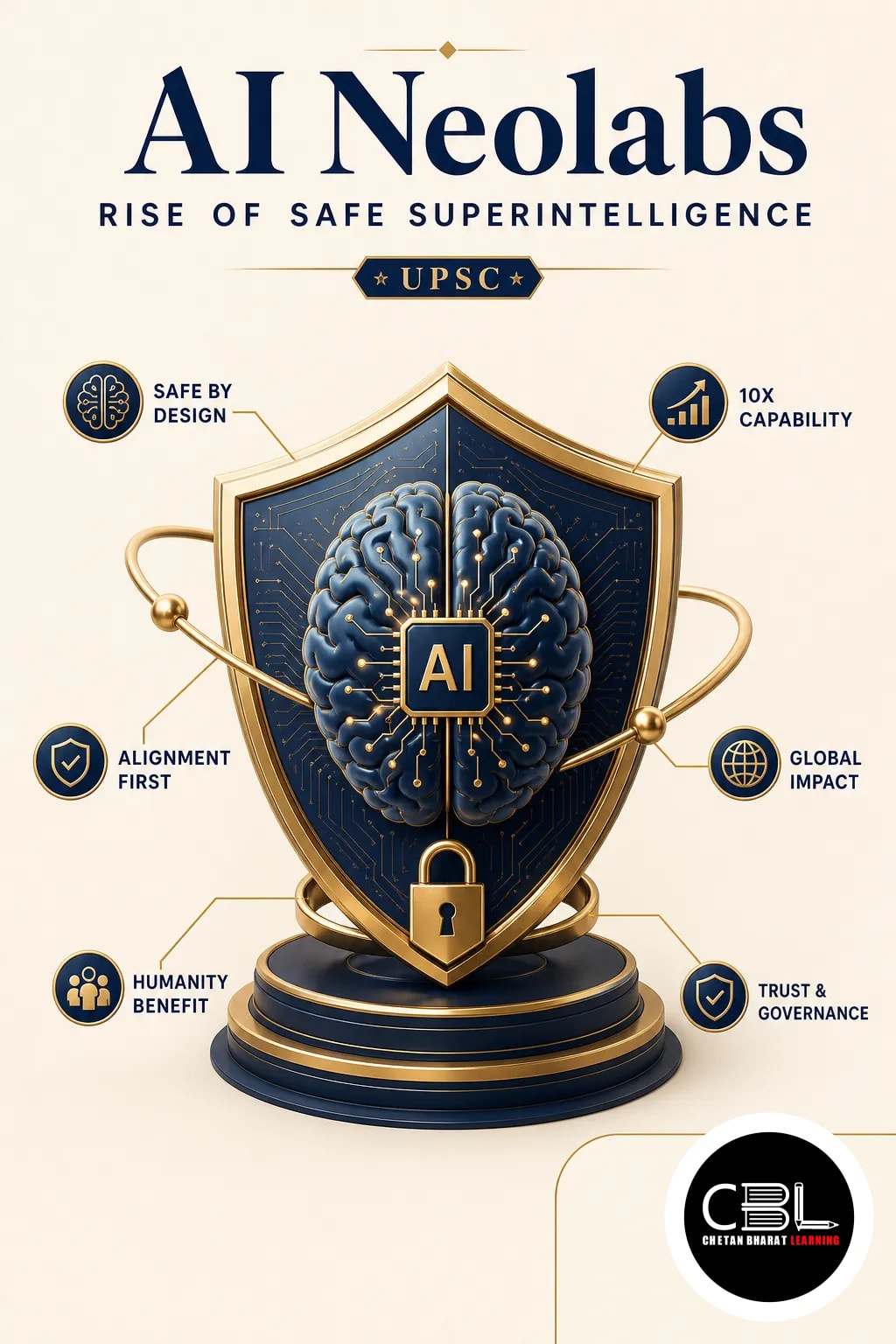

AI Neolabs are emerging as an important force in advanced artificial intelligence research as leading scientists leave established technology companies to build independent laboratories. These organisations pursue frontier AI capabilities, fundamental scientific breakthroughs and, in several cases, the development of safe superintelligence. Their growing influence has raised important questions about AI safety, research funding, technological competition and responsible governance. For related developments, explore the daily current affairs archive.
A recent industry assessment identified approximately 29 independent AI research laboratories that collectively attracted about $23 billion in funding over two years. Fewer than 35% had released commercial products, indicating substantial investor confidence in long-term research even before proven commercial outcomes.
What Are AI Neolabs?
AI Neolabs are newly established, independent research-focused organisations that develop advanced artificial intelligence systems. Experienced AI scientists often establish them after leaving major technology companies or established model developers.
Unlike many conventional technology startups, these laboratories may prioritise fundamental research and long-term capability development before launching commercial products. Their work can include advanced machine learning, reasoning systems, model interpretability and methods for improving AI reliability.
The term describes an emerging industry trend rather than a formal scientific or regulatory classification. Individual laboratories pursue different objectives, and not all neolabs concentrate exclusively on superintelligence or AI alignment.
Why in News?
Recent reports have highlighted increasing investment in independent frontier AI laboratories. A count associated with Radical Ventures identified 29 such organisations established over approximately two years, while industry reporting placed their combined fundraising near $23 billion.
Despite these investments, fewer than 35% had introduced commercial offerings. Slightly more than half had released publicly accessible code, sometimes only through research demonstrations. These figures illustrate the unusual relationship between scientific ambition, commercial uncertainty and venture capital in frontier AI development.
The emergence of independent laboratories also reflects intense competition for experienced researchers and specialised computing infrastructure. Investors increasingly fund teams based on their technical expertise and potential to produce major breakthroughs.
Sources: Business Standard industry analysis and Dealroom research summary.
Key Features of Independent AI Research Laboratories
- Research-driven approach: Laboratories invest in advanced algorithms, foundational models and scientific experimentation without necessarily seeking immediate profits.
- Long-term innovation: Research programmes may pursue capabilities that require extensive experimentation and substantial computing resources.
- Specialised talent: Leading researchers bring expertise in model training, neural networks, reasoning and evaluation from established institutions.
- Significant private financing: Venture capital and strategic investments support research teams, specialised computing infrastructure and large training experiments.
- AI alignment research: Some laboratories investigate how increasingly capable systems can remain consistent with human goals and safety requirements.
- Flexible organisational structures: Independent laboratories may pursue research agendas without the same product schedules as large technology companies.
Prominent Examples
| Laboratory | Founder | Principal Focus |
|---|---|---|
| Safe Superintelligence Inc. (SSI) | Ilya Sutskever and co-founders | Development of safe superintelligence |
| Thinking Machines Lab | Mira Murati and co-founders | Advanced AI systems, customisation and human-AI collaboration |
Safe Superintelligence Inc. began operations in June 2024 with a stated objective of developing superintelligence while prioritising safety. The organisation has attracted substantial investment despite its research-first strategy.
Thinking Machines Lab, established by former OpenAI chief technology officer Mira Murati, focuses on making advanced AI systems more accessible, understandable and useful. Its research agenda differs from SSI’s exclusive emphasis on safe superintelligence.
The distinction matters: although both organisations belong to the emerging neolab ecosystem, their objectives, research methods and commercial strategies are not identical.
Understanding Artificial Superintelligence
Artificial Superintelligence (ASI) refers to a hypothetical level of artificial intelligence that exceeds human capabilities across a broad range of intellectual tasks. It differs from narrow AI systems designed for specific applications.
Artificial General Intelligence (AGI) usually describes systems capable of performing a wide variety of cognitive tasks at a human-comparable level. ASI implies capabilities substantially beyond those of humans, although neither concept has a universally accepted operational definition.
AI researchers debate when, whether and how such systems might emerge. Current commercial AI capabilities should not automatically be treated as evidence that artificial superintelligence has already been achieved.
AI Alignment and Safety
AI alignment concerns developing artificial intelligence systems that behave consistently with intended human goals, instructions and relevant safety constraints. The challenge becomes more complex as systems gain autonomy and operate in unfamiliar environments.
Important research areas include interpretability, human oversight, robustness and the evaluation of potentially harmful model behaviour. Safety-oriented organisations may investigate these questions alongside improvements in model capabilities.
- Interpretability: Researchers attempt to understand how models process information and produce decisions.
- Controllability: Developers seek mechanisms that allow authorised humans to direct, correct or stop AI systems.
- Robustness: Safety evaluations examine whether models behave reliably under unexpected or adversarial conditions.
- Human oversight: Governance arrangements preserve meaningful accountability for high-impact automated decisions.
- Misuse prevention: Safeguards aim to reduce malicious applications, including fraud, manipulation and harmful cyber activities.
AI alignment remains an active research challenge rather than a fully solved engineering problem. Powerful AI systems require continuous evaluation, transparent governance and appropriate safeguards throughout their lifecycle.
Significance for India
The emergence of independent frontier laboratories offers important lessons for India’s artificial intelligence ecosystem. Domestic innovation requires research expertise, affordable computing infrastructure, specialised datasets and long-term institutional investment.
India’s IndiaAI Mission seeks to strengthen national AI capacity through computing access, innovation support, datasets, applications and responsible AI development. Independent research institutions can complement public programmes by exploring emerging technical challenges.
Universities, startups and public research organisations can also contribute to AI safety research. Collaboration between these institutions may help India develop more reliable systems for healthcare, agriculture, education and public administration.
AI governance should remain sensitive to India’s linguistic diversity, public-service requirements and socioeconomic conditions. Research capacity must support both advanced technological innovation and practical social applications.
Additional information about national technology initiatives is available through the Ministry of Electronics and Information Technology and the IndiaAI portal.
Challenges Associated with AI Neolabs
- High research costs: Advanced model training requires expensive computing resources, electricity, infrastructure and specialised personnel.
- Commercial uncertainty: Large investments may not translate into commercially successful products or sustainable revenue.
- Concentration of resources: Access to specialised chips, computing facilities and capital can favour a small group of organisations.
- Safety verification: Demonstrating that increasingly capable systems are reliable and aligned remains technically difficult.
- Limited transparency: Some proprietary research programmes provide little public information about evaluation methods or safety performance.
- Regulatory uncertainty: Governments must balance scientific freedom, innovation incentives, public accountability and the prevention of harmful applications.
Way Forward
Governments should encourage independent AI research while developing risk-based governance frameworks that distinguish low-risk applications from potentially dangerous systems. Safety evaluation and accountability should remain important throughout the development process.
India can strengthen its research ecosystem through sustained university funding, shared computing resources, interdisciplinary collaboration and support for responsible innovation. Independent testing and clear disclosure expectations can improve public confidence without unnecessarily restricting scientific discovery.
International cooperation on AI safety standards, evaluation methods and scientific research is equally important. Policymakers must recognise that AI capabilities and associated risks increasingly extend across national boundaries.
The rise of AI Neolabs therefore represents both an opportunity for scientific progress and a challenge for technology governance. Their long-term significance will depend on whether advanced research produces demonstrable benefits while maintaining effective human oversight.
Readers can follow related technology developments through the CBL current affairs platform.
Punjab PCS and Haryana HCS aspirants should connect independent AI research with emerging technologies, ethical governance, digital public services and India’s innovation ecosystem. State-level applications in agriculture, education, healthcare and citizen services offer practical examples of responsible AI deployment. Questions may also address algorithmic accountability, digital inclusion and the role of public institutions in supporting technological research.
Frequently Asked Questions
What are AI neolabs and why are they gaining importance?
AI neolabs are independent laboratories established to pursue advanced artificial intelligence research. They are attracting attention because prominent scientists and investors are supporting long-term research programmes that may produce major technological breakthroughs.
What is the difference between artificial general intelligence and artificial superintelligence?
Artificial general intelligence generally refers to broad cognitive capabilities comparable to human intelligence. Artificial superintelligence refers to hypothetical systems that substantially exceed human capabilities across many intellectual domains.
Why are AI neolabs relevant to UPSC preparation?
The topic connects with emerging technologies and innovation under GS Paper III, governance and international cooperation under GS Paper II, and ethics, accountability and human values under GS Paper IV. It also provides contemporary examples for questions on responsible technological development.
Related Current Affairs
Preparing for UPSC, PCS or HCS?
Talk to a mentor at Chetan Bharat Learning, Chandigarh. Free guidance on choosing the right exam and building a study plan.
Chat on WhatsAppCall 97793 53345UPSC / IAS / PCS coaching in Chandigarh · Trusted by aspirants across Punjab & Haryana
Leave a Reply
You must be logged in to post a comment.