

UPSC Mapping
| Exam Stage | Relevance |
|---|---|
| Prelims | ISRO, GSAT-7 series, communication satellites, geostationary orbit |
| Mains | GS Paper 3: Science and Technology, Defence and Internal Security |
Article
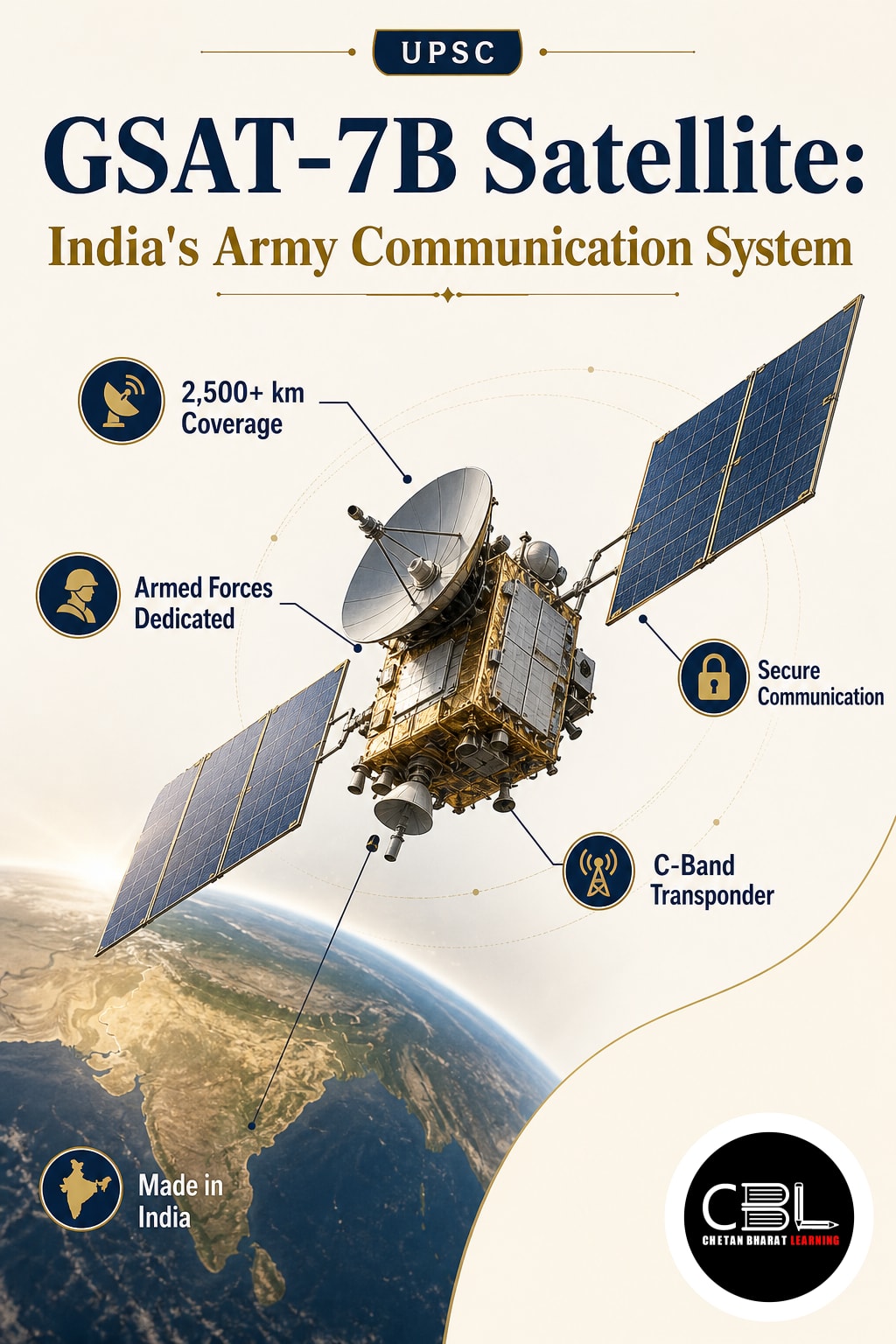
The GSAT-7B Satellite, India’s first dedicated communication satellite planned specifically for the Indian Army, has attracted attention amid efforts to modernise military communication infrastructure. According to the reported development, the Indian Space Research Organisation (ISRO) is expected to launch the satellite around mid-2028. The project aims to strengthen secure communication, surveillance coordination and operational connectivity for the Army. It is particularly relevant for UPSC current affairs preparation under space technology, defence modernisation and national security.
The satellite forms part of the GSAT-7 series of military communication satellites. Its planned deployment reflects India’s growing emphasis on indigenous space-based infrastructure to support defence operations.
What is the GSAT-7B Satellite?
GSAT-7B is a proposed dedicated military communication satellite being developed to meet the operational communication requirements of the Indian Army. It belongs to the GSAT-7 family, which supports specialised communication requirements of India’s defence services.
According to the supplied report, the satellite is expected to operate in a geostationary orbit. Such an orbit allows continuous communication coverage over a designated geographical region.
It is intended to improve communications among Army units, including formations operating in difficult terrain. Secure and dependable satellite connectivity can help commanders communicate effectively across large distances.
Unlike Earth observation satellites, which primarily collect imagery and other measurements, a communication satellite principally relays signals. Surveillance information from other systems may use these links, but GSAT-7B should not be described as a dedicated imaging satellite.
Why in News?
The Indian Army is strengthening its communication infrastructure through the proposed satellite. The reported launch schedule places the mission around mid-2028, although the final date remains subject to official confirmation.
The satellite is expected to provide improved communication support for military units, command centres and operational formations. It could reduce dependence on terrestrial networks in areas where conventional infrastructure is unreliable.
The development also reflects the wider integration of space-based capabilities into military operations. Satellite communication increasingly supports information exchange, operational awareness and coordinated decision-making.
Key Features of GSAT-7B
- Dedicated Army communications: The satellite is intended to provide communication services tailored to the operational requirements of the Indian Army.
- Geostationary operation: Its planned orbital position is expected to support continuous connectivity over a broad geographical region.
- Secure information exchange: Dedicated satellite links can strengthen communication reliability and support protected military information transfer.
- Operational coordination: It is expected to assist communication between command centres and widely dispersed military formations.
- Support in difficult terrain: Satellite links are particularly valuable where mountains, remote locations and damaged ground networks restrict communication.
- Integration with military systems: Communication infrastructure can connect operational units and support the exchange of information from other defence platforms.
- Indigenous development: ISRO’s role contributes to India’s efforts to develop strategic space technologies domestically.
GSAT-7 Series: Important Satellites
The GSAT-7 family includes communication satellites intended to meet specialised defence requirements. For UPSC Prelims, aspirants should understand the differences among the major members of this series.
| Satellite | Important Details |
|---|---|
| GSAT-7 (Rukmini) | Launched on 30 August 2013 by an Ariane 5 rocket from French Guiana. It primarily supports Indian Navy communications. |
| GSAT-7A | Launched on 19 December 2018. It primarily supports communications for the Indian Air Force, including communication links relevant to UAV operations. |
| GSAT-7B | Planned dedicated communication satellite for the Indian Army, with a launch around mid-2028 according to the supplied report. |
| GSAT-7R (CMS-03) | Launched in November 2025 as a replacement for Rukmini, supporting the Navy’s communication requirements. |
The series demonstrates the increasing importance of specialised communication networks for different defence services. Each mission contributes to the broader development of indigenous strategic space infrastructure.
Understanding Geostationary Orbit
A geostationary orbit is a circular orbit above Earth’s equator in which a satellite travels in the same direction as Earth’s rotation. Its orbital period matches Earth’s sidereal rotation period.
Such satellites operate at an altitude of approximately 35,786 kilometres above Earth’s surface. They appear nearly stationary relative to an observer on the ground.
This characteristic makes geostationary satellites valuable for communications because ground antennas can maintain alignment with a fixed position in the sky. Their broad geographical coverage can support television broadcasting, telecommunications and strategic communications.
Geostationary satellites also face limitations, including communication latency and reduced visibility at high latitudes. Mission planners must balance these constraints against their advantages in continuous regional coverage.
Significance for India’s Defence Preparedness
1. Strengthening Command and Control
Modern military operations require rapid communication among commanders and deployed units. Dedicated satellite connectivity can make information exchange more reliable across dispersed formations.
Improved connectivity may strengthen situational awareness and support timely operational decisions, especially when conventional infrastructure becomes unavailable.
2. Supporting Remote and Border Operations
Indian Army personnel operate in mountainous, remote and strategically sensitive regions. These environments can present significant difficulties for ground-based communication systems.
Satellite communications offer an alternative channel for maintaining connectivity across difficult terrain. They may also support military coordination during emergencies and disrupted infrastructure conditions.
3. Defence Space Self-Reliance
Developing dedicated communication infrastructure through ISRO supports Aatmanirbhar Bharat in strategic technologies. Domestic capabilities can reduce reliance on externally controlled communication infrastructure.
Self-reliance also requires secure ground stations, reliable terminals, technical expertise and sustained maintenance capabilities.
4. Joint and Network-Centric Operations
Network-centric operations rely on exchanging relevant information among multiple platforms and operational units. Satellite systems can provide important links within such networks.
Effective integration requires compatible communication procedures and secure handling of operational information. For wider context, aspirants can consult the Indian Space Research Organisation and the Ministry of Defence.
Challenges in Military Satellite Communications
- Cybersecurity threats: Ground infrastructure and communication networks require protection against cyberattacks and unauthorised access.
- Signal interference: Satellite communication systems must withstand accidental interference and deliberate attempts to disrupt transmissions.
- Space debris: Growing orbital congestion creates long-term challenges for spacecraft safety and sustainable space operations.
- Technical complexity: Military communication satellites require dependable spacecraft systems, ground terminals and operational support infrastructure.
- Launch uncertainty: Development schedules can change because of technical validation, manufacturing and launch-readiness requirements.
- System integration: New space-based networks must work effectively with existing command and communication arrangements.
Way Forward
- Strengthen indigenous capabilities: Continue developing secure communication payloads, ground infrastructure and military satellite technologies.
- Build resilient networks: Combine satellite communications with alternative terrestrial systems to reduce single-point failures.
- Improve cybersecurity: Strengthen protective measures across spacecraft communication links and supporting ground networks.
- Promote service integration: Support appropriate coordination among the Army, Navy, Air Force and relevant space agencies.
- Invest in technical expertise: Develop specialised skills in satellite operations, secure communications and space system maintenance.
- Ensure operational readiness: Conduct rigorous testing and establish reliable arrangements for deployment, maintenance and system upgrades.
The proposed mission represents another step towards integrating space technology with India’s defence requirements. Its eventual effectiveness will depend on secure connectivity, reliable ground infrastructure and successful operational integration.
Prelims Package
Q1. GSAT-7B is primarily intended to serve which branch of the Indian Armed Forces?
(a) Indian Navy (b) Indian Air Force (c) Indian Army (d) Indian Coast Guard
Answer: (c). GSAT-7B is planned as a dedicated communication satellite for the Indian Army.
Q2. Which Indian satellite is also known as Rukmini?
(a) GSAT-7 (b) GSAT-7A (c) GSAT-7B (d) GSAT-6
Answer: (a). GSAT-7, launched in 2013, is also known as Rukmini and primarily supported Indian Navy communications.
Q3. Consider the following statements about geostationary satellites: 1. They orbit approximately 35,786 km above Earth’s surface. 2. Their orbital plane coincides with the equatorial plane. 3. They appear nearly stationary relative to an observer on Earth. Which statements are correct?
(a) 1 and 2 only (b) 2 and 3 only (c) 1 and 3 only (d) 1, 2 and 3
Answer: (d). All three statements describe the essential characteristics of a geostationary satellite.
Q4. GSAT-7A is primarily associated with the communication requirements of which service?
(a) Indian Navy (b) Indian Air Force (c) Border Security Force (d) Central Reserve Police Force
Answer: (b). GSAT-7A was developed primarily to support Indian Air Force communications.
Q5. Which of the following best describes the primary function of a military communication satellite?
(a) Manufacturing military equipment in orbit (b) Providing communication links among authorised military systems (c) Directly replacing every reconnaissance platform (d) Conducting all military operations without ground support
Answer: (b). Communication satellites relay information among connected systems and support operational coordination.
Mains Package
Q1. Discuss the strategic importance of GSAT-7B for improving the Indian Army’s communication and operational coordination. (150 words, 10 marks)
Answer Structure
Intro: Identify GSAT-7B as the proposed dedicated communication satellite for the Indian Army.
Body: Examine secure communications, command connectivity, remote operations, geostationary coverage and indigenous development.
Conclusion: Emphasise reliable, secure and integrated military communication infrastructure.
Q2. Space-based communication systems have become critical components of modern defence preparedness. Examine their strategic advantages and associated technological challenges in the Indian context. (250 words, 15 marks)
Answer Structure
Intro: Explain the growing role of space infrastructure in network-centric military operations.
Body: Discuss continuous connectivity, situational awareness, operational coordination and strategic self-reliance. Analyse cyber threats, interference, orbital congestion, technical dependencies and integration challenges.
Conclusion: Recommend indigenous innovation, resilient communication architecture and effective inter-service coordination.
FAQs
What is GSAT-7B?
GSAT-7B is India’s planned dedicated military communication satellite for the Indian Army. It is expected to support secure communication and operational coordination among military formations.
When is GSAT-7B expected to be launched?
The supplied October 2026 report indicates a proposed launch around mid-2028. This is an expected schedule rather than confirmation of a completed launch.
Which Indian satellites are associated with different defence services?
GSAT-7 primarily supported the Indian Navy, while GSAT-7A primarily serves Indian Air Force communications. GSAT-7B is intended for the Indian Army, and GSAT-7R is associated with the Navy’s next-generation communication requirements.
Related Current Affairs
Preparing for UPSC, PCS or HCS?
Talk to a mentor at Chetan Bharat Learning, Chandigarh. Free guidance on choosing the right exam and building a study plan.
Chat on WhatsAppCall 97793 53345UPSC / IAS / PCS coaching in Chandigarh · Trusted by aspirants across Punjab & Haryana
Leave a Reply
You must be logged in to post a comment.