
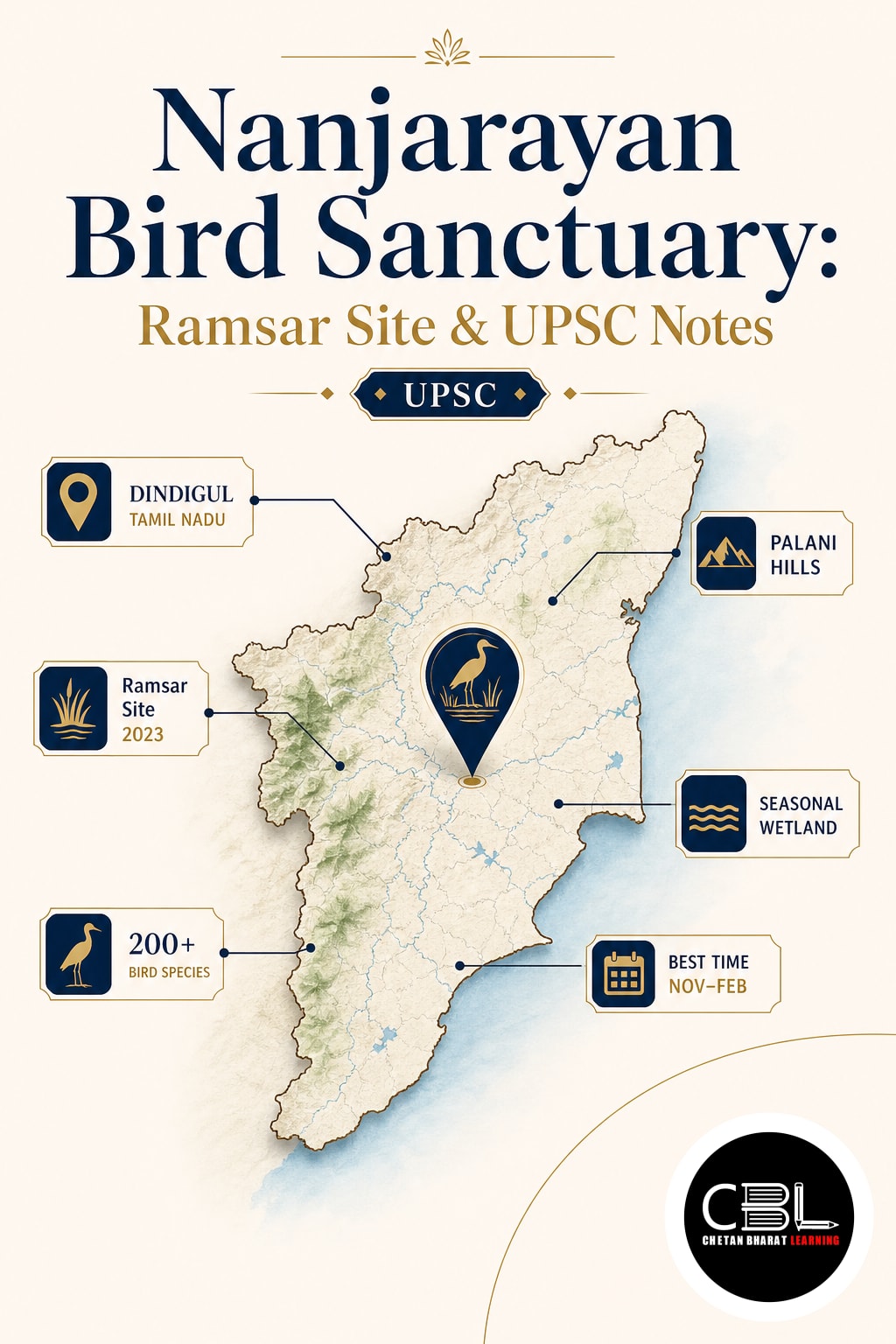

UPSC Mapping
| Parameter | Details |
|---|---|
| Location | Tiruppur, Tamil Nadu |
| Area | 125.865 hectares |
| Ramsar Designation | 16 January 2024 |
| Wetland Type | Permanent Freshwater Lake |
Article
Nanjarayan Bird Sanctuary in Tiruppur district, Tamil Nadu, has attracted attention over concerns about delays in its conservation and infrastructure development following its notification as a bird sanctuary. The wetland, which received Ramsar recognition in 2024, is an important habitat for resident and migratory birds. Its ecological significance makes it relevant for UPSC current affairs preparation, particularly biodiversity, wetland conservation and environmental governance.
The sanctuary supports diverse wildlife, contributes to local groundwater recharge and serves as an important bird habitat along the Central Asian Flyway. Its conservation highlights the need to translate protected-area notifications into effective on-ground management.
Location and Key Features
The sanctuary is a large, shallow freshwater wetland situated in Uthukuli taluk of Tiruppur district. It lies approximately 10 kilometres north of Tiruppur city along the Tiruppur-Uthukuli road.
- State: Tamil Nadu, in southern India.
- District: Tiruppur, within the Uthukuli region.
- Historical origin: The reservoir is associated with restoration undertaken by King Nanjarayan centuries ago.
- Primary water source: The Nallar River supplies water to the lake, supplemented by seasonal rainfall.
- River system: Nallar is associated with the Noyyal River basin, which forms part of the Cauvery river system.
- Ecological classification: Inland freshwater wetland supporting aquatic habitats and surrounding vegetation.
- Conservation status: Notified as a bird sanctuary in 2022 and designated a Ramsar Site in 2024.
- Migratory importance: The sanctuary lies along the Central Asian Flyway and supports resident and migratory birds.
Why in News?
Recent reporting has questioned the pace of improvements at the sanctuary more than four years after its 2022 notification. Concerns relate to whether conservation management and visitor facilities have developed sufficiently to support its ecological importance.
The sanctuary’s recognition under the Ramsar Convention provides an additional reason to prioritise effective wetland management. International recognition identifies ecological significance but does not automatically guarantee adequate infrastructure or conservation outcomes.
The development highlights a broader environmental governance challenge: protected areas require sustained monitoring, adequate funding and participation from surrounding communities after formal notification.
Biodiversity of Nanjarayan Bird Sanctuary
The sanctuary supports remarkable biodiversity despite its relatively limited geographical area. According to government documentation, the wetland contains several important groups of aquatic and terrestrial organisms.
| Biodiversity Group | Recorded Species |
|---|---|
| Birds | 191 |
| Butterflies | 87 |
| Amphibians | 7 |
| Reptiles | 21 |
| Mammals | 11 |
| Plants | 77 |
The wetland supports species such as the Indian darter and Indian cormorant. Trees and vegetation along the reservoir bunds provide nesting and roosting opportunities.
Ecological and Strategic Significance
1. Importance for Migratory Birds
The sanctuary lies along the Central Asian Flyway, one of the major migratory bird routes connecting breeding and non-breeding habitats across Eurasia.
2. Breeding and Feeding Habitat
The shallow lake provides food and shelter for resident waterbirds. Vegetated bunds and different water depths create varied ecological niches.
3. Groundwater Recharge and Irrigation
The reservoir also supports local water management by contributing to groundwater recharge and irrigation.
4. Ecosystem Services
Wetlands provide services such as nutrient cycling, habitat maintenance and local hydrological regulation. They can also support environmental education and nature-based recreation.
Ramsar Convention and the Sanctuary
The Ramsar Convention on Wetlands is an international treaty adopted in 1971 at Ramsar, Iran. It promotes the conservation and wise use of wetlands through national action and international cooperation.
India became a contracting party to the convention in 1982. Ramsar designation recognises wetlands that fulfil internationally agreed ecological criteria.
Nanjarayan Bird Sanctuary received its Ramsar designation effective 16 January 2024. It is identified as Ramsar Site number 2549 in the international Ramsar Sites Information Service.
Threats and Conservation Challenges
- Management delays: Slow development of conservation facilities can limit effective monitoring and visitor management.
- Water pollution: Untreated runoff and waste may affect wetland water quality and aquatic organisms.
- Habitat disturbance: Excessive human activity near breeding and feeding zones may disturb birds.
- Seasonal water variation: Changes in rainfall and inflow can alter the availability of suitable shallow-water habitats.
- Invasive species: Uncontrolled invasive vegetation may affect habitat structure and ecological balance.
- Institutional coordination: Wetland protection requires cooperation among forest, water-management and local administrative agencies.
Conservation and Policy Measures
- Strengthen wetland monitoring: Conduct regular assessments of water quality, bird populations and habitat conditions.
- Protect breeding sites: Identify sensitive nesting areas and minimise disturbance during important breeding periods.
- Improve water management: Maintain appropriate water conditions while considering local irrigation and groundwater needs.
- Develop responsible facilities: Provide essential conservation infrastructure without damaging the sanctuary’s ecological character.
- Encourage community participation: Involve local residents in wetland protection, awareness campaigns and responsible tourism.
- Implement Ramsar principles: Integrate ecological monitoring and wise-use practices into long-term management plans.
Prelims Package
Important for: Prelims: Ramsar Sites, Tamil Nadu Wetlands, Bird Sanctuaries and Central Asian Flyway
| Quick Fact | Details |
|---|---|
| Location | Tiruppur, Tamil Nadu |
| Area | 125.865 hectares |
| Ramsar Designation | 16 January 2024 |
| Wetland Type | Permanent Freshwater Lake |
- The sanctuary is located in Tiruppur district, Tamil Nadu, approximately 10 kilometres north of Tiruppur city.
- It lies along the Central Asian Flyway and offers feeding, resting and breeding habitats for waterbirds.
- It supports approximately 191 recorded bird species.
- The Nallar River contributes water to the wetland.
Mains Package
GS Paper 3: Biodiversity, Environment and Conservation
Answer Structure for Q1
- Intro: Identify the sanctuary’s location, freshwater wetland character and Ramsar status.
- Body: Discuss bird diversity, Central Asian Flyway connectivity, breeding habitats, groundwater recharge and local ecosystem services.
- Conclusion: Emphasise effective habitat management and long-term wetland protection.
Answer Structure for Q2
- Intro: Explain the purpose of Ramsar designation and the wise-use principle.
- Body: Examine ecological monitoring, habitat threats, infrastructure development, community participation and institutional coordination. Use Nanjarayan Bird Sanctuary as a case study.
- Conclusion: Recommend measurable conservation outcomes and integrated wetland governance.
FAQs
Where is Nanjarayan Bird Sanctuary located?
The sanctuary is located in Tiruppur district, Tamil Nadu, approximately 10 kilometres north of Tiruppur city. It lies within the Uthukuli region near Sarkar Periyapalayam and Neruperichal villages.
Is Nanjarayan Bird Sanctuary a Ramsar Site?
Yes. The sanctuary received Ramsar designation effective 16 January 2024 and is internationally recognised as Ramsar Site number 2549. Its recognised wetland area is approximately 125.865 hectares.
Why is the sanctuary important for migratory birds?
It lies along the Central Asian Flyway and offers feeding, resting and breeding habitats for waterbirds. Its freshwater habitats support approximately 191 recorded bird species.
Related Current Affairs
Preparing for UPSC, PCS or HCS?
Talk to a mentor at Chetan Bharat Learning, Chandigarh. Free guidance on choosing the right exam and building a study plan.
Chat on WhatsAppCall 97793 53345UPSC / IAS / PCS coaching in Chandigarh · Trusted by aspirants across Punjab & Haryana
Leave a Reply
You must be logged in to post a comment.