

UPSC Mapping
| Prelims | Malla Dynasty, Newar Architecture, Kathmandu Valley, UNESCO Heritage |
|---|---|
| Mains | GS Paper 1: Art and Culture; GS Paper 2: India-Nepal Relations |
Article
Taleju Bhawani Temple in Kathmandu, Nepal, opened to devotees on 20 October 2026 on the occasion of Maha Navami, an important day of the Dashain festival. The historic shrine traditionally permits public worship only once annually, attracting thousands of devotees. Its significance extends beyond religion to Nepal’s Malla dynasty, Newar architectural traditions and UNESCO-listed heritage. The development is relevant for UPSC current affairs preparation, particularly Art and Culture and India-Nepal relations.
The temple stands within the historic Hanuman Dhoka palace complex at Kathmandu Durbar Square. Its annual opening reflects the continuity of religious traditions associated with Nepal’s former royal courts.
Location and Key Features
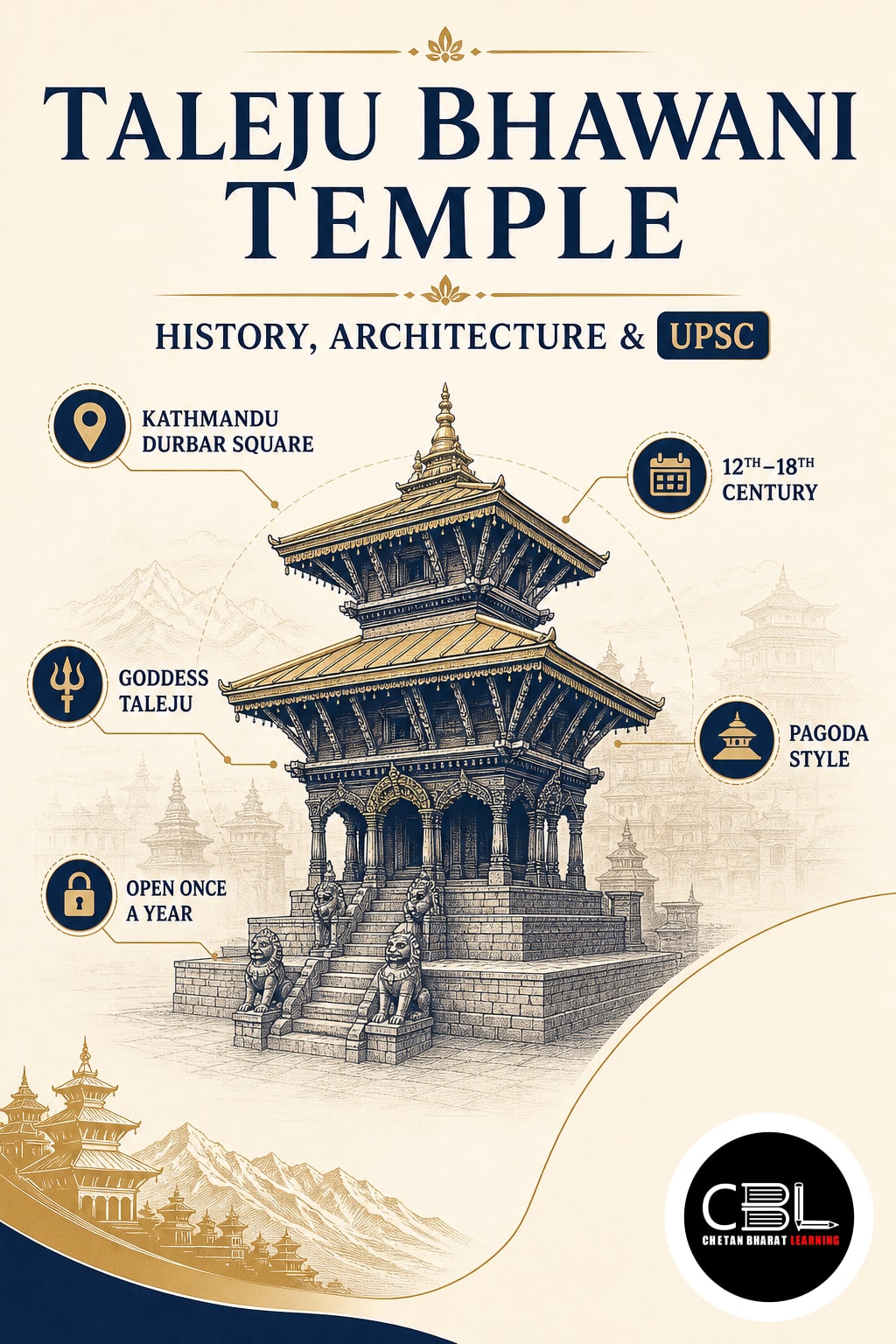
The shrine is located within Hanuman Dhoka Durbar Square in Nepal’s capital, Kathmandu. This historic palace precinct forms part of the UNESCO World Heritage property known as Kathmandu Valley.
King Mahendra Malla constructed the present temple in 1564 CE. It became an important centre of royal worship associated with the Malla rulers of the Kathmandu Valley.
The temple honours Goddess Taleju Bhawani, regarded as a manifestation of Goddess Durga. She served as the tutelary or patron deity of the Malla kings.
Its elevated structure, traditional wooden craftsmanship and distinctive roof arrangement make it an important example of Nepalese temple architecture.
Why in News?
On 20 October 2026, the historic temple opened to the general public for Maha Navami during Nepal’s Dashain celebrations. The shrine traditionally remains closed to ordinary visitors during the rest of the year.
The Hanuman Dhoka Durbar Care Office announced arrangements for public worship between 5 AM and 6 PM. Devotees gathered to offer prayers and participate in the annual religious observance.
The celebrations also involved ceremonial movements of the deity within the palace complex, including rituals associated with Mul Chowk. The annual occasion preserves a longstanding relationship between royal traditions and public religious life.
Contemporary reports from Akashvani News and Nepal News documented the 2026 public opening.
Taleju Bhawani Temple Architecture
The shrine is a significant example of Newar pagoda architecture, a distinctive architectural tradition of the Kathmandu Valley. The Newar communities developed sophisticated craftsmanship involving timber, brick, metal and decorative sculpture.
Multi-Tiered Pagoda Structure
The temple features a three-storey arrangement crowned by tiered roofs. This design produces a pyramidal profile through projecting eaves and progressively smaller upper levels.
The pagoda form differs from the curvilinear shikhara traditionally associated with many North Indian temples. It represents a regional architectural tradition shaped by Nepal’s history and craftsmanship.
Twelve-Level Elevated Foundation
The temple stands on a prominent elevated platform consisting of twelve plinth levels. This raised foundation increases its visibility within the surrounding palace precinct.
The elevated arrangement also reinforces the monument’s ceremonial importance. Visitors can recognise the temple as a major landmark of Kathmandu Durbar Square.
Wooden Carvings and Decorative Elements
Traditional wooden construction and ornamentation form important elements of the structure. Elaborate carved supports and projecting roof edges demonstrate the skills associated with Newar artisans.
Decorative details reflect a close relationship between architecture, craftsmanship and religious symbolism. The building therefore provides evidence of both artistic achievement and historical patronage.
Golden Architectural Details
Gilded ornamental features contribute to the temple’s distinctive appearance. Their use reflects the importance of ceremonial decoration in royal religious architecture.
The structure combines brick construction with timber and metal elements. This combination characterises several historic buildings of Nepal’s Kathmandu Valley.
Shri Yantra and Sacred Geometry
Local traditions associate the temple’s construction with the Shri Yantra, a sacred geometric diagram linked to Shakta religious practices. The association belongs to the temple’s religious and architectural tradition.
Such symbolism demonstrates how sacred geometry can influence the interpretation of religious spaces. It should be distinguished from independently verified structural measurements or engineering plans.
Historical and Cultural Significance
The Malla period contributed substantially to temple construction, palace architecture and artistic patronage in the Kathmandu Valley. Rulers supported religious institutions that became important elements of public and courtly life.
Goddess Taleju occupied a particularly important position as the royal patron deity. Her worship connected political authority with religious traditions and ceremonial practices.
The temple’s annual opening during Maha Navami illustrates the continuity of rituals beyond the period of Malla rule. Such practices contribute to the region’s intangible cultural heritage.
The shrine also demonstrates historical cultural connections across South Asia. Traditions associated with Goddess Durga and Shakta worship appear in different regional forms across India and Nepal.
For UPSC, the monument provides an example of how architecture, political history and religious traditions can be studied together. Aspirants should also review related history and culture current affairs.
UNESCO Heritage and Conservation
The temple forms part of the Kathmandu Durbar Square monument zone within the UNESCO-listed Kathmandu Valley property. The World Heritage recognition covers a wider ensemble of historically significant sites rather than treating this individual temple as a separate World Heritage property.
The area’s cultural value arises from its architectural diversity, urban history and living religious traditions. UNESCO documentation also emphasises the importance of conserving the region’s historic monuments.
Conservation must balance preservation of original architectural features with continued religious use. Traditional construction materials and skilled craftsmanship are particularly relevant to maintaining architectural authenticity.
Aspirants can consult UNESCO’s Kathmandu Valley World Heritage listing for official heritage information.
Threats to Historic Heritage
- Seismic vulnerability: Earthquakes present a major conservation risk to historic structures in the Kathmandu Valley.
- Material deterioration: Weather exposure and ageing can affect wooden, brick and metal architectural components.
- Urban pressure: Development and increasing activity around historic monuments may create preservation challenges.
- Visitor management: Large gatherings during annual religious events require careful arrangements to protect visitors and heritage structures.
- Specialised restoration: Conservation work needs skilled artisans familiar with traditional Newar construction methods.
- Authenticity concerns: Repairs must protect original architectural character while meeting necessary safety requirements.
Conservation and Policy Measures
Effective heritage protection requires coordination among archaeological authorities, local communities and temple management institutions. Conservation strategies should address both physical structures and continuing cultural practices.
- Scientific conservation: Structural assessments and appropriate restoration methods can help protect vulnerable historic elements.
- Traditional craftsmanship: Skilled artisans should participate in repairs involving specialised wooden carvings and architectural details.
- Disaster preparedness: Heritage management plans should consider earthquakes, fire and other potential emergencies.
- Community participation: Local stakeholders and religious custodians play an important role in maintaining living heritage.
- Responsible tourism: Visitor management can reduce physical pressure on sensitive heritage sites.
- Documentation: Detailed architectural records can assist restoration and preserve knowledge for future generations.
The continued importance of Taleju Bhawani Temple demonstrates how historic monuments function as living cultural institutions. Its preservation requires safeguarding architectural authenticity alongside the traditions that give the site social meaning.
For Punjab PCS and Haryana HCS, this topic is relevant to South Asian temple architecture, UNESCO World Heritage Sites and the historical relationship between religion and political authority. Aspirants should remember the temple’s location, Malla dynasty association, construction under Mahendra Malla and Newar pagoda design. The topic also offers a useful comparison between Indian and Nepalese architectural traditions.
Prelims Package
Mains Package
FAQs
Where is Taleju Bhawani Temple located?
The temple is located within Hanuman Dhoka Durbar Square in Kathmandu, Nepal. The site forms part of the UNESCO-listed Kathmandu Valley World Heritage property.
Which ruler constructed Taleju Bhawani Temple?
King Mahendra Malla constructed the present temple in 1564 CE. The shrine is historically associated with the Malla dynasty’s royal worship of Goddess Taleju.
Why is the temple opened only once a year?
The restriction follows the temple’s longstanding religious and royal traditions. General public access is traditionally permitted on Maha Navami during the Dashain festival.
Related Current Affairs
Preparing for UPSC, PCS or HCS?
Talk to a mentor at Chetan Bharat Learning, Chandigarh. Free guidance on choosing the right exam and building a study plan.
Chat on WhatsAppCall 97793 53345UPSC / IAS / PCS coaching in Chandigarh · Trusted by aspirants across Punjab & Haryana
Leave a Reply
You must be logged in to post a comment.