
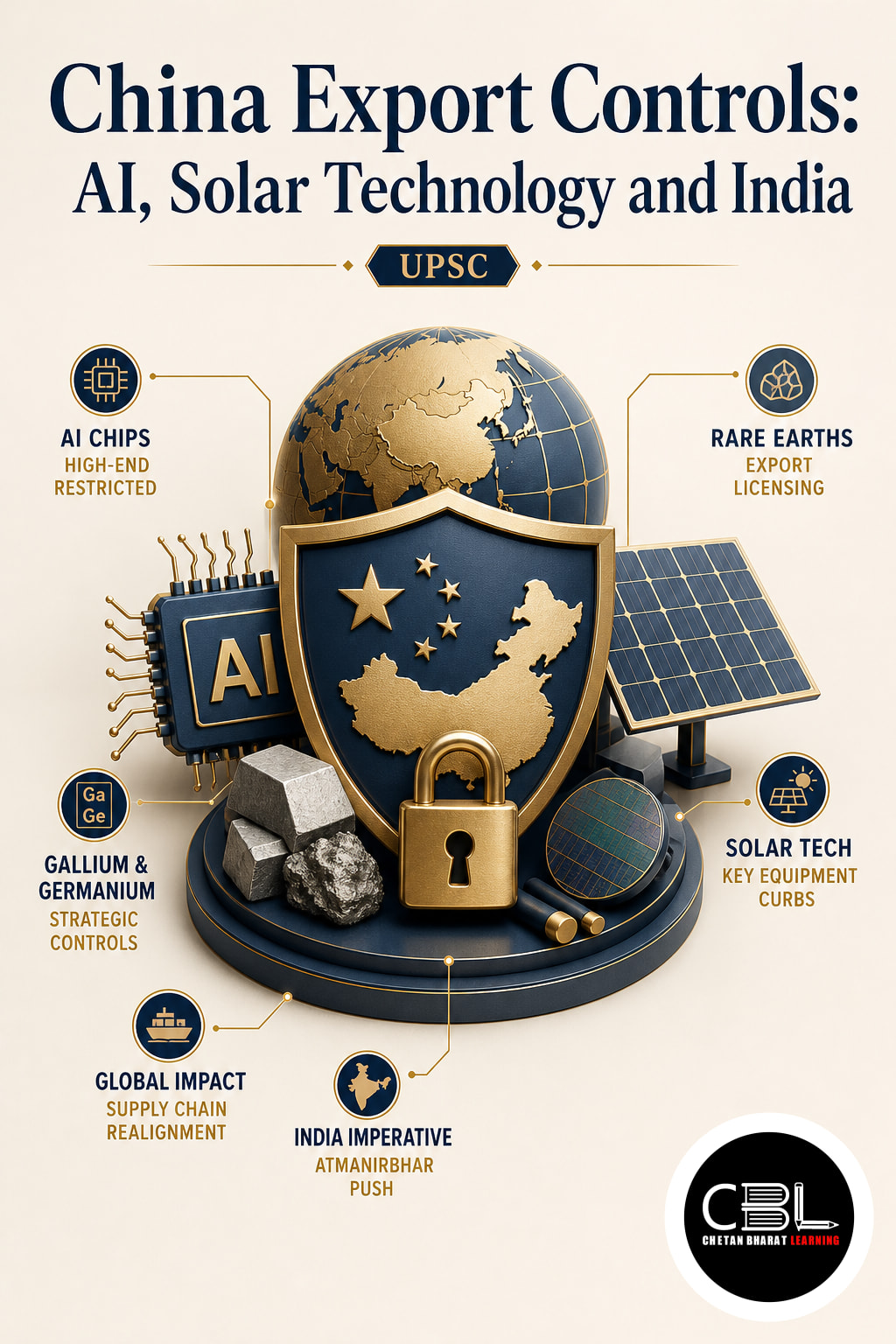

UPSC Mapping
Prelims
Export controls, photovoltaic supply chains, AI and biotechnology
Mains
GS Paper II: International Relations; GS Paper III: Technology, Industry and Energy
Quick Facts
| Announcement | 16 October 2026 |
|---|---|
| Proposed coverage | 40 technologies |
| Proposed treatment | 14 prohibited; 26 restricted |
Article
What are China Export Controls?
The latest proposal would expand restrictions on transferring specified technologies outside China. Its scope includes technical knowledge and manufacturing capabilities, rather than a blanket prohibition on every associated product. This distinction matters for overseas factories that depend on licensed processes or cooperation with Chinese firms.
An export prohibition would prevent transfers covered by a listed category. A restriction generally subjects covered transfers to regulatory scrutiny and permission under applicable rules. The exact consequences depend on the final text, technical definitions and implementation procedures.
China’s Ministry of Commerce and Ministry of Science and Technology announced the draft on 16 October 2026. The newspaper identifies it as Announcement No. 48. Its proposed catalogue changes should not be presented as a final blanket ban already covering all AI systems or solar exports.
Key Outcomes
- Proposed prohibitions: The draft identifies 14 technologies for an export ban, including specified advanced solar processes and certain AI and biotechnology capabilities.
- Restricted categories: Another 26 technologies would face export restrictions rather than automatic prohibition.
- Photovoltaic coverage: Twelve proposed additions concern technologies across polysilicon production, wafer manufacturing and solar-cell production.
- AI coverage: Twenty-three technologies involve areas including foundation models, intelligent agents, computing clusters and information processing.
- Biotechnology coverage: Certain cell- and gene-therapy platforms also fall within the proposal.
- Security rationale: Chinese authorities cite national security, sensitive applications and risks from malicious technological use.
The article identifies perovskite and tandem-cell manufacturing know-how among proposed prohibited solar technologies. It also reports proposed restrictions on specified polysilicon engineering technologies involving production lines with annual capacity of at least 30,000 tonnes. These provisions concern defined capabilities, not every solar manufacturing activity.
For AI, the proposal includes capabilities associated with autonomous malicious-code generation and mutation. Chinese authorities distinguish such sensitive technologies from most ordinary AI exports. Reporting also identifies a public consultation period ending on 15 November 2026.
Understanding the affected technologies
Polysilicon is an important input for crystalline-silicon solar manufacturing. Producers convert it into ingots, slice these into wafers, manufacture cells and assemble modules. Access to one stage does not automatically provide the knowledge required for the entire chain.
Perovskite solar cells use materials with a particular crystal structure to absorb light. Tandem cells combine light-absorbing layers to capture different parts of the solar spectrum. These technologies offer potential efficiency gains, while commercial deployment also depends on durability and scalable production.
AI models and computing infrastructure can support both civilian innovation and sensitive applications. This dual-use character complicates regulation because broad restrictions can affect legitimate commercial and research activities. Clear technical thresholds therefore matter for predictable compliance.
Significance for India
Solar manufacturing expansion may face difficulties where Indian projects depend on covered Chinese production processes. Licensing negotiations, technical assistance and joint ventures could require additional scrutiny. This represents a potential implementation risk rather than proof that every planned Indian factory will face delays.
India’s ambition to move upstream from module assembly requires process knowledge, equipment integration and skilled personnel. Manufacturing capacity cannot expand through investment announcements alone. Firms need dependable access to technology, inputs and commercially viable production methods.
China Export Controls also highlight the difference between investment permission and technology availability. Even where an Indian project receives domestic approvals, the overseas partner may face separate restrictions on transferring know-how. Industrial planning must assess both regulatory systems.
The broader lesson concerns strategic technology dependence. India needs diversified partnerships and stronger domestic research without assuming that complete self-sufficiency is immediately achievable. Relevant policy context is available through the Ministry of New and Renewable Energy and the Ministry of Electronics and Information Technology.
Concerns
- Project uncertainty: Unclear licensing timelines can complicate financing, commissioning and production schedules.
- Supply-chain concentration: Dependence on a limited set of technology providers can reduce bargaining power and resilience.
- Innovation barriers: Restrictions may impede lawful research collaboration and the international diffusion of useful technologies.
- Compliance complexity: Firms must distinguish prohibited transfers, restricted transfers and activities outside the catalogue’s scope.
- Fragmented markets: Competing national-security rules can raise costs and encourage separate technological ecosystems.
- Overgeneralisation: Treating selective technology controls as universal product bans can distort policy and investment decisions.
Way Forward
Indian firms should conduct technology-dependence assessments before finalising projects. Contracts need clear provisions covering licences, technical support and regulatory contingencies. Authorities should distinguish confirmed restrictions from proposals and monitor subsequent official clarifications.
Public policy should strengthen research, pilot production and industry-academia partnerships. Support should address process engineering and commercial scaling alongside equipment purchases. Diversifying suppliers can reduce vulnerabilities while domestic capabilities develop.
International engagement should promote transparent and proportionate controls that address genuine security risks. Domestic industrial programmes should evaluate technology access alongside investment and capacity targets.
Punjab & Haryana PCS Angle
Punjab PCS and Haryana HCS can examine this development through renewable-energy deployment, industrial investment and technology dependence. State agencies should assess supplier capacity and project timelines when planning energy infrastructure. Restrictions on manufacturing know-how should not automatically be interpreted as an immediate ban on purchasing solar modules.
Prelims Practice Corner
-
Q1. The October 2026 draft primarily concerns which three fields?
- (a) AI, photovoltaics and biomedicine
- (b) Tourism, fisheries and insurance
- (c) Aviation, banking and textiles
- (d) Coal, shipping and agriculture
Answer: (a) The proposal covers technologies across artificial intelligence, solar manufacturing and biomedicine.
-
Q2. Consider two statements: 1. A restriction necessarily means a complete prohibition. 2. Technology controls can affect licensing and know-how transfers. Which is correct?
- (a) 1 only
- (b) 2 only
- (c) Both 1 and 2
- (d) Neither 1 nor 2
Answer: (b) Restricted transfers may require permission, while technology controls can extend beyond physical goods.
-
Q3. Which sequence correctly represents crystalline-silicon solar manufacturing?
- (a) Modules → wafers → polysilicon → cells
- (b) Polysilicon → ingots → wafers → cells → modules
- (c) Cells → ingots → modules → wafers
- (d) Wafers → modules → ingots → polysilicon
Answer: (b) Polysilicon forms ingots, which become wafers for cell fabrication and subsequent module assembly.
-
Q4. What is the basic principle of a tandem solar cell?
- (a) Combining light-absorbing layers to utilise different spectral regions
- (b) Generating electricity only from heat
- (c) Replacing all semiconductor materials with copper wires
- (d) Producing electricity without light
Answer: (a) Complementary absorbing layers can improve utilisation of the solar spectrum.
-
Q5. A dual-use technology is one that:
- (a) Has both civilian and military or security applications
- (b) Always requires two operators
- (c) Cannot cross national borders
- (d) Works only twice
Answer: (a) Its potential applications span civilian and sensitive security-related purposes.
Mains Practice Questions
-
Q1. Examine how restrictions on technology transfers can affect India’s efforts to develop an integrated solar manufacturing ecosystem. (15 marks)
Answer Structure:
- Intro: Distinguish solar-product imports from access to manufacturing know-how.
- Body: Examine upstream dependence, licensing uncertainty, joint ventures and project timelines; discuss research, supplier diversification and process engineering.
- Conclusion: Recommend capability development supported by realistic technology-access assessments.
-
Q2. National-security concerns increasingly shape international technology trade. Discuss the implications for innovation and economic cooperation. (10 marks)
Answer Structure:
- Intro: Explain the dual-use character of advanced technologies.
- Body: Assess misuse risks, export controls, compliance costs and fragmented research networks; distinguish targeted safeguards from excessive restrictions.
- Conclusion: Advocate transparent, proportionate rules alongside stronger domestic innovation.
Frequently Asked Questions
- Does the proposal ban all Chinese solar exports?
- No. It targets specified technologies and manufacturing processes rather than imposing a universal ban on solar products. Its effects depend on the final categories and implementation rules.
- How could Indian manufacturers be affected?
- Projects relying on covered Chinese know-how could face licensing or technology-transfer constraints. The impact would vary by production process, partnership structure and regulatory treatment.
- Are all AI technologies covered by the proposed prohibitions?
- No. The proposal identifies selected categories, including sensitive capabilities, while authorities state that most AI technologies would remain exportable. Public-domain and open-source treatment requires attention to the applicable definitions and exceptions.
Related Current Affairs
Preparing for UPSC, PCS or HCS?
Talk to a mentor at Chetan Bharat Learning, Chandigarh. Free guidance on choosing the right exam and building a study plan.
Chat on WhatsAppCall 97793 53345UPSC / IAS / PCS coaching in Chandigarh · Trusted by aspirants across Punjab & Haryana
Leave a Reply
You must be logged in to post a comment.