

UPSC Mapping
| Prelims | UNICEF, International Observances and Child Rights |
|---|---|
| Mains | GS Paper II: Social Justice, Health, Education and International Institutions |
Overview
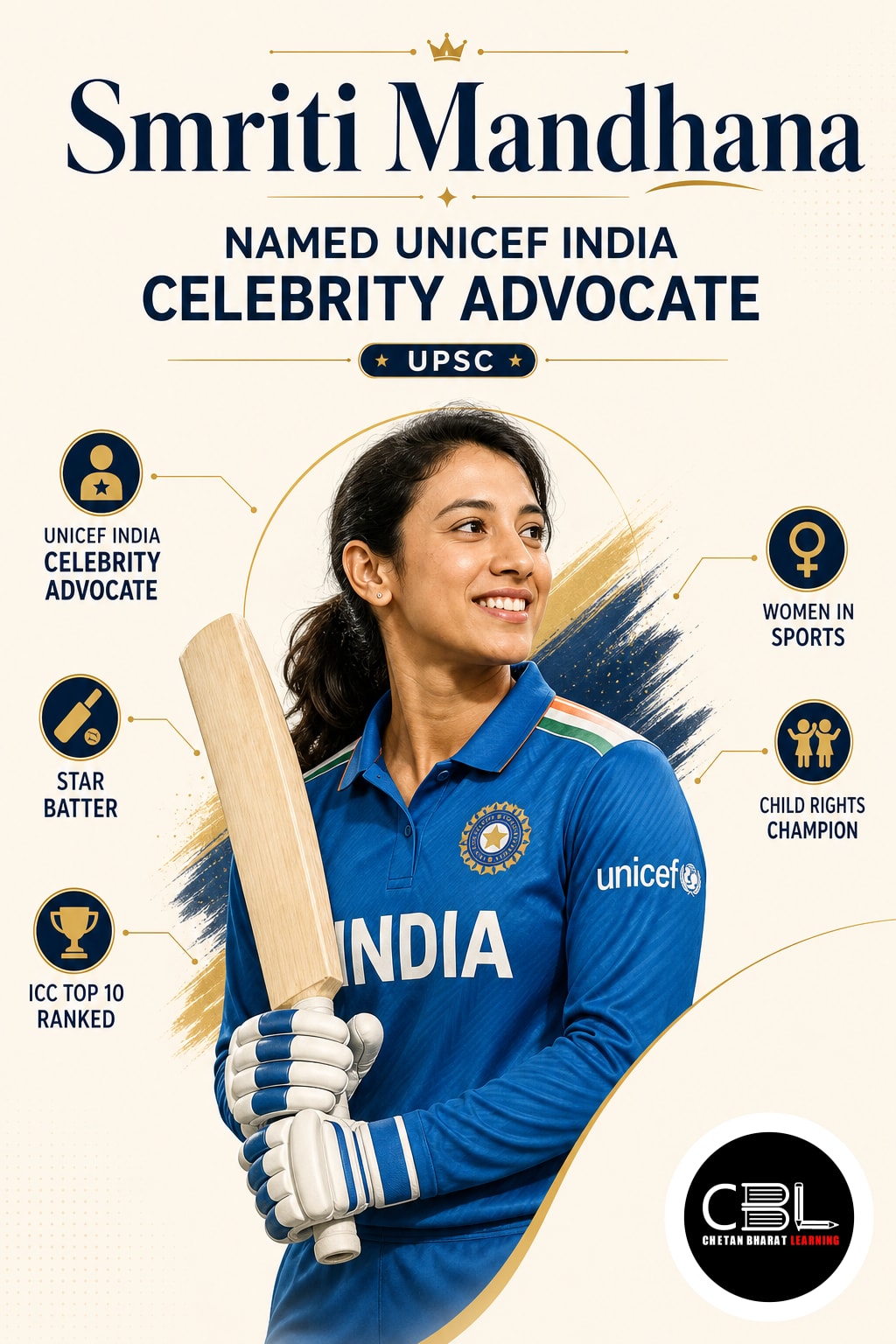
Smriti Mandhana has become UNICEF India’s Celebrity Advocate, bringing sporting visibility to children’s rights and adolescent girls’ empowerment. The appointment highlights equal opportunities to learn, participate and pursue ambitions. Explore related social development issues through our daily current affairs archive.
Quick Facts
| Appointment | UNICEF India Celebrity Advocate |
|---|---|
| Occasion | International Day of the Girl: 11 October |
| Priority | Girls’ empowerment, health and well-being |
Who is Smriti Mandhana?
The Indian international cricketer is an Arjuna Award recipient and a two-time ICC Women’s Cricketer of the Year. She was part of India’s 2025 Women’s Cricket World Cup-winning team. Her sporting profile gives her a platform to reach young people and families.
Her new designation is Celebrity Advocate for UNICEF India. This title should remain distinct from other UNICEF advocacy designations. The role involves supporting public awareness and engagement around children’s rights, with particular attention to adolescent girls.
Why in News?
UNICEF India announced the appointment on the occasion of the International Day of the Girl, observed on 11 October 2026. Its official press release, dated 12 October, identifies girls’ empowerment, health and well-being as priorities. It also connects the role with opportunities for girls to participate in sport.
The appointment builds on Smriti Mandhana’s earlier support for UNICEF–International Cricket Council campaigns and UNICEF’s Promise to Children campaign. Her advocacy brings together sport, public communication and equal opportunity. The broader policy concern is whether girls can access the conditions needed to develop their abilities.
Major Contributions and Milestones
| Year or Period | Milestone |
|---|---|
| Before the appointment | Supported campaigns concerning gender equality, life skills and children’s opportunities. |
| 2025 | Member of India’s Women’s Cricket World Cup-winning team. |
| October 2026 | Named UNICEF India Celebrity Advocate to support children’s rights and adolescent girls’ empowerment. |
About UNICEF
The United Nations Children’s Fund works to advance children’s rights and well-being. The UN General Assembly established it on 11 December 1946 to assist children affected by the Second World War. Its original name was the United Nations International Children’s Emergency Fund.
UNICEF became a permanent part of the UN system in 1953 and adopted its present name while retaining its acronym. Its headquarters is in New York. The organisation’s official history explains this institutional evolution.
The Convention on the Rights of the Child, 1989 guides its work. The framework recognises children as rights-holders, including rights relating to survival, development, protection and participation. UNICEF supports national efforts across areas such as education, nutrition, health and child protection.
A 36-member Executive Board provides intergovernmental oversight and approves policies, country programmes and budgets. ECOSOC elects members for three-year terms. UNICEF relies on voluntary contributions rather than mandatory assessed contributions for its funding.
UNICEF began working in India in 1949. India is a member of its Executive Board in 2026, with its listed term ending on 31 December 2027. This membership concerns intergovernmental governance and is separate from individual celebrity advocacy roles.
Present-Day Relevance: Sport and Girls’ Empowerment
Role models can challenge assumptions about which activities girls should pursue. Visible sporting achievement can encourage families to recognise abilities beyond restrictive expectations. Such influence creates an opening for discussion; it does not by itself remove practical barriers.
Access to sport involves safe facilities, suitable equipment, trained supervision and time to participate. Girls may also need reliable transport and encouragement from schools and families. Inclusive programmes should consider disability, income and differences between rural and urban settings.
Health and education remain central to meaningful opportunity. Nutrition, adolescent health information and continued schooling help young people participate confidently. Awareness campaigns work best when communities can connect their messages with accessible services.
Celebrity advocacy can also draw attention to children’s participation in decisions affecting them. Programmes should listen to girls’ experiences rather than assume that adults understand every barrier. Respectful communication must protect children’s dignity, privacy and safety.
The appointment’s wider significance lies in connecting public visibility with sustained institutional work. Governments, schools and communities retain responsibility for delivering services and addressing discrimination. Readers can explore this relationship between awareness and implementation through our social development learning resources.
Effective follow-through should assess participation, service access and changes in community practices. Publicity alone cannot establish improved outcomes for girls. UNICEF’s India programme overview provides context on the organisation’s wider work with children.
Punjab & Haryana PCS Angle
Punjab PCS and Haryana HCS can connect this development with girls’ education, adolescent health and access to sport. State and district administrations can support participation through safe school facilities, accessible transport and coordination among education, health and sports departments. Answers should distinguish awareness campaigns from measurable improvements in service delivery.
Prelims Practice Corner
Q1. Which designation did UNICEF India confer on the Indian cricketer in October 2026?
(a) Executive Director
(b) Celebrity Advocate
(c) Executive Board President
(d) UN Resident Coordinator
Answer: (b) Celebrity Advocate.
Q2. The International Day of the Girl is observed on:
(a) 8 March
(b) 11 October
(c) 20 November
(d) 11 December
Answer: (b) 11 October.
Q3. Consider the following statements: 1. UNICEF was established in 1946. 2. Its headquarters is in Geneva. Which is correct?
(a) 1 only
(b) 2 only
(c) Both 1 and 2
(d) Neither 1 nor 2
Answer: (a) 1 only.
Q4. Which UN body elects members of UNICEF’s Executive Board?
(a) Security Council
(b) International Court of Justice
(c) Economic and Social Council
(d) Trusteeship Council
Answer: (c) Economic and Social Council.
Q5. Consider the following statements: 1. The Convention on the Rights of the Child guides UNICEF’s work. 2. UNICEF receives voluntary contributions. Which is correct?
(a) 1 only
(b) 2 only
(c) Both 1 and 2
(d) Neither 1 nor 2
Answer: (c) Both 1 and 2.
Mains Practice Questions
Q1. How can sporting role models contribute to adolescent girls’ empowerment? Discuss the limits of awareness-based interventions. (150 words, 10 marks)
Answer Structure
- Intro: Explain how visible sporting achievement can expand girls’ aspirations.
- Body: Discuss stereotypes, family attitudes and participation; examine barriers involving safety, facilities, health and schooling.
- Conclusion: Link public advocacy with accessible services and measurable opportunities.
Q2. Examine the role of UNICEF in advancing children’s rights. Suggest how state administrations can translate child-rights commitments into effective local action. (250 words, 15 marks)
Answer Structure
- Intro: Introduce UNICEF and its child-rights mandate.
- Body: Cover health, nutrition, education and protection; propose departmental coordination, inclusive facilities, child participation and monitoring.
- Conclusion: Emphasise accountable institutions and equal access for vulnerable children.
Frequently Asked Questions
What will the new Celebrity Advocate support?
She will support UNICEF India’s advocacy for children’s rights and equal opportunities. Adolescent girls’ empowerment, health, well-being and participation in sport are key priorities.
Why does UNICEF retain an acronym that differs from its present name?
The acronym comes from its original name, United Nations International Children’s Emergency Fund. The organisation retained it after adopting the name United Nations Children’s Fund in 1953.
Is India represented on UNICEF’s Executive Board in 2026?
Yes. India is a member in 2026, with its listed term extending to 31 December 2027. The Board provides intergovernmental oversight of UNICEF.
Related Current Affairs
Preparing for UPSC, PCS or HCS?
Talk to a mentor at Chetan Bharat Learning, Chandigarh. Free guidance on choosing the right exam and building a study plan.
Chat on WhatsAppCall 97793 53345UPSC / IAS / PCS coaching in Chandigarh · Trusted by aspirants across Punjab & Haryana
Leave a Reply
You must be logged in to post a comment.