
UPSC Mapping
Prelims
- Indian Navy, Defence Infrastructure and Strategic Geography
Mains
- GS Paper 3 – Internal Security and Defence; GS Paper 1 – Geography
What is Project Seabird?
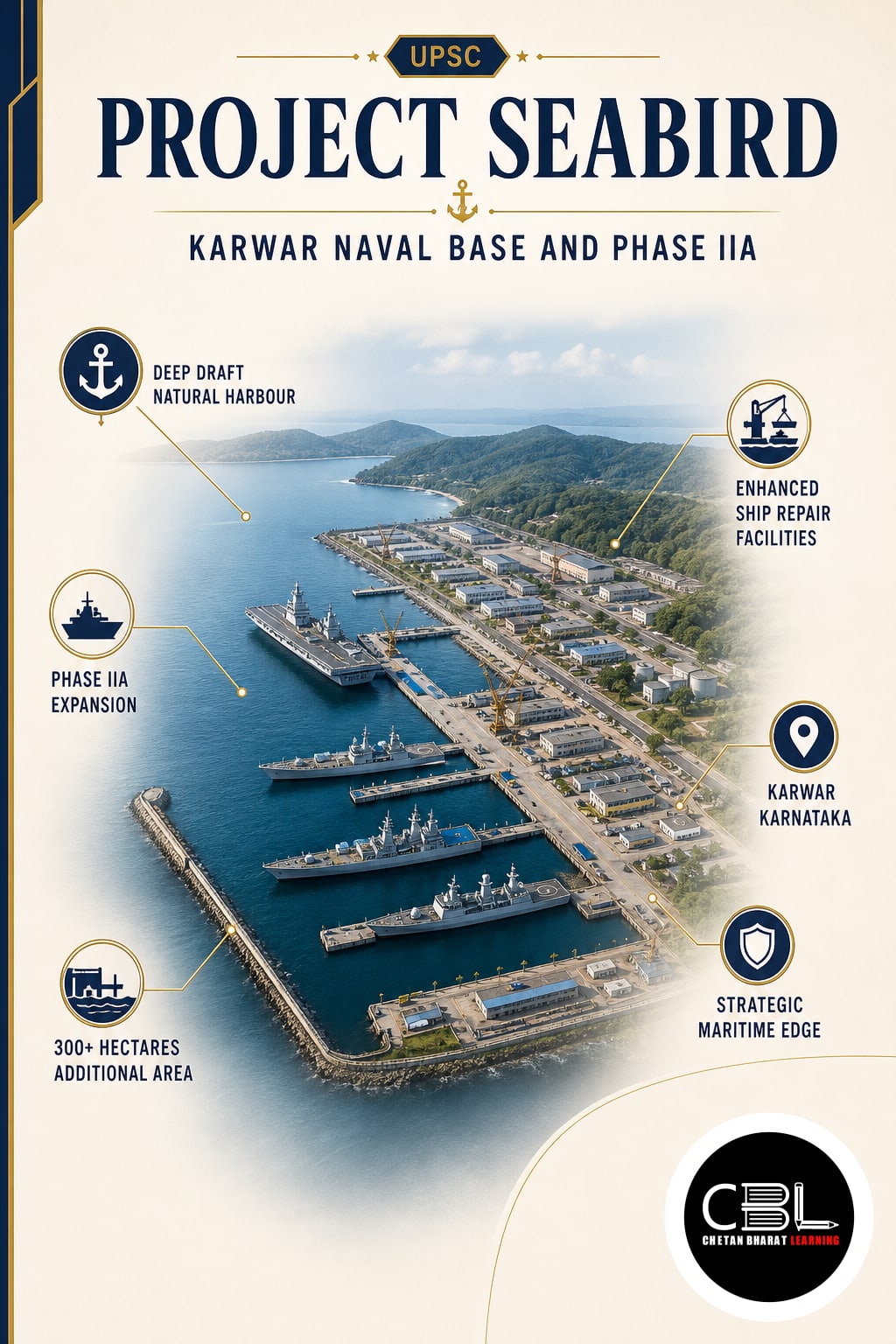
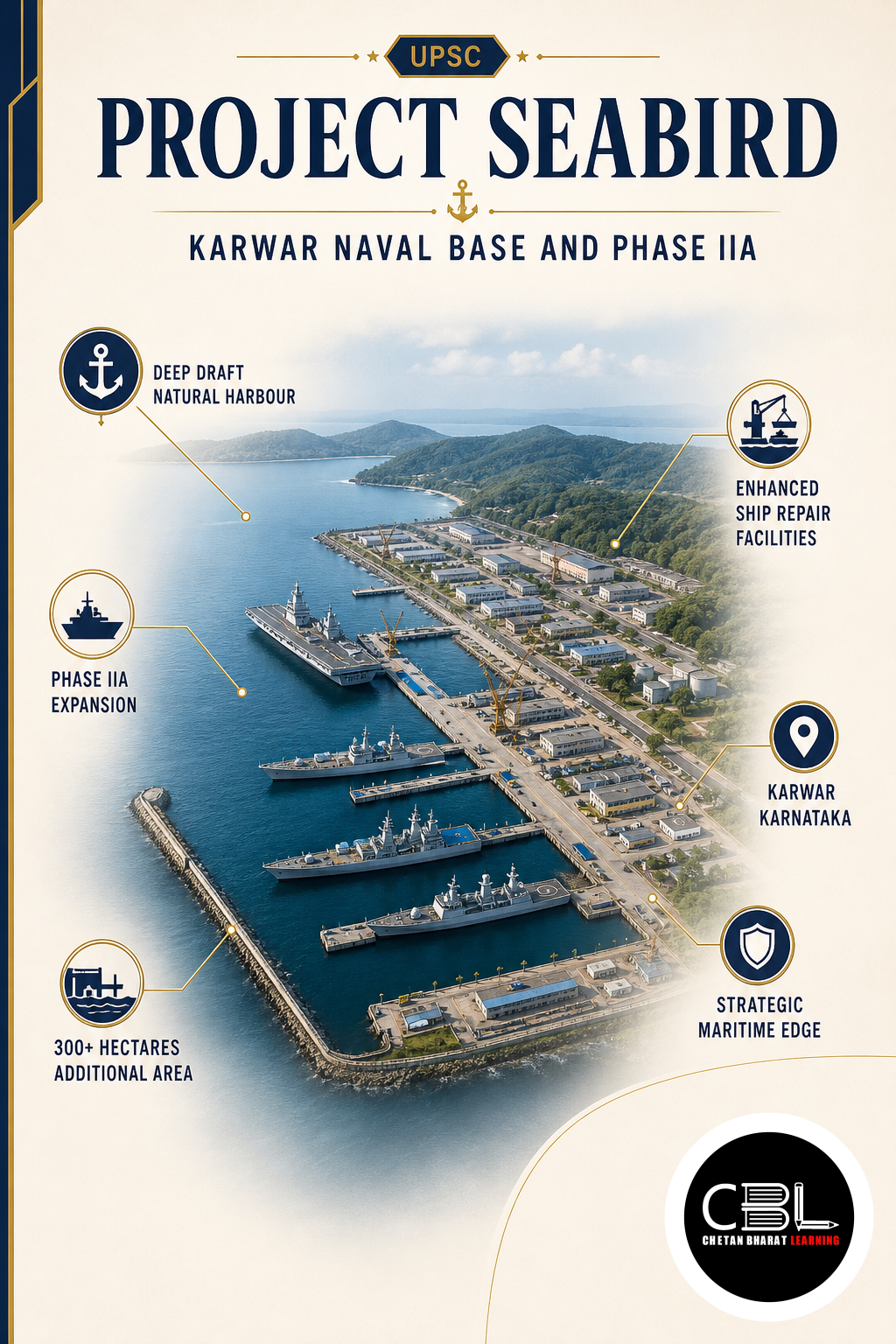
Project Seabird is the Indian Navy’s major naval infrastructure development programme at Karwar on Karnataka’s western coast. It has established INS Kadamba as a strategically located deep-water naval base.
The project aims to reduce dependence on the congested Mumbai naval harbour while providing dedicated infrastructure for warship basing, maintenance, repairs, logistics and operational support.
Unlike commercial ports, a dedicated naval base can prioritise military operations and develop specialised facilities for strategic naval requirements.
Location and Strategic Geography
INS Kadamba lies near Karwar in the Uttara Kannada district of Karnataka, along India’s Arabian Sea coastline. The surrounding coastal hills and natural harbour conditions offer geographical advantages for naval operations.
The base provides access to the Arabian Sea and major Indian Ocean maritime routes. Its location also offers an alternative to naval facilities concentrated around Mumbai.
Why in News?
On 8 October 2026, Chief of Defence Staff General N. S. Raja Subramani inaugurated new Phase IIA facilities at Naval Base Karwar, including residential towers, in-living accommodation and utility networks.
Vice Admiral Vivek Dahiya, Director General Seabird, attended alongside senior naval officials. The facilities were developed east of Manzil Creek and Amadalli.
| Facility Inaugurated | Details |
|---|---|
| Senior Sailors’ Accommodation | One residential tower with 60 dwelling units |
| Defence Civilians’ Accommodation | One residential tower with 60 dwelling units |
| Defence Security Corps | In-living accommodation for 156 personnel |
| Educational Facility | One kindergarten school |
| Utility Infrastructure | Critical trunk utility networks and supporting amenities |
NCC Limited, Hyderabad, constructed the accommodation; Cemindia Projects India Limited developed the trunk infrastructure.
Official source: Ministry of Defence announcement, 9 October 2026.
Historical Background and Evolution
India conceived the Karwar naval base to reduce operational constraints at Mumbai and establish a dedicated facility with greater strategic depth. Former Navy Chief Admiral O. S. Dawson supported Karwar for its geographical suitability.
| Year | Major Development |
|---|---|
| 1986 | Prime Minister Rajiv Gandhi laid the foundation stone |
| 2004 | First ship received in November |
| 2005 | INS Kadamba formally commissioned (Phase I) |
| 2011 | Phase I infrastructure completed |
| 2012 | Cabinet Committee on Security approves Phase IIA expansion |
| 2024–2025 | Additional piers, accommodation and support infrastructure inaugurated |
| 2026 | New residential accommodation and trunk utilities under Phase IIA inaugurated |
Key Features of Project Seabird
- Natural Harbour and Strategic Depth: Protected coastal geography supports sustained operations.
- Deep-Water Berthing: Facilities for major warships and submarines.
- Naval Dockyard and Repair: Maintenance and refit infrastructure.
- Dual-Use Naval Air Station: Planned aviation support.
- Integrated Logistics: Dedicated storage and supply chains.
- Residential Townships: Accommodation, schools and community facilities.
- Green Infrastructure: Aiming for IGBC Gold certification.
- Indigenous Procurement: Over 90% domestic sourcing.
Phase I and Phase IIA
Phase I established breakwater, berths, repair yards, armament storage, accommodation and a naval hospital, supporting about 10 ships. Phase IIA expands capacity for 32 ships, submarines and 23 yardcraft, adds dockyard, aviation and logistics infrastructure, and four covered dry berths.
Reference: Ministry of Defence details on Project Seabird expansion.
Strategic Significance for India
- Naval Operational Readiness: Enhanced fleet maintenance and deployment.
- Reduced Mumbai Dependence: Diversified naval basing.
- Strategic Dispersion: Lower geographic concentration of assets.
- Arabian Sea Surveillance: Improved western coastline coverage.
- Maritime Trade Security: Protects sea lines of communication.
- Defence Self-Reliance: Boosts Indian manufacturing.
- Regional Development: Employment and infrastructure growth in Uttara Kannada.
Economic and Employment Benefits
The expanded base will accommodate around 10,000 naval and civilian personnel with families. Construction and services generate local business opportunities and spur housing, education and healthcare investment.
Challenges and Concerns
- Complex Execution: Coordination across agencies and contractors.
- Cost and Schedule: Risk of delays and overruns.
- Environmental Impact: Marine ecosystems and shoreline habitats.
- Local Livelihoods: Addressing fishing community concerns.
- Infrastructure Integration: Coordinated utilities and planning.
- Maintenance Sustainability: Long-term technical and financial support.
Way Forward
- Complete Phase IIA Efficiently: Prioritise operational and aviation facilities.
- Strengthen Environmental Management: Coastal regulation compliance.
- Promote Indigenous Supply Chains: Support MSMEs and defence firms.
- Integrate Maritime Infrastructure: Coordinate bases and deployment.
- Support Coastal Communities: Local employment and consultation.
- Plan Lifecycle Maintenance: Reliable financing and technical systems.
Project Seabird represents a major investment in India’s maritime defence infrastructure, supporting strategic dispersion and operational flexibility in the Arabian Sea.
Prelims Practice Corner
Q1. Project Seabird is associated with the development of which naval base?
- (a) INS Chilka
- (b) INS Kadamba
- (c) INS Shivaji
- (d) INS Hamla
Answer: (b) INS Kadamba at Karwar, Karnataka.
Q2. Where is the naval base developed under Project Seabird located?
- (a) Kochi, Kerala
- (b) Visakhapatnam, Andhra Pradesh
- (c) Porbandar, Gujarat
- (d) Karwar, Karnataka
Answer: (d) Karwar, Karnataka.
Q3. Consider the following statements about Project Seabird:
1. Phase I was commissioned in 2005.
2. Phase IIA includes a dual-use Naval Air Station.
3. The project is on India’s eastern coastline.
Which are correct?
- (a) 1 and 2 only
- (b) 2 and 3 only
- (c) 1 and 3 only
- (d) 1, 2 and 3
Answer: (a) 1 and 2 only.
Q4. Who inaugurated residential and utility infrastructure under Phase IIA on 8 October 2026?
- (a) Admiral Dinesh K. Tripathi
- (b) Rajnath Singh
- (c) General N. S. Raja Subramani
- (d) Vice Admiral Krishna Swaminathan
Answer: (c) General N. S. Raja Subramani.
Q5. Which statement about Phase IIA is correct?
- (a) Exclusively for commercial shipping
- (b) Includes dockyard, aviation and logistics facilities
- (c) On the Brahmaputra
- (d) Contains no residential accommodation
Answer: (b) It expands berthing, dockyard, aviation, logistics and residential infrastructure.
Mains Practice Questions
Q1. Examine the strategic significance of Project Seabird in strengthening India’s maritime security and operational capabilities in the Arabian Sea. (15 marks)
Answer Structure:
- Intro: Introduce the Karwar naval base and Phase IIA expansion.
- Body: Discuss naval basing, strategic dispersion, maritime surveillance, logistics, fleet maintenance and protection of sea routes.
- Conclusion: Emphasise integrated infrastructure development and long-term preparedness.
Q2. Large defence infrastructure projects can promote national security and regional economic development simultaneously. Discuss with reference to Project Seabird. (10 marks)
Answer Structure:
- Intro: Highlight the October 2026 inauguration of naval and residential facilities.
- Body: Explain employment generation, domestic procurement, infrastructure development, local businesses, environmental safeguards and operational benefits.
- Conclusion: Recommend timely execution and sustainable development.
Frequently Asked Questions
What is Project Seabird?
Project Seabird is the Indian Navy’s major infrastructure development programme at Karwar in Karnataka. It established INS Kadamba and aims to create extensive naval berthing, repair, aviation, logistics and residential facilities.
What is Project Seabird Phase IIA?
Phase IIA expands the Karwar naval base to accommodate more ships and submarines while developing a naval dockyard, aviation infrastructure and accommodation. It also incorporates environmental standards and extensive domestic sourcing.
Why is INS Kadamba strategically important?
INS Kadamba provides a dedicated naval base on India’s western coastline, reducing dependence on Mumbai’s commercialised harbour. It strengthens fleet readiness, maritime security and the Navy’s ability to support operations in the Arabian Sea and Indian Ocean.
Related Current Affairs
Preparing for UPSC, PCS or HCS?
Talk to a mentor at Chetan Bharat Learning, Chandigarh. Free guidance on choosing the right exam and building a study plan.
Chat on WhatsAppCall 97793 53345UPSC / IAS / PCS coaching in Chandigarh · Trusted by aspirants across Punjab & Haryana
Leave a Reply
You must be logged in to post a comment.