
Introduction
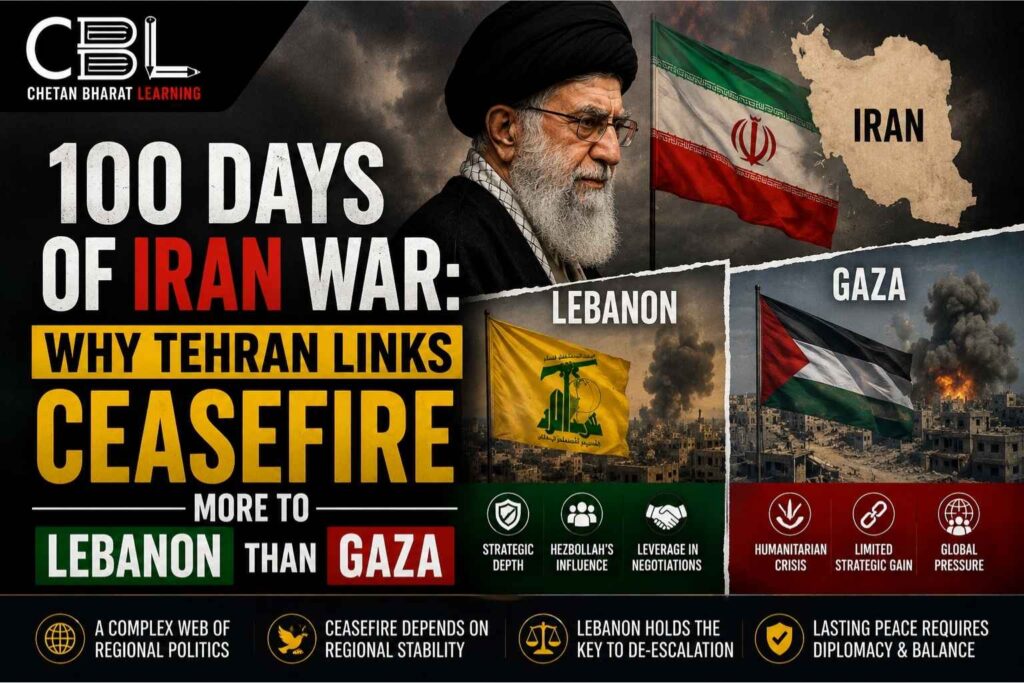
As the Iran-Israel conflict crosses the 100-day mark, the strategic calculations of regional powers are becoming increasingly visible. While much of the international discussion remains focused on Gaza, recent diplomatic signals suggest that Iran’s priorities are closely tied to developments in Lebanon. Tehran appears to be linking any meaningful ceasefire arrangements not only to Gaza but also to the situation in southern Lebanon, where Hezbollah continues to play a central role.
This approach reflects a broader geopolitical reality in West Asia. For Iran, Lebanon is not merely another conflict zone; it is a crucial pillar of its regional security architecture. The evolving conflict demonstrates how modern wars are rarely confined to a single battlefield. Instead, they are interconnected through alliances, strategic interests, and regional power dynamics.
For UPSC aspirants, this issue is highly relevant under International Relations, Security Studies, and West Asia geopolitics.
Background of the Iran-Israel Conflict
The current phase of confrontation between Iran and Israel represents one of the most serious escalations in recent years. Military strikes, proxy engagements, maritime tensions, and diplomatic negotiations have all contributed to a volatile regional environment.
Over the past several months, neither side has achieved a decisive victory. While military pressure continues, both Iran and the United States remain engaged in diplomatic discussions aimed at preventing a wider regional war. The conflict has also affected critical trade routes, global energy markets, and regional stability.
Iran’s strategy during these 100 days has been to maintain pressure while preserving its regional influence. Rather than seeking an immediate military breakthrough, Tehran appears focused on strengthening its bargaining position before any comprehensive ceasefire agreement is reached.
Why Lebanon Has Become Central to Iran’s Strategy
Lebanon occupies a unique position in Iran’s regional calculations because of its long-standing relationship with Hezbollah. Unlike Gaza, where Iran’s influence is indirect, Lebanon provides Tehran with a well-established strategic partner that significantly enhances its regional leverage.
Hezbollah has long served as one of Iran’s most important allies in West Asia. Through political influence, military capabilities, and geographic proximity to Israel, Hezbollah provides Iran with an effective deterrence mechanism. Any agreement affecting Lebanon directly influences Iran’s broader security interests.
For this reason, Tehran views developments in Lebanon as inseparable from wider ceasefire negotiations. From Iran’s perspective, a ceasefire that weakens Hezbollah could undermine decades of strategic investment and reduce its influence across the region.
This explains why Iranian officials increasingly discuss Lebanon alongside Gaza when addressing ceasefire proposals.
Iran’s Strategic Objectives in Lebanon
Iran’s focus on Lebanon is driven by several long-term objectives. The most important among these is the preservation of regional influence. Lebanon allows Iran to project power beyond its borders and maintain a presence in one of the most strategically sensitive regions of the world.
Another objective is deterrence. Hezbollah’s capabilities create strategic pressure on Israel and help Iran maintain a balance of power. This deterrence factor remains central to Tehran’s security doctrine.
Lebanon also serves as a diplomatic bargaining tool. By linking developments in Lebanon with broader ceasefire negotiations, Iran increases its leverage during discussions with the United States and other international actors.
Additionally, Iran views stability in Lebanon as essential for protecting its regional alliances. Any major shift in Lebanon’s political or security landscape could have consequences for Tehran’s influence throughout West Asia.
Why Tehran Is Not Linking the Ceasefire Primarily to Gaza
Although Iran consistently supports the Palestinian cause, its current diplomatic approach suggests that Lebanon has become a higher strategic priority.
This does not indicate a reduction in support for Gaza. Rather, it reflects the reality that Hezbollah represents a more direct and valuable strategic asset for Iran. While developments in Gaza carry symbolic and political importance, events in Lebanon have a more immediate impact on Tehran’s regional influence.
By focusing on Lebanon, Iran seeks to secure tangible strategic gains. Tehran understands that any future regional security arrangement will likely depend on the balance of power along Israel’s northern border. Consequently, Iran wants guarantees regarding Lebanon before accepting broader ceasefire frameworks.
This approach demonstrates how states often prioritize long-term strategic interests alongside ideological commitments.
The Role of Hezbollah in Iran’s Regional Policy
No discussion of Iran’s regional strategy is complete without understanding Hezbollah’s significance.
Since its emergence in the 1980s, Hezbollah has evolved into one of the most influential non-state actors in the world. The organisation possesses military capabilities, political influence, and deep social roots within Lebanon.
For Iran, Hezbollah serves multiple strategic functions. It acts as a deterrent against potential Israeli military action, strengthens Tehran’s regional influence, and provides leverage during diplomatic negotiations.
Hezbollah’s importance explains why Iran closely monitors developments in Lebanon and remains unwilling to separate the Lebanese situation from wider ceasefire discussions.
Any agreement affecting Hezbollah’s position would directly impact Iran’s long-term regional strategy.
The United States and the Regional Equation
The United States remains a key stakeholder in the conflict. Washington has attempted to prevent further escalation while simultaneously supporting its regional allies.
Iran believes that continued pressure may eventually encourage the United States to support concessions during negotiations. Consequently, Tehran uses multiple pressure points, including Lebanon, to strengthen its negotiating position.
From Iran’s perspective, developments in Lebanon offer an opportunity to influence broader regional discussions. This explains why Tehran often references Lebanon when discussing diplomatic solutions.
The interaction between Iran, Israel, and the United States continues to shape the overall direction of the conflict and will remain a crucial factor in determining future outcomes.
Impact on Regional Stability
The ongoing conflict has created significant uncertainty across West Asia. Military tensions remain elevated, and the possibility of miscalculation continues to concern policymakers and security experts.
Regional trade routes have also experienced disruption. Strategic waterways remain under close scrutiny, while shipping companies face increased operational risks.
Political uncertainty has affected investment flows, tourism, and economic growth in several countries. Governments across the region are increasingly focused on preventing the conflict from expanding into a broader confrontation.
The longer the conflict continues, the greater the risk that regional instability could spill over into neighbouring areas.
Implications for Global Energy Markets
The Iran conflict has important consequences for global energy security. West Asia remains one of the world’s most significant energy-producing regions, and any disruption can affect international markets.
Rising tensions often lead to higher oil prices because investors anticipate potential supply disruptions. Shipping risks can increase transportation costs, which may eventually contribute to inflation in importing countries.
Countries heavily dependent on energy imports, including India, closely monitor developments in the region. Any prolonged instability can influence economic growth, fiscal planning, and energy security strategies.
These factors explain why the international community continues to support diplomatic efforts aimed at reducing tensions.
What Does This Mean for India?
India has significant interests in West Asia, including energy security, trade, and the welfare of Indian citizens working in the region.
Any escalation in the conflict could increase energy prices and affect India’s import bill. Disruptions in maritime trade routes may also influence logistics costs and supply chains.
At the diplomatic level, India continues to maintain balanced relations with various regional actors. This approach allows New Delhi to protect its strategic interests while supporting regional stability.
For Indian policymakers, developments in Iran, Lebanon, and Gaza remain closely interconnected with broader economic and security considerations.
Students preparing through UPSC Coaching in Chandigarh and IAS Coaching in Chandigarh should pay particular attention to this issue because it combines international relations, security studies, energy security, and contemporary geopolitics.
UPSC Relevance
This topic is important from both the Preliminary and Mains examination perspectives.
In Prelims, questions may focus on Hezbollah, Lebanon, Gaza, Iran, Israel, and important geopolitical locations in West Asia.
In GS Paper II, the issue can be linked to International Relations, India’s foreign policy, and regional diplomacy.
In GS Paper III, it can be connected to energy security, internal security implications, and global economic challenges arising from geopolitical conflicts.
The topic also provides valuable material for essay writing on regional conflicts, diplomacy, and international security.
FAQs
Why is Iran focusing more on Lebanon than Gaza?
Iran considers Lebanon strategically more important because of its close relationship with Hezbollah and its broader regional influence.
What role does Hezbollah play in Iran’s strategy?
Hezbollah acts as a key regional ally, deterrent force, and source of political influence for Iran.
Does Iran still support Gaza?
Yes. Iran continues to support Gaza, but its current negotiations indicate greater strategic emphasis on Lebanon.
Why is this conflict important globally?
The conflict affects energy markets, international trade routes, regional stability, and global security.
Why is this topic important for UPSC?
It covers International Relations, Security Studies, Energy Security, and contemporary geopolitical developments.
Conclusion
The completion of 100 days of the Iran conflict highlights the complexity of modern geopolitical struggles. While Gaza continues to attract international attention, Iran’s strategic priorities reveal that Lebanon occupies a more significant position in its regional calculations. Through its relationship with Hezbollah, Tehran seeks to preserve influence, maintain deterrence, and strengthen its negotiating position.
The evolving ceasefire discussions demonstrate that conflicts in West Asia are deeply interconnected and cannot be understood through a single lens. Developments in Lebanon, Gaza, Israel, and Iran collectively shape the future of regional stability. As diplomatic efforts continue, the outcome of these negotiations will have implications not only for West Asia but also for global security, energy markets, and international relations.
Related Current Affairs
Preparing for UPSC, PCS or HCS?
Talk to a mentor at Chetan Bharat Learning, Chandigarh. Free guidance on choosing the right exam and building a study plan.
Chat on WhatsAppCall 97793 53345UPSC / IAS / PCS coaching in Chandigarh · Trusted by aspirants across Punjab & Haryana
Leave a Reply
You must be logged in to post a comment.