
Important for:
UPSC, Haryana HCS, Punjab PCS
Prelims: Women’s reservation, 73rd & 74th Amendments
Mains: GS Paper 2 — Governance, Representation, Gender Equality
Essay/Ethics: Equality vs merit, empowerment
Why in News?
A debate in an editorial discusses whether reservation is an effective tool to address gender inequality or whether focus should shift to performance, opportunity, and systemic reforms.
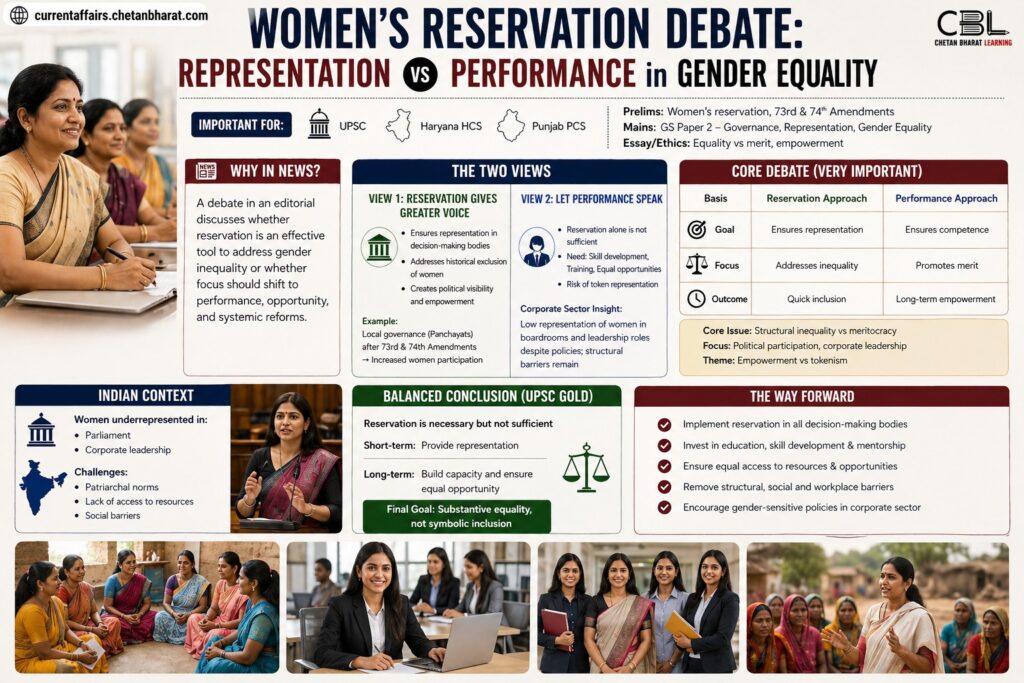
View 1: Reservation Gives Greater Voice
✔︎ Key Arguments
- Ensures representation in decision-making bodies
- Addresses historical exclusion of women
- Creates political visibility and empowerment
✔︎ Example:
- Local governance (Panchayats) after 73rd & 74th Amendments
→ Increased women participation
Key Insight
Reservation acts as:
✔️ Entry point for structural change
✔️ Broader Impact
- Enhances democracy
- Strengthens inclusivity
- Brings grassroots issues forward
View 2: Let Performance Speak
✔︎ Key Arguments
- Reservation alone is not sufficient
- Need:
- Skill development
- Training
- Equal opportunities
✔︎ Concern:
- Risk of token representation
Corporate Sector Insight
- Low representation of women in:
- Boardrooms
- Leadership roles
✔︎ Despite policies:
- Structural barriers remain
✔️ Key Idea
✔︎ Empowerment must be:
- Capability-based
- Not just quota-based
Core Debate
| Reservation Approach | Performance Approach |
|---|---|
| Ensures representation | Ensures competence |
| Addresses inequality | Promotes merit |
| Quick inclusion | Long-term empowerment |
Indian Context
- Women underrepresented in:
- Parliament
- Corporate leadership
✔︎ Challenges:
- Patriarchal norms
- Lack of access to resources
- Social barriers
Balanced Conclusion
♦︎ Reservation is necessary but not sufficient
✔ Short-term:
- Provide representation
✔ Long-term:
- Build capacity
- Ensure equal opportunity
▻ Final goal:
Substantive equality, not symbolic inclusion
PRELIMS PRACTICE QUESTIONS
Q1. 73rd Constitutional Amendment relates to:
A. Parliament
B. Panchayati Raj
C. Judiciary
D. Finance
✅ Answer: B
Q2. Reservation for women in Panchayats is:
A. 10%
B. 25%
C. 33%
D. 50%
✅ Answer: C (minimum constitutional provision)
Q3. Which of the following is a benefit of reservation?
- Increased participation
- Structural equality
- Immediate merit improvement
A. 1 only
B. 1 and 2 only
C. 2 and 3 only
D. 1, 2 and 3
✅ Answer: B
Q4. Which of the following is a challenge to women’s participation?
A. Education
B. Patriarchy
C. Technology
D. Urbanisation
✅ Answer: B
Q5. Women’s reservation primarily aims at:
A. Economic growth
B. Social equality
C. Military strength
D. Trade expansion
✅ Answer: B
CBL Mains Practice Question
“Reservation for women is a necessary but not sufficient condition for achieving gender equality.”
Discuss. (250 words)
FAQs
1. Why is women’s reservation important?
It ensures representation in political and decision-making institutions.
2. What is the limitation of reservation?
It may not guarantee capability or performance.
3. What is the solution?
Combine reservation with skill development and opportunity.
4. Which GS paper covers this topic?
GS Paper 2 — Governance and Social Justice.
5. Why is this important for essays?
It involves equality, merit, and empowerment themes.
Related Current Affairs
Preparing for UPSC, PCS or HCS?
Talk to a mentor at Chetan Bharat Learning, Chandigarh. Free guidance on choosing the right exam and building a study plan.
Chat on WhatsAppCall 97793 53345UPSC / IAS / PCS coaching in Chandigarh · Trusted by aspirants across Punjab & Haryana
Leave a Reply
You must be logged in to post a comment.