
Important for:
UPSC, Haryana HCS, Punjab PCS
Prelims: Governor, Chief Minister, Floor Test, Article 164
Mains: GS Paper 2 — Constitution, Centre-State Relations, Governor’s Powers
Why in News?
The issue gained attention after political developments in West Bengal, where discussions emerged over whether a Chief Minister can continue in office if election results or majority are questioned.
What Does the Constitution Say?
Article 164(1)
➤ Chief Minister is appointed by the Governor.
The Constitution states:
➤ Ministers hold office “during the pleasure of the Governor”.
Does Governor Have Absolute Power?
❌ No.
In practice, the Governor usually acts:
✔ On the advice of the Council of Ministers
✔ According to constitutional conventions
The Governor cannot arbitrarily remove a Chief Minister.
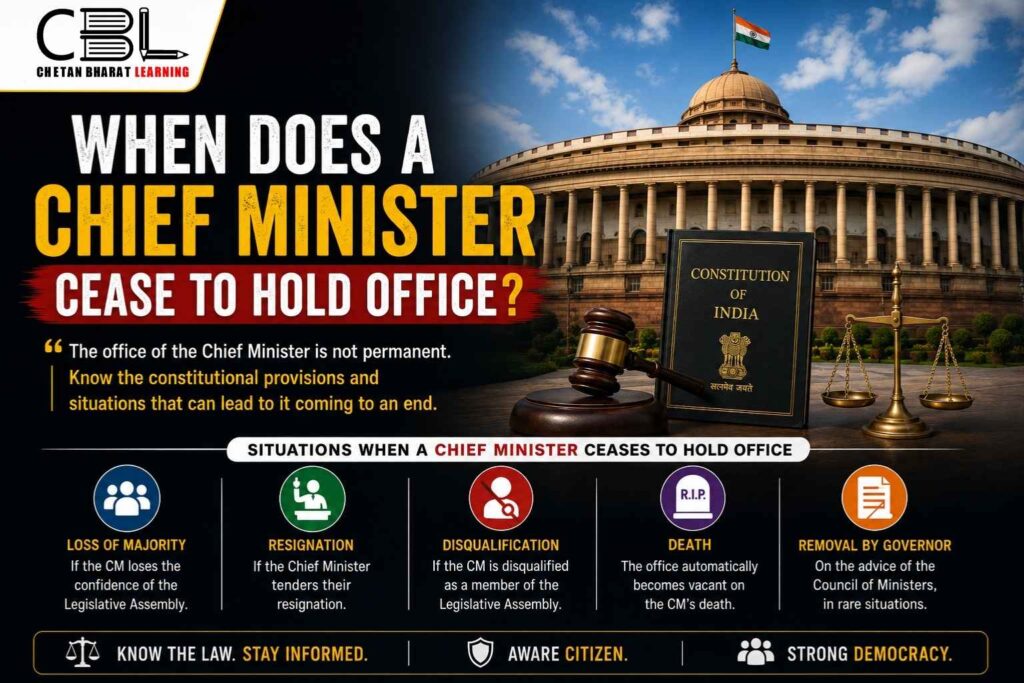
When Can a CM Lose Office?
A Chief Minister may cease to hold office if:
1. Loss of Majority
Fails to prove majority in Assembly.
2. Defeat in Floor Test
Governor can ask CM to prove majority.
3. Resignation
CM voluntarily resigns.
4. End of Assembly Term
Government falls after Assembly term unless re-elected.
What is a Floor Test?
➤ A floor test is conducted in the Legislative Assembly to determine whether the government still enjoys majority support.
Usually ordered when:
✔ Political instability exists
✔ Majority is doubtful
Can Election Results Be Challenged?
✔ Yes.
Election results can be challenged through:
→ Election petitions
→ High Courts
But until legally overturned:
✔ The elected government generally continues.
Role of Governor
The Governor acts as:
✔ Constitutional head of the state
The Governor’s role becomes important during:
- Hung assemblies
- Political crises
- Majority disputes
Important Supreme Court Judgments
S.R. Bommai Case (1994)
✔ Floor test is the proper method to determine majority.
This judgment strengthened:
→ Federalism and constitutional morality.
Special Note for Aspirants
If you’re preparing for:
UPSC coaching Chandigarh
or looking for
then topics like:
✔ Governor’s powers
✔ Constitutional morality
✔ Floor test
✔ Centre-State relations
are extremely important for:
→ Prelims + GS2 Mains + Interview preparation.
Key Insight for UPSC
→ In parliamentary democracy:
✔ Real legitimacy comes from majority support in the Assembly — not merely constitutional wording.
PRELIMS PRACTICE QUESTIONS
Q1. Article 164 relates to:
A. Parliament
B. Chief Minister and Council of Ministers
C. Election Commission
D. Emergency
⇢ Answer: B
Q2. A floor test is used to determine:
A. Judicial powers
B. Financial emergency
C. Legislative majority
D. Election expenditure
⇢ Answer: C
Q3. Which case established the importance of floor tests?
A. Kesavananda Bharati
B. Maneka Gandhi
C. S.R. Bommai
D. Golaknath
⇢ Answer: C
Q4. The Governor is:
A. Real executive head
B. Constitutional head of the state
C. Elected by people
D. Member of Parliament
⇢ Answer: B
Q5. Election disputes are generally decided by:
A. President
B. Election Commission alone
C. High Courts
D. NITI Aayog
⇢ Answer: C
CBL Mains Practice Question
“The office of Governor becomes politically sensitive during majority disputes in state assemblies.”
Discuss with reference to constitutional conventions and judicial rulings in India.
FAQs
1. Can a Governor remove a Chief Minister?
Only if the CM loses majority or under constitutional circumstances.
2. What is a floor test?
A legislative process to prove majority support.
3. Which Article deals with CM appointment?
Article 164.
4. Which case strengthened floor test principles?
S.R. Bommai case.
5. Which GS paper covers this topic?
GS Paper 2.
Related Current Affairs
Preparing for UPSC, PCS or HCS?
Talk to a mentor at Chetan Bharat Learning, Chandigarh. Free guidance on choosing the right exam and building a study plan.
Chat on WhatsAppCall 97793 53345UPSC / IAS / PCS coaching in Chandigarh · Trusted by aspirants across Punjab & Haryana
Leave a Reply
You must be logged in to post a comment.