
Why India-US Relations Matter Today
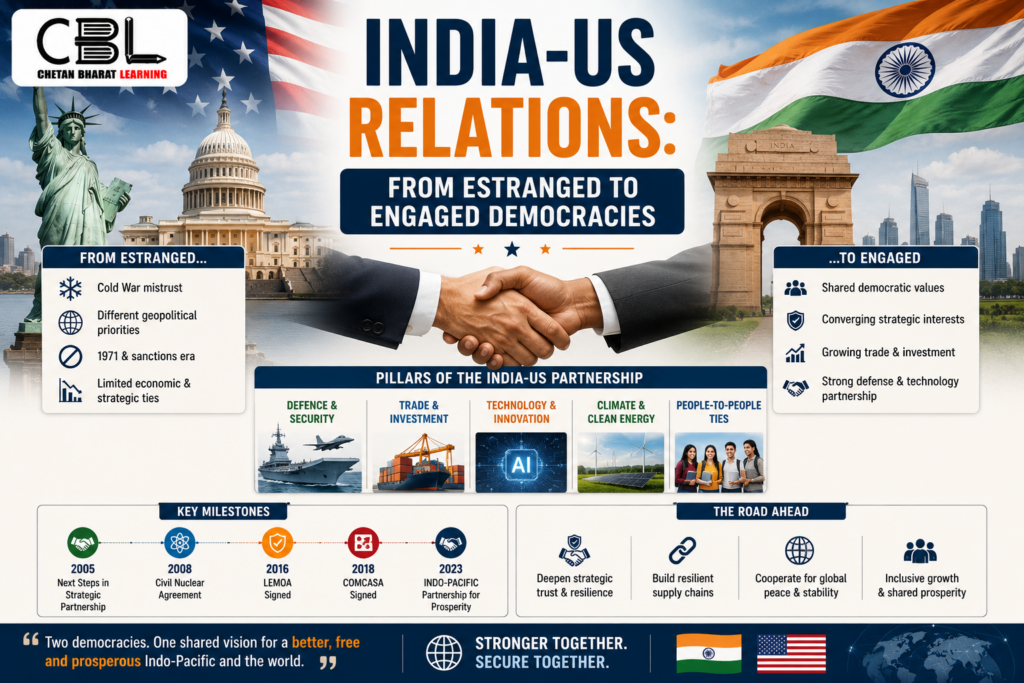
India and the United States share one of the most significant strategic partnerships of the 21st century. While both countries are the world’s largest democracies, their relationship was not always as close as it is today.
From Cold War-era mistrust and policy differences, the relationship has evolved into a broad-based partnership covering:
- Defence cooperation
- Trade and investment
- Technology collaboration
- Energy security
- Indo-Pacific strategy
However, despite growing cooperation, differences remain on issues such as trade, strategic autonomy, and geopolitical priorities.
Students preparing through UPSC Coaching in Chandigarh and IAS Coaching in Chandigarh should closely follow topics like India-US relations, strategic partnerships, the Indo-Pacific, and global geopolitics because these themes are highly important for GS Paper 2, Essay, and UPSC Interview preparation.
The Early Years: Why Relations Remained Distant
Cold War Dynamics
After independence, India adopted a policy of non-alignment, while the United States was a leading power in the Western bloc during the Cold War.
This created strategic differences because:
- India pursued independent foreign policy choices.
- The US maintained close security ties with Pakistan.
- Both countries viewed global security issues differently.
As a result, bilateral relations remained limited for several decades.
Nuclear Differences
India’s nuclear programme also created tensions.
Key developments included:
- India’s 1974 nuclear test
- Technology restrictions
- Export control regimes
These issues prevented deeper strategic engagement for many years.
The Turning Point: Post-Cold War Transformation
The end of the Cold War created new opportunities for cooperation.
Important factors included:
✔ India’s economic liberalisation in 1991
✔ Growing economic interdependence
✔ Shared concerns regarding regional stability
✔ Expanding globalisation
The relationship gradually shifted from suspicion to engagement.
The Landmark Civil Nuclear Agreement
One of the biggest milestones in bilateral relations was the India-US Civil Nuclear Agreement.
The agreement:
- Recognized India as a responsible nuclear power
- Enabled civilian nuclear cooperation
- Expanded strategic trust
It is often considered a major turning point in modern India-US relations.
Key Pillars of the Strategic Partnership
1. Defence Cooperation
Defence cooperation has expanded significantly.
Major areas include:
- Joint military exercises
- Defence technology cooperation
- Logistics agreements
- Maritime security
Both countries increasingly collaborate in maintaining stability across the Indo-Pacific region.
2. Trade and Investment
The United States is among India’s most important economic partners.
Cooperation includes:
- Goods and services trade
- Foreign direct investment
- Innovation partnerships
- Startup collaboration
Economic engagement remains one of the strongest pillars of the relationship.
3. Technology Partnership
Emerging technologies have become a major area of cooperation.
Key sectors include:
- Artificial Intelligence
- Semiconductors
- Space technology
- Critical and emerging technologies
Technology collaboration is expected to shape future bilateral relations.
4. Indo-Pacific Cooperation
Both countries support a free, open, and inclusive Indo-Pacific region.
The Indo-Pacific framework focuses on:
- Maritime security
- Supply chain resilience
- Freedom of navigation
- Regional stability
The Quad has become an important platform for cooperation in this regard.
Areas of Continuing Differences
Despite strong cooperation, disagreements remain.
Trade Issues
Both countries occasionally differ on:
- Market access
- Tariff policies
- Trade regulations
Trade negotiations continue to address these concerns.
Strategic Autonomy
India continues to emphasize strategic autonomy in foreign policy.
This means:
- Independent decision-making
- Diversified partnerships
- Issue-based cooperation
While the US understands this approach, differences can emerge on global strategic issues.
Geopolitical Priorities
India and the United States do not always share identical positions on every international issue.
However, both countries increasingly seek pragmatic cooperation where interests converge.
The Importance of the Indian Diaspora
The Indian diaspora in the United States has become a major bridge between the two countries.
Its contributions include:
✔ Economic engagement
✔ Educational exchanges
✔ Technology leadership
✔ Cultural connectivity
The diaspora strengthens people-to-people relations and enhances mutual understanding.
The Future of India-US Relations
Future cooperation is likely to focus on:
- Advanced technology
- Defence manufacturing
- Clean energy
- Critical minerals
- Supply chain resilience
As global geopolitics evolves, both countries are expected to deepen cooperation while managing differences through dialogue.
Prelims Pointers
Important Groupings
- Quad
- Indo-Pacific Framework
Key Agreement
- India-US Civil Nuclear Agreement
Important Areas
- Defence cooperation
- Technology partnership
- Trade relations
Mains Perspective
Possible Question
“India-US relations have evolved from strategic distance to strategic partnership. However, significant challenges continue to remain.” Discuss.
Key Dimensions to Include
- Historical evolution
- Defence cooperation
- Economic engagement
- Technology partnerships
- Strategic autonomy
- Indo-Pacific strategy
Frequently Asked Questions (FAQ)
Why were India-US relations strained during the Cold War?
Differences over non-alignment, geopolitical alignments, and regional security issues contributed to limited cooperation.
What transformed India-US relations?
Economic reforms, strategic convergence, and the Civil Nuclear Agreement played important roles.
What is the significance of the Quad?
The Quad promotes cooperation on regional security, maritime stability, and strategic issues in the Indo-Pacific.
Does India’s strategic autonomy affect relations with the US?
India’s strategic autonomy sometimes creates differences, but both countries increasingly manage these through dialogue and cooperation.
Conclusion: Partnership Without Alliance
India-US relations have undergone a remarkable transformation over the past few decades. Today, both countries cooperate across defence, technology, trade, and regional security.
Yet the relationship remains unique because it is built not on a formal alliance but on shared interests, democratic values, and pragmatic cooperation.
The future of the partnership will depend on how effectively both countries deepen cooperation while respecting each other’s strategic priorities.
“India and the United States may not agree on every issue, but their growing convergence on key global challenges makes the partnership increasingly important in shaping the 21st-century world order.”
Related Current Affairs
Preparing for UPSC, PCS or HCS?
Talk to a mentor at Chetan Bharat Learning, Chandigarh. Free guidance on choosing the right exam and building a study plan.
Chat on WhatsAppCall 97793 53345UPSC / IAS / PCS coaching in Chandigarh · Trusted by aspirants across Punjab & Haryana
Leave a Reply
You must be logged in to post a comment.