

UPSC Mapping
| Prelims | Mains |
|---|---|
| Social Sector & Health | GS Paper II |
Quick Facts
| Definition | Combination of multiple APIs in a fixed ratio |
|---|---|
| Regulatory body | DCGI & DTAB (under CDSCO) |
What are Fixed Dose Combinations?
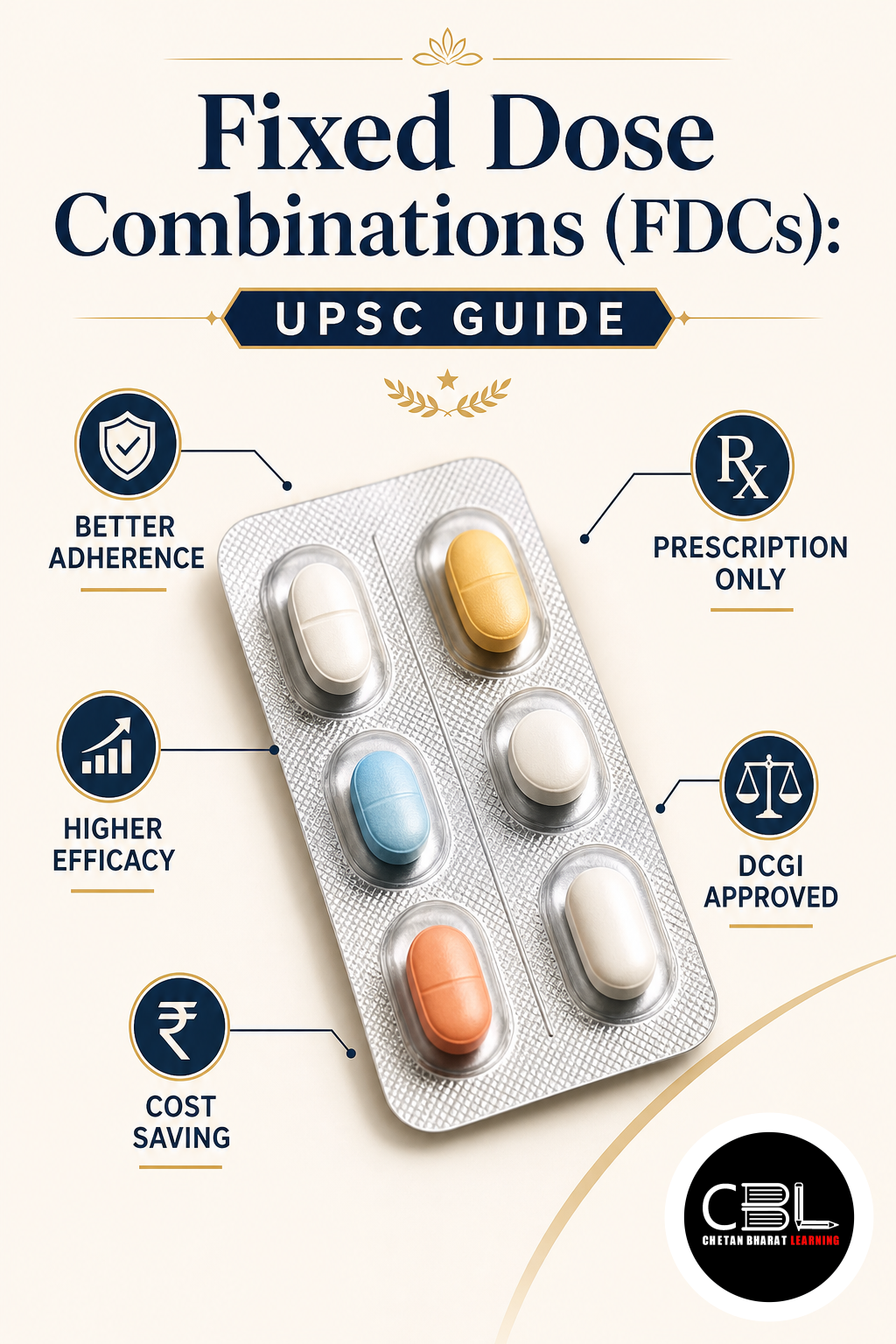
Fixed dose combinations (FDCs) are pharmaceutical products that contain two or more active pharmaceutical ingredients (APIs) in a specific fixed ratio, combined in a single dosage form such as a tablet, capsule, or topical cream. They are intended to improve patient compliance by reducing the number of pills taken, and sometimes to achieve synergistic therapeutic effects.
However, fixed dose combinations must be carefully evaluated for safety, efficacy, and pharmacokinetic compatibility. Every first-time drug combination is legally classified as a new drug and requires manufacturing approval from the Drugs Controller General of India (DCGI) before being marketed domestically, under the Drugs and Cosmetics Act, 1940.
Why are Fixed Dose Combinations in News?
Recently, the central government imposed restrictions on the manufacture, sale, and distribution of all FDCs containing Chlorpheniramine Maleate and Phenylephrine Hydrochloride for use in children below 4 years. This decision was based on expert advice from the Drug Technical Advisory Board (DTAB), India’s highest statutory decision-making body on drug-related technical matters.
This move highlights the government’s vigilance in drug safety, particularly for vulnerable populations. It also raises questions about the oversight of FDCs and the need for rigorous post-market surveillance.
Key Features of Fixed Dose Combinations
- Definition: Multiple APIs in a fixed ratio within a single dose form.
- Approval process: Every new FDC is classified as a new drug and requires DCGI approval.
- Rationality: FDCs should be rational, meaning the combination provides therapeutic advantage over single drugs.
- Regulatory bodies: The Drugs Controller General of India (DCGI) and the Drug Technical Advisory Board (DTAB) oversee FDC approval and safety.
- Risk factors: Irrational FDCs can lead to adverse effects, drug interactions, and antimicrobial resistance.
Challenges with Fixed Dose Combinations
- Irrational combinations: Some FDCs lack scientific justification and may increase side effects without added benefit.
- Fixed dosing: The fixed ratio may not suit all patients, especially children and elderly, where dose titration is needed.
- Regulatory backlog: Many FDCs were approved before stricter rules were implemented, creating safety concerns.
- Pharmacovigilance: Monitoring adverse reactions for FDCs is more complex due to multiple active ingredients.
- Antimicrobial resistance: Irrational antibiotic FDCs can contribute to resistance.
Way Forward for Fixed Dose Combinations
To ensure safe use of FDCs, India must strengthen its regulatory framework for approval and post-market surveillance. The DTAB and DCGI should periodically review existing FDCs to weed out irrational combinations. Drug manufacturers should be required to generate robust clinical data for FDCs, especially for paediatric and geriatric populations.
Public awareness campaigns on rational drug use and the potential risks of self-medication with FDCs are also needed. International harmonisation of FDC standards, as per WHO guidelines, can improve drug quality.
Prelims Practice Corner
Q1. What does FDC stand for in pharmaceuticals?
a) Fixed Drug Combination
b) Fixed Dose Combination
c) Flexible Dose Combination
d) Fast Disintegrating Combination
Answer: b) Fixed Dose Combination.
Q2. Which authority is responsible for approving new FDCs in India?
a) FDA
b) DCGI
c) NMC
d) ICMR
Answer: b) The Drugs Controller General of India (DCGI).
Q3. Which advisory body recommended the recent restriction on certain FDCs for children?
a) NITI Aayog
b) DTAB
c) ICMR
d) WHO
Answer: b) The Drug Technical Advisory Board (DTAB).
Q4. What is the primary advantage of FDCs?
a) Lower cost
b) Improved patient compliance by reducing pill burden
c) Faster absorption
d) Longer shelf life
Answer: b) Improved compliance by combining multiple drugs in one dose.
Q5. Which act governs drug regulation in India?
a) Indian Penal Code
b) Drugs and Cosmetics Act, 1940
c) Food Safety Act
d) Medical Ethics Act
Answer: b) The Drugs and Cosmetics Act, 1940.
Mains Practice Questions
Q1. Discuss the regulatory framework for drugs in India and evaluate the challenges in ensuring the safety of fixed dose combinations. (15 marks)
Answer Structure:
Intro: Outline the regulatory framework (Drugs Act, DCGI, DTAB, CDSCO).
Body: Discuss challenges: irrational FDCs, lack of post-market surveillance, paediatric safety concerns, and the need for rational combination review. Suggest improvements.
Conclusion: Emphasise the importance of evidence-based regulation and pharmacovigilance.
Q2. Analyse the role of the Drug Technical Advisory Board (DTAB) in ensuring drug safety in India. (10 marks)
Answer Structure:
Intro: Introduce DTAB as the highest statutory advisory body under the Drugs Act.
Body: Describe its composition and functions—advising on drug standards, safety, and regulatory decisions. Highlight its role in the recent FDC restriction. Evaluate its effectiveness and suggest improvements.
Conclusion: Stress the need for timely expert advice and transparency.
FAQs on Fixed Dose Combinations
What is the difference between a fixed dose combination and a single drug?
An FDC contains two or more active ingredients in one dose form, whereas a single drug contains only one active ingredient. FDCs are used to simplify dosing and improve adherence.
Why did the government restrict certain FDCs?
To protect children below 4 years from potential adverse effects of chlorpheniramine and phenylephrine combinations, based on expert advice from DTAB.
What is the role of CDSCO?
The Central Drugs Standard Control Organization is the national regulatory authority for pharmaceuticals and medical devices, under the Ministry of Health and Family Welfare.
Related Current Affairs
Preparing for UPSC, PCS or HCS?
Talk to a mentor at Chetan Bharat Learning, Chandigarh. Free guidance on choosing the right exam and building a study plan.
Chat on WhatsAppCall 97793 53345UPSC / IAS / PCS coaching in Chandigarh · Trusted by aspirants across Punjab & Haryana
Leave a Reply
You must be logged in to post a comment.