

UPSC Mapping
- GS Paper II: Governance, Education, Social Justice and Human Resource Development.
- Prelims: Article 21A, Article 45, NEP 2020, School Complexes.
- Mains: Educational reforms, public service delivery, quality of education and inclusive development.
Article
Why in News?
Nearly 94,000 government schools have closed over the past decade. The article attributes this trend to factors such as demographic changes, migration, declining student enrolment and state policies promoting school consolidation.
The central question raised is whether students should travel farther to attend better-equipped schools instead of studying in small neighbourhood schools with limited facilities.
What is School Consolidation?
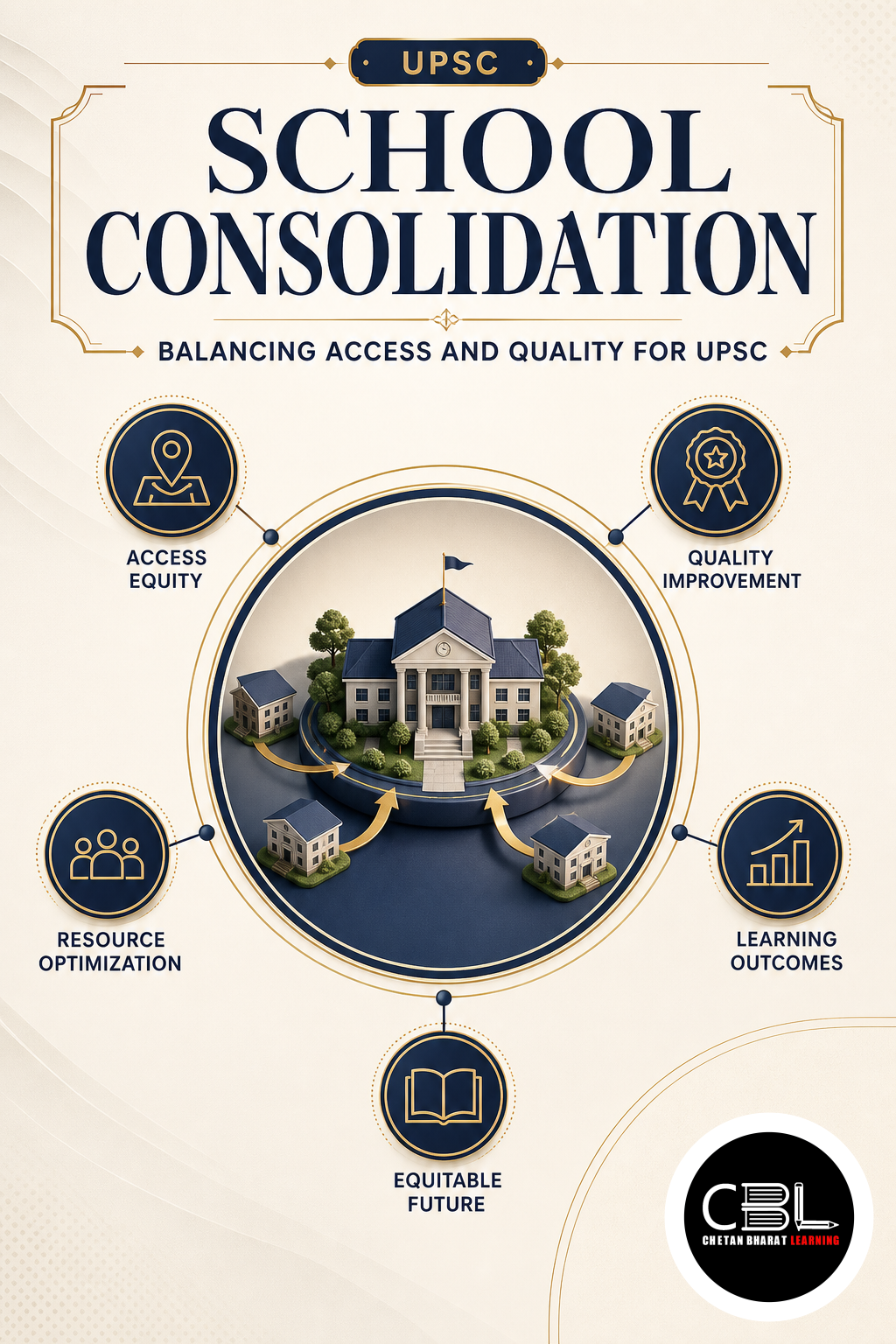
The passage defines school consolidation as the process of merging several small schools into a larger institution with better infrastructure, teachers and learning facilities.
The stated objective is to improve the quality of education rather than simply reduce the number of schools.
Before vs After Consolidation
| Before | After |
|---|---|
| Multiple small village schools with limited resources. | One larger school with improved classrooms, laboratories, libraries, transport and sports facilities. |
Why is India Considering School Consolidation?
- Demographic Transition: Smaller families and migration have reduced enrolment in several rural schools.
- Declining Government School Enrolment: More students are attending private schools in some areas.
- Better Teacher Availability: Larger schools may achieve improved teacher-student ratios and subject specialisation.
What Does the Data Reveal?
According to the passage:
- The number of government schools has declined.
- The number of teachers has increased.
- Student enrolment has declined.
- The number of private schools has increased.
The editorial interprets these trends as reflecting structural changes driven by urbanisation, demographic transition and changing parental aspirations.
Why Does School Size Matter?
Many small rural schools operate with one or two teachers who simultaneously teach multiple grades in the same classroom. Such multi-grade teaching can affect learning quality.
Larger schools can provide separate teachers for different subjects, laboratories, libraries, sports facilities and wider co-curricular opportunities.
Advantages of School Consolidation
- Better Quality Education: Improved infrastructure and qualified teachers.
- Efficient Use of Resources: Better allocation of educational infrastructure.
- Improved Teacher Deployment: Greater subject specialisation.
- Better Learning Outcomes: Enhanced academic performance and extracurricular opportunities.
Challenges of School Consolidation
- Accessibility: Longer travel distances for students.
- Higher Dropout Risk: Particularly among younger children and girls.
- Safety Concerns: Longer travel routes and transport issues.
- Social Impact: Closure of neighbourhood schools that often function as community centres.
School Consolidation and NEP 2020
The passage links school consolidation with the concept of School Complexes/School Clusters under the National Education Policy (NEP) 2020.
These clusters enable neighbouring schools to share teachers, laboratories, libraries, sports facilities and administrative resources while improving efficiency.
The Real Debate
The editorial frames the policy challenge as balancing two objectives:
- Access: Every child should have a nearby school within reasonable distance.
- Quality: Every child deserves competent teachers, good infrastructure and meaningful learning.
Constitutional Perspective
- Article 21A: Right to Free and Compulsory Education (6–14 years).
- Article 45: Early childhood care and education.
- Directive Principles: Promotion of education and social development.
Way Forward
- Adopt evidence-based planning using scientific school mapping.
- Provide special protection for tribal and remote regions.
- Strengthen digital classrooms and technology integration.
- Improve teacher deployment.
- Expand community participation and consultation.
- Measure educational outcomes instead of merely counting school closures.
Editorial Analysis
The success of school consolidation should not be measured by the number of schools merged. Instead, performance should be assessed using indicators such as improved learning outcomes, better teacher availability, equitable access, lower dropout rates and higher educational quality.
Key Takeaway
The editorial concludes that education reform should focus on quality enhancement rather than administrative rationalisation. School consolidation should therefore become a tool for educational transformation and not simply a strategy for reducing institutions.
Prelims Practice
- According to the passage, what is the primary objective of school consolidation? Answer: Improve educational quality rather than merely reduce the number of schools.
- Which constitutional provision guarantees the Right to Free and Compulsory Education? Answer: Article 21A.
- Which education policy introduces the concept of School Complexes or School Clusters? Answer: National Education Policy (NEP) 2020.
- According to the editorial, what major challenge can arise from school consolidation? Answer: Increased travel distance and accessibility concerns.
- Which indicator does the passage recommend using to evaluate school consolidation? Answer: Learning outcomes rather than the number of schools merged.
Mains Practice
- Q1. Discuss the opportunities and challenges associated with school consolidation in India.
- Q2. ‘Quality education must be balanced with universal access.’ Examine this statement in the context of school consolidation and NEP 2020.
FAQs
What is the primary objective of school consolidation?
Improve educational quality rather than merely reduce the number of schools.
Which constitutional provision guarantees the Right to Free and Compulsory Education?
Article 21A.
Which education policy introduces the concept of School Complexes or School Clusters?
National Education Policy (NEP) 2020.
What major challenge can arise from school consolidation?
Increased travel distance and accessibility concerns.
Which indicator does the passage recommend using to evaluate school consolidation?
Learning outcomes rather than the number of schools merged.
Related Current Affairs
Preparing for UPSC, PCS or HCS?
Talk to a mentor at Chetan Bharat Learning, Chandigarh. Free guidance on choosing the right exam and building a study plan.
Chat on WhatsAppCall 97793 53345UPSC / IAS / PCS coaching in Chandigarh · Trusted by aspirants across Punjab & Haryana
Leave a Reply
You must be logged in to post a comment.