
Important for:
UPSC, Haryana HCS, Punjab PCS
Prelims: Right to Education Act, Section 12(1)(c)
Mains: GS Paper 2 — Polity, Education, Social Justice
Why in News?
The Supreme Court has reaffirmed the importance of Section 12(1)(c) of the Right to Education (RTE) Act, 2009, emphasizing its role in promoting social inclusion and equality in education.
What is the RTE Act, 2009?
- Provides:
→ Free and compulsory education (6–14 years) - Aims:
→ Universal access to education
What is Section 12(1)(c)?
➤ Mandates:
- 25% reservation in private schools
- For:
- Economically weaker sections (EWS)
- Socially disadvantaged groups
Core Objective: Social Inclusion
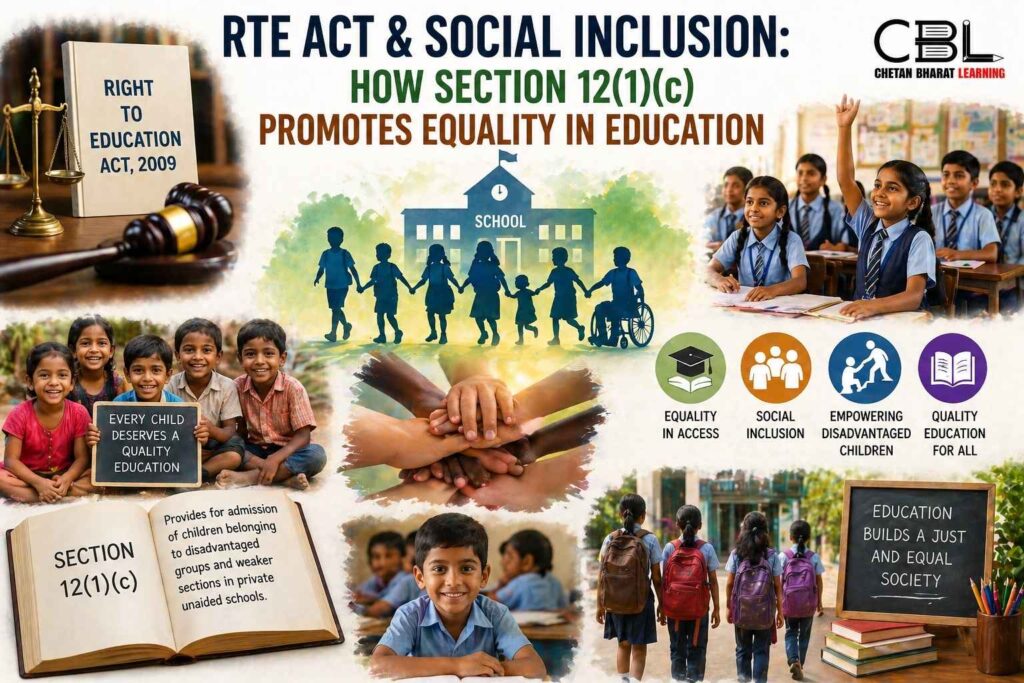
Key Idea:
- Students from different backgrounds:
→ Study together
Outcome:
- Breaks social barriers
- Promotes equality
Why is This Important?
1. Equality of Opportunity
- Reduces socio-economic divide
2. Social Integration
- Builds shared learning spaces
3. Long-Term Impact
- Improves:
- Aspirations
- Social mobility
Debate & Challenges
Challenges:
- Hidden costs (uniforms, books)
- Implementation gaps
- Delays in reimbursements to schools
- Resistance from private institutions
Administrative Issues:
- Lack of transparency
- Weak grievance redressal
- Uneven implementation across states
Ground Reality
- Millions of children benefited
- Mixed classrooms:
→ Increase social understanding
→ Reduce discrimination
India-Specific Significance
- Addresses:
- Educational inequality
- Social exclusion
➤Supports:
- Inclusive development
Key Insight for UPSC
➤ RTE is not just an education law
It is:
- A social justice tool
- A constitutional vision of equality
PRELIMS PRACTICE QUESTIONS
Q1. RTE Act was enacted in:
A. 2005
B. 2009
C. 2012
D. 2015
✅ Answer: B
Q2. Section 12(1)(c) provides:
A. Free college education
B. 25% reservation in private schools
C. Scholarship only
D. Teacher training
✅ Answer: B
Q3. RTE applies to age group:
A. 0–6 years
B. 6–14 years
C. 14–18 years
D. 18–25 years
✅ Answer: B
Q4. RTE promotes
A. Economic growth only
B. Social inclusion
C. Industrial development
D. Trade
✅ Answer: B
Q5. Which Article relates to education?
A. Article 21A
B. Article 19
C. Article 32
D. Article 44
✅ Answer: A
CBL Mains Practice Question
“Section 12(1)(c) of the RTE Act is a powerful instrument of social integration in India.”
Discuss its significance and challenges.
FAQs
1. What is Section 12(1)(c)?
A provision mandating 25% reservation in private schools.
2. Who benefits from RTE?
Children from economically weaker and disadvantaged groups.
3. Why is it important?
It promotes equality and social integration.
4. What are the challenges?
Implementation gaps, hidden costs, and resistance.
5. Which GS paper covers this topic?
GS Paper 2 — Polity & Social Justice.
Related Current Affairs
Preparing for UPSC, PCS or HCS?
Talk to a mentor at Chetan Bharat Learning, Chandigarh. Free guidance on choosing the right exam and building a study plan.
Chat on WhatsAppCall 97793 53345UPSC / IAS / PCS coaching in Chandigarh · Trusted by aspirants across Punjab & Haryana
Leave a Reply
You must be logged in to post a comment.