

What happened and why does it matter?
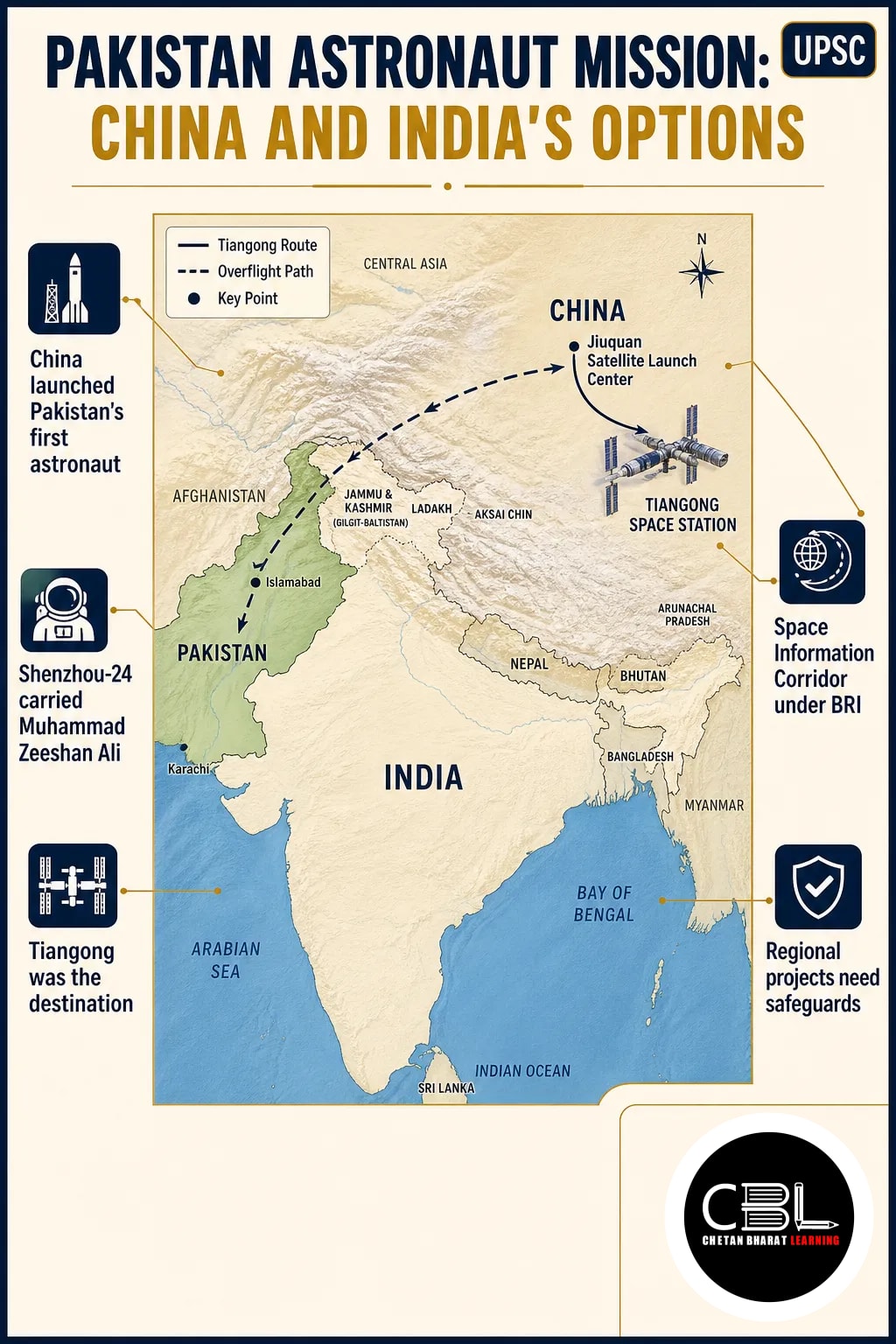
China’s Shenzhou-24 carried Pakistan’s first astronaut to its Tiangong space station. The mission gives Pakistan experience in human spaceflight through cooperation with China.
In diplomatic terms, the launch demonstrates how access to advanced facilities can strengthen partnerships. The Hindu editorial describes this as part of Beijing’s Space Silk Road diplomacy. It also argues that such networks can expand China’s influence in South Asia.
For comparison, the editorial points to the United States-based Axiom-4 mission as a significant experience for the Indian Space Research Organisation (ISRO). India’s own space ambitions provide a separate context; see CBL’s explainer on the proposed Bhartiya Antriksh Station.
Key facts and cooperation platforms
The Pakistan astronaut mission connects a bilateral launch with wider regional space cooperation platforms.
| Item | Relevance |
|---|---|
| Shenzhou-24 | Chinese mission that carried Muhammad Zeeshan Ali to Tiangong. |
| Asia-Pacific Space Cooperation Organization | Regional space cooperation organisation that includes Pakistan and Bangladesh. |
| Space Information Corridor | A space-related cooperation platform under China’s Belt and Road Initiative. |
| Axiom-4 | United States-based mission cited as a significant spaceflight experience for ISRO. |
The editorial suggests that the Shenzhou-24 experience could lower Pakistan’s costs of accessing future opportunities. However, that is an assessment of potential benefits, not a quantified mission outcome.
Why is regional satellite cooperation relevant?
Earlier disagreement over a proposed regional satellite shows how programme design can shape scientific partnerships.
In 2015, Pakistan offered to contribute to India’s proposed satellite for the South Asian Association for Regional Cooperation (SAARC). Pakistan wanted SAARC to administer the project; India preferred to operate it as a contribution to its neighbours.
The editorial argues that shared administration could have created an institutional channel between ISRO and Pakistan’s Space and Upper Atmosphere Research Commission (SUPARCO). However, this is a counterfactual: the proposed relationship and its diplomatic benefits cannot be treated as established outcomes.
For India, the lesson is broader than one satellite. Regional projects can offer services while also creating relationships among scientists and institutions. Their diplomatic value, therefore, depends partly on whether partners see a meaningful role in their governance.
What are the implications for India?
The launch highlights both competition with China and the cost of limited India-Pakistan scientific contact.
- Regional influence: Access to missions and infrastructure can make a space partner valuable; consequently, China’s cooperation can strengthen its regional networks.
- Shared geography: Indian and Pakistani scientists have fewer substitutes for studying conditions across their shared region. Thus, restricted contact can constrain work on environmental problems.
- Institutional access: Regular scientific channels could sustain technical dialogue when broader diplomacy is strained. Moreover, they can help countries address practical problems without settling every political dispute first.
- Strategic asymmetry: The editorial considers India technologically ahead of Pakistan in spaceflight, but behind China. Therefore, India’s regional choices also involve competition with a more capable space power.
Space diplomacy is not identical to a formal alliance. Nevertheless, repeated cooperation can build technical familiarity and relationships that influence future choices. For another perspective on neighbourhood engagement, see CBL’s analysis of India-Nepal relations and bilateral concerns.
What are the opportunities and concerns?
Science diplomacy can address common problems, but it cannot remove security differences by itself.
The editorial cites the Cold War Apollo-Soyuz interaction and India-Pakistan cooperation against a locust outbreak after the 2019 Balakot crisis. These examples show that technical cooperation can remain possible amid political strain. However, neither example guarantees durable improvement in relations.
Furthermore, sensitive data and technologies require scrutiny. Governments must distinguish civilian exchanges from activities that raise security concerns. Domestic political opposition and mistrust can also interrupt even technically useful programmes.
As a result, treating every scientific contact as either a security threat or a diplomatic breakthrough would be misleading. Cooperation needs defined objectives, while counter-terrorism and other security concerns remain separate matters for policy.
What should India consider as a way forward?
India could pursue limited, issue-specific scientific engagement alongside clear security safeguards.
- Start with shared problems: Explore technical exchanges on environmental conditions and locust response, where geography creates common interests.
- Define safeguards: Specify permissible data, participating institutions and review procedures before any exchange. Consequently, scientific cooperation need not imply unrestricted access.
- Build institutional channels: Consider structured contact among relevant agencies and scientists. In addition, regional platforms could provide continuity beyond individual events.
- Make partnerships inclusive: Consult potential regional partners on project design and governance. Thus, cooperation can offer participation as well as services.
- Assess outcomes: Review whether exchanges improve information access and problem-solving. However, retain the option to pause activities when security conditions require it.
Overall, the Pakistan astronaut mission is a reminder that scientific capacity can serve diplomatic as well as technical goals. For India, the policy challenge is to combine regional engagement with credible safeguards, rather than assume that either objective excludes the other.
Source: The Hindu, 29 November 2026
- Bhartiya Antriksh Station (BAS) (5 Nov 2024)
Asked in UPSC: Previous Year Questions
- UPSC CSE Mains 2026 (GS Paper II): Analyse the strategic implications of China’s Belt and Road Initiative for India’s security and regional influence in South Asia.
UPSC links China’s regional initiatives to India’s security and influence, so connect space partnerships to the wider strategic context.
Punjab PCS and Haryana HCS may test the mission, astronaut and regional organisations in General Studies. In addition, candidates can connect scientific cooperation to shared environmental and agricultural challenges.
Prelims Practice Corner
Mains Practice Questions
Frequently Asked Questions
Who is Pakistan’s first astronaut?
Muhammad Zeeshan Ali is Pakistan’s first astronaut. China launched him aboard Shenzhou-24 on 25 November 2026.
Which space station did Shenzhou-24 visit?
Tiangong was the mission’s destination. It is China’s space station and hosted the Pakistan astronaut mission.
Why is science diplomacy relevant to India and Pakistan?
It can support cooperation on shared environmental and other technical problems. However, such engagement requires safeguards and does not replace security policy.
Related Current Affairs
Preparing for UPSC, PCS or HCS?
Talk to a mentor at Chetan Bharat Learning, Chandigarh. Free guidance on choosing the right exam and building a study plan.
Chat on WhatsAppCall 97793 53345UPSC / IAS / PCS coaching in Chandigarh · Trusted by aspirants across Punjab & Haryana





Leave a Reply
You must be logged in to post a comment.