
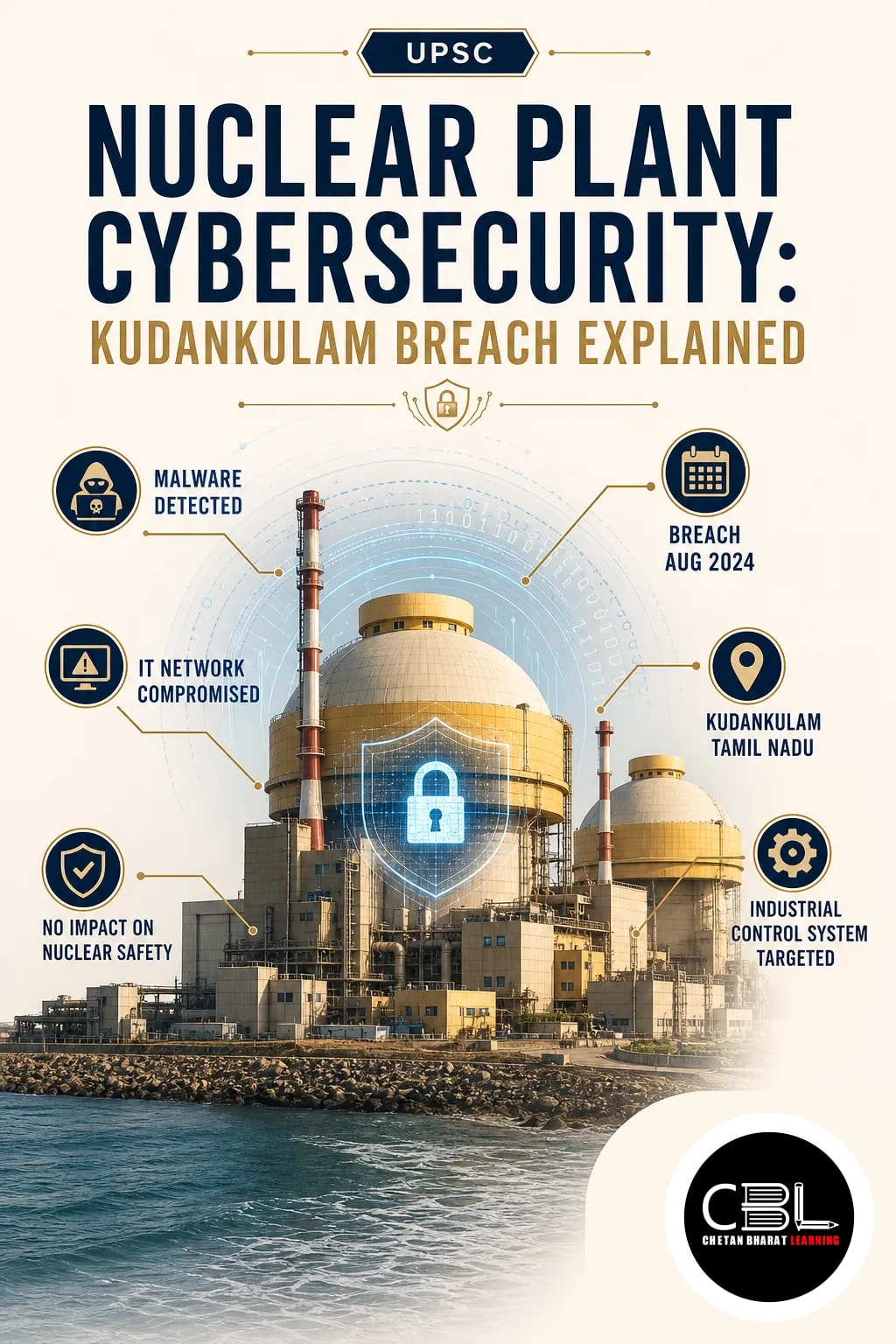

nuclear plant cybersecurity has moved beyond perimeter walls, as the Kudankulam breach shows. Read our related current affairs coverage to place this issue in the wider security context.
What is nuclear plant cybersecurity?
It refers to the protection of digital systems, data, contractors and networks linked to a nuclear facility. The Kudankulam episode shows that the risk may sit outside the reactor room, yet still affect security planning.
For a nuclear installation, cybersecurity is not only about isolated control systems. It also includes the contractor ecosystem, third-party storage, software vendors, and administrative networks.
Why in News?
According to the report, files linked to Kudankulam were allegedly posted on a dark web portal after a ransomware-linked incident. The material reportedly included engineering drawings, supplier records, inspection files, minutes and insurance documents.
The central concern is not that the reactor was breached. Rather, the incident highlights how sensitive information can leak through a contractor or a data centre that handles project data.
Key Features
- Outer perimeter matters – A nuclear facility may keep control systems air-gapped, yet supporting data can remain exposed elsewhere.
- Multiple actors hold sensitive data – Contractors, subcontractors, cloud providers, insurers and certifiers may all retain operational information.
- Supply-chain cybersecurity – Security now depends on the weakest link across the data chain, not only the main operator.
- Administrative networks can be risky – The article recalls the 2019 Dtrack episode as an earlier sign of peripheral vulnerability.
- Operational data may be misused – Drawings, schedules and credentials can aid phishing or reconnaissance even without direct system access.
- Accountability is fragmented – Operators, vendors and hosts may each deny full responsibility when data moves across systems.
Challenges
- Limited legal clarity – Protection often follows the operator’s system, while shared project data outside it gets weaker coverage.
- Uneven standards – Service providers may apply different security practices, especially across commercial data centres and subcontractors.
- Hard to assign liability – Each party can point to another, leaving gaps in accountability.
- Critical data, non-critical storage – Sensitive technical information may sit on infrastructure not governed like the main facility.
- Expanding digital footprint – Smart grids, cloud platforms and private participation widen the attack surface around strategic sectors.
Way Forward
India needs a whole-of-ecosystem approach for strategic infrastructure. That means uniform security expectations for contractors, better audit trails, stricter data segmentation and clearer incident reporting duties.
CERT-In and NCIIPC already provide a governance base. The next step is to extend practical safeguards to every entity that stores or processes sensitive infrastructure data.
Project documents should be classified, access-controlled and periodically reviewed across the supply chain. Contract clauses, vendor vetting and secure hosting standards must become part of critical infrastructure planning.
Source: The Hindu Lead, October 27, 2026
This topic fits state PCS General Studies under internal security, cyber governance and infrastructure protection. It also helps in questions on public utilities, digital administration and the legal duties of state agencies when critical data is handled by private vendors.
FAQ
Did the Kudankulam reactor get hacked?
The available material says there is no public indication that reactor or safety control systems were accessed. The concern is about data stored outside the plant, especially with contractors and hosting providers.
Why is contractor data important in a nuclear plant case?
Contractors may hold drawings, schedules, credentials and reports that help attackers understand systems. Such information can support phishing, reconnaissance or future intrusion attempts.
What is the exam relevance of this issue?
It links cybersecurity with critical infrastructure, IT law and governance. For UPSC and state PCS exams, it is useful for internal security, science and technology, and public policy questions.
Related Current Affairs
Preparing for UPSC, PCS or HCS?
Talk to a mentor at Chetan Bharat Learning, Chandigarh. Free guidance on choosing the right exam and building a study plan.
Chat on WhatsAppCall 97793 53345UPSC / IAS / PCS coaching in Chandigarh · Trusted by aspirants across Punjab & Haryana
Leave a Reply
You must be logged in to post a comment.