
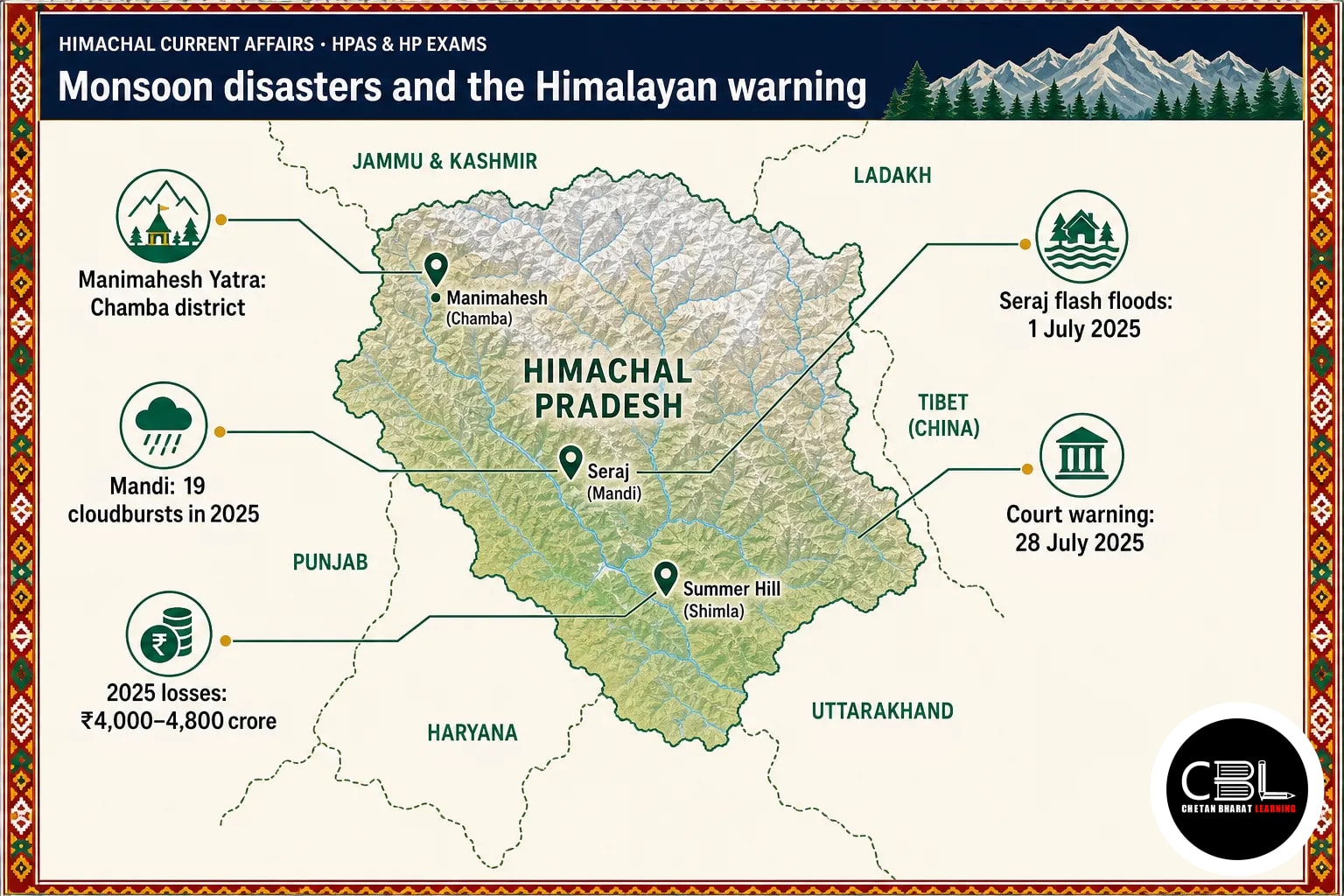
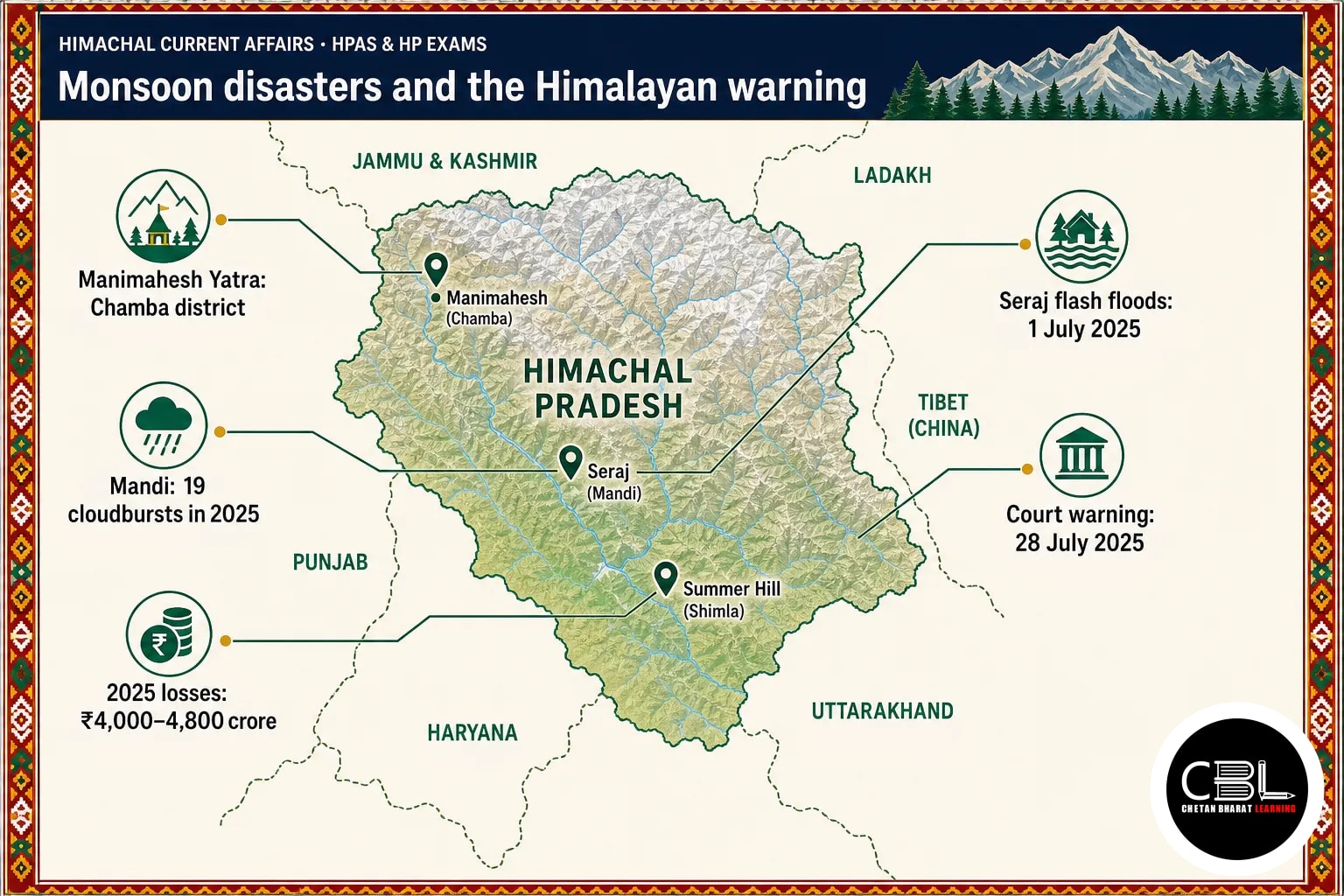
Himachal Pradesh faced destructive monsoons in 2023 and 2025. Flash floods struck Seraj in Mandi on the night of 30 June–1 July 2025. On 28 July 2025, the Supreme Court warned that Himachal could vanish from the map if destructive activities continued. It took up ecological imbalance as a public interest case. Later reports put 2025 monsoon losses at ₹4,000–4,800 crore and deaths at about 448.
Timeline: from landslide to warning
- Aug2023Summer Hill
A landslide struck the Shiv Bawdi temple in Shimla; state ministers cited monsoon losses near ₹10,000 crore.
- 30 Jun–1 Jul2025Seraj floods
Cloudbursts and flash floods struck Seraj in Mandi during the night.
- 28 Jul2025Court warning
The Supreme Court warned of ecological damage and took up a public interest case.
- Aug2025Yatra tragedy
During heavy rain, 16 pilgrims died during the Manimahesh Yatra, the Chief Minister said.
- 2025season totalSeason toll
Later reports put monsoon losses at ₹4,000–4,800 crore and deaths at about 448.
- Mandi recorded the most reported cloudbursts in the 2025 season: 19.
- Seraj in Mandi was hit by flash floods on the night of 30 June–1 July 2025.
- The Supreme Court issued its Himachal ecological warning on 28 July 2025.
- The Manimahesh Yatra takes place in the Bharmour area of Chamba district.
- A cloudburst means at least 100 mm of rain in one hour over a small area.
What lies behind the disaster warning?
The Himalayas are young fold mountains, with slopes vulnerable to landslides. The India Meteorological Department defines a cloudburst as at least 100 mm of rain in an hour over a small area. Such intense rain can trigger flash floods and debris flows.
On 28 July 2025, Justices J.B. Pardiwala and R. Mahadevan warned that Himachal could vanish from the map if the situation continued. They identified hydropower projects, four-laning, deforestation and multi-storey construction as human pressures. The court converted the matter into a suo motu public interest litigation, meaning a case taken up on its own initiative, and later appointed an amicus curiae, or friend of the court.
Why it matters
Flash floods and landslides threaten lives, homes and access routes. Heavy rain also affected pilgrims during the Manimahesh Yatra.
Later reports put 2025 monsoon losses at ₹4,000–4,800 crore. Damage can disrupt livelihoods, transport and public services.
The court warning links infrastructure and construction decisions with ecological risk. Disaster response and land-use regulation must address these pressures.
- District: Mandi town is the headquarters of Mandi district.
- River: The Beas flows through Mandi and Kullu districts.
- Temple: Manimahesh is associated with Lord Shiva and lies in Chamba district.
Key data
| Point | Details |
|---|---|
| 2023 losses | Near ₹10,000 crore, cited by state ministers |
| 2025 cloudbursts | Mandi 19; Kullu 12; Chamba 6, reported season counts |
| 2025 losses and deaths | ₹4,000–4,800 crore and about 448 deaths, later reports |
| Supreme Court warning | 28 July 2025; ecological imbalance taken up as a public interest case |
| Cloudburst threshold | At least 100 mm of rain in one hour over a small area |
| Legal and constitutional hooks | Disaster Management Act, 2005; Articles 48A and 51A(g) |
Way forward
- Risk-sensitive planning: Use hazard maps to guide construction and protect floodplains.
- Early warning: Connect weather alerts with local evacuation plans and accessible communication.
- Safer infrastructure: Assess cumulative ecological risks before road widening and hydropower works.
- Community preparedness: Conduct drills and identify safe shelters with residents and local bodies.
- Recovery and ecology: Restore damaged services while protecting slopes, drainage and vegetation.
HPAS Mains practice questions
Explain the significance of the Supreme Court’s 2025 warning for Himachal Pradesh. (150 words)
Answer pointers:
- Introduce the 28 July warning and ecological imbalance case.
- Identify human pressures named by the court.
- Connect these pressures to disaster risk and governance.
- Conclude with risk-sensitive development.
Critically examine infrastructure development and ecological security in Himachal Pradesh. (250 words)
Answer pointers:
- Introduce Himalayan vulnerability and the 2025 warning.
- Discuss connectivity, energy and livelihood benefits of infrastructure.
- Examine slope damage, deforestation and cumulative risks.
- Conclude with rigorous assessment and safer design.
As SDM of a subdivision in Mandi district, how would you manage a flash-flood warning? Discuss. (150 words)
Answer pointers:
- Begin with immediate verification and coordination.
- Issue accessible alerts and evacuate exposed settlements.
- Arrange shelters, medical aid and safe routes.
- Conclude with damage assessment and resilient recovery.
Discuss how Articles 48A and 51A(g) can guide disaster-resilient development in Himachal Pradesh. (150 words)
Answer pointers:
- Introduce environmental protection as a constitutional concern.
- Explain the state’s directive under Article 48A.
- Explain citizens’ duty under Article 51A(g).
- Conclude with joint action on risk and ecological protection.
For the Himachal Pradesh Administrative Service (HPAS) prelims and Himachal Pradesh Rajya Chayan Aayog (HPRCA) papers, memorise the warning date and the Mandi–Kullu–Chamba cloudburst counts. For mains, connect disaster risk with infrastructure and environmental governance.
MCQ Practice Corner
Q1. Consider the following statements about Himachal’s 2025 monsoon:
1. Mandi reported 19 cloudbursts during the season.
2. Kullu reported more cloudbursts than Chamba.
3. The Supreme Court warning was issued on 28 July 2025.
Which statements are correct?
(a) 1 and 2 only (b) 2 and 3 only (c) 1 and 3 only (d) 1, 2 and 3
Show answer
Answer: (d) because the reported counts were Mandi 19, Kullu 12 and Chamba 6, and the warning came on 28 July.
Q2. Which activity was identified by the Supreme Court as a human pressure on Himachal’s ecology?
(a) Four-laning (b) Weather forecasting (c) Evacuation drills (d) Rainfall measurement
Show answer
Answer: (a) because the court identified four-laning among the activities placing pressure on the environment.
Q3. The Manimahesh Yatra is associated with which Himachal district?
(a) Una (b) Chamba (c) Solan (d) Sirmaur
Show answer
Answer: (b) because Manimahesh lies in the Bharmour area of Chamba district.
Q4. A cloudburst involves at least how much rain in one hour over a small area?
(a) 10 mm (b) 25 mm (c) 50 mm (d) 100 mm
Show answer
Answer: (d) because the meteorological definition uses a threshold of 100 mm in one hour.
Frequently Asked Questions
What did the Supreme Court say about Himachal Pradesh in 2025?
On 28 July, it warned that the state could vanish from the map if destructive activities continued. The court took up ecological imbalance as a public interest case.
Which Himachal district reported the most cloudbursts in 2025?
Mandi reported the most, with 19 cloudbursts. Kullu followed with 12 and Chamba with six.
What were the reported Himachal monsoon losses in 2025?
Later reports put the losses at ₹4,000–4,800 crore. They also reported about 448 deaths during the season.
Sources: The Tribune, Down To Earth, LiveLaw, The Federal
Related Current Affairs
More Himachal topics for HPAS & HP exams
Preparing for UPSC, PCS or HCS?
Talk to a mentor at Chetan Bharat Learning, Chandigarh. Free guidance on choosing the right exam and building a study plan.
Chat on WhatsAppCall 97793 53345UPSC / IAS / PCS coaching in Chandigarh · Trusted by aspirants across Punjab & Haryana



Leave a Reply
You must be logged in to post a comment.