
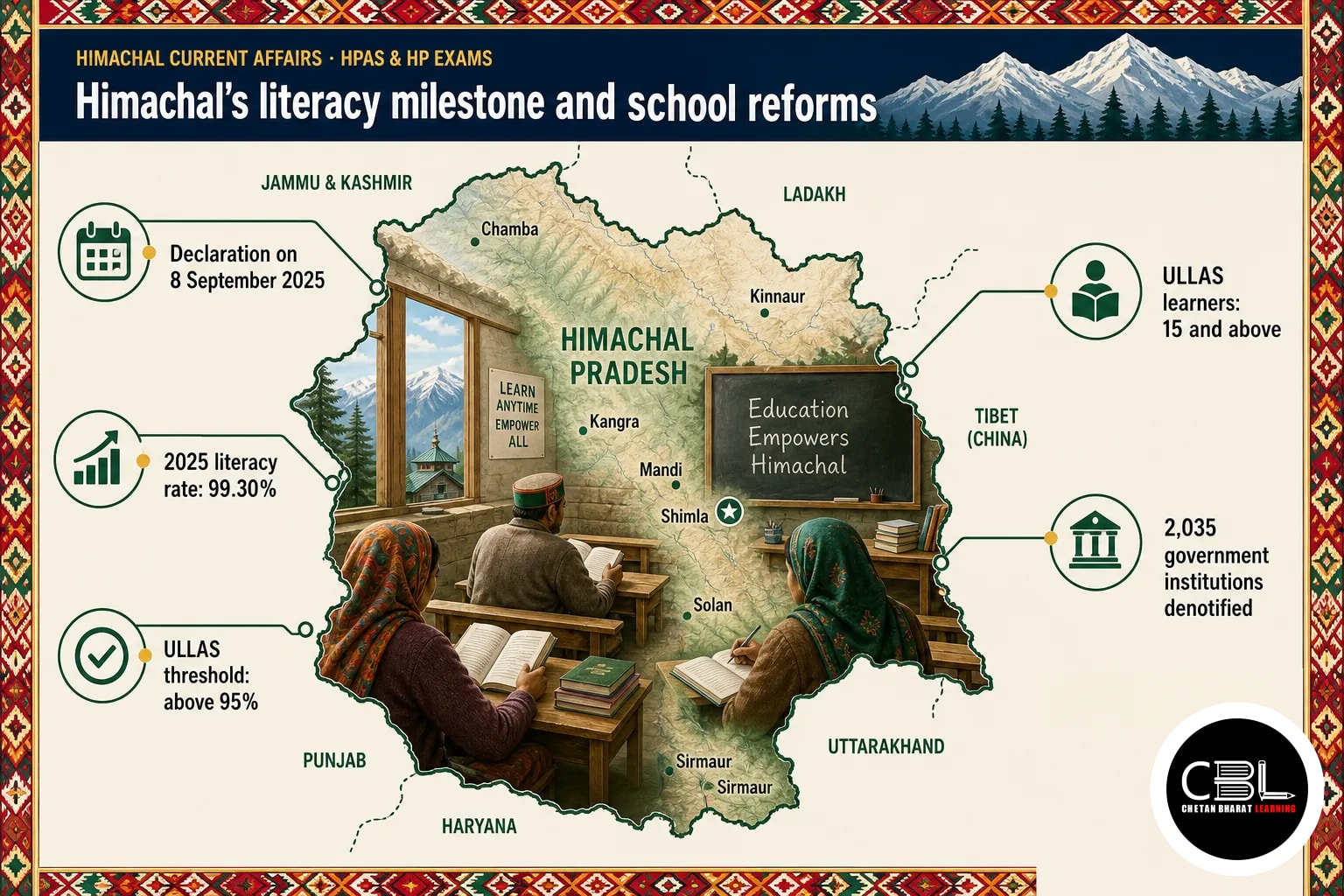
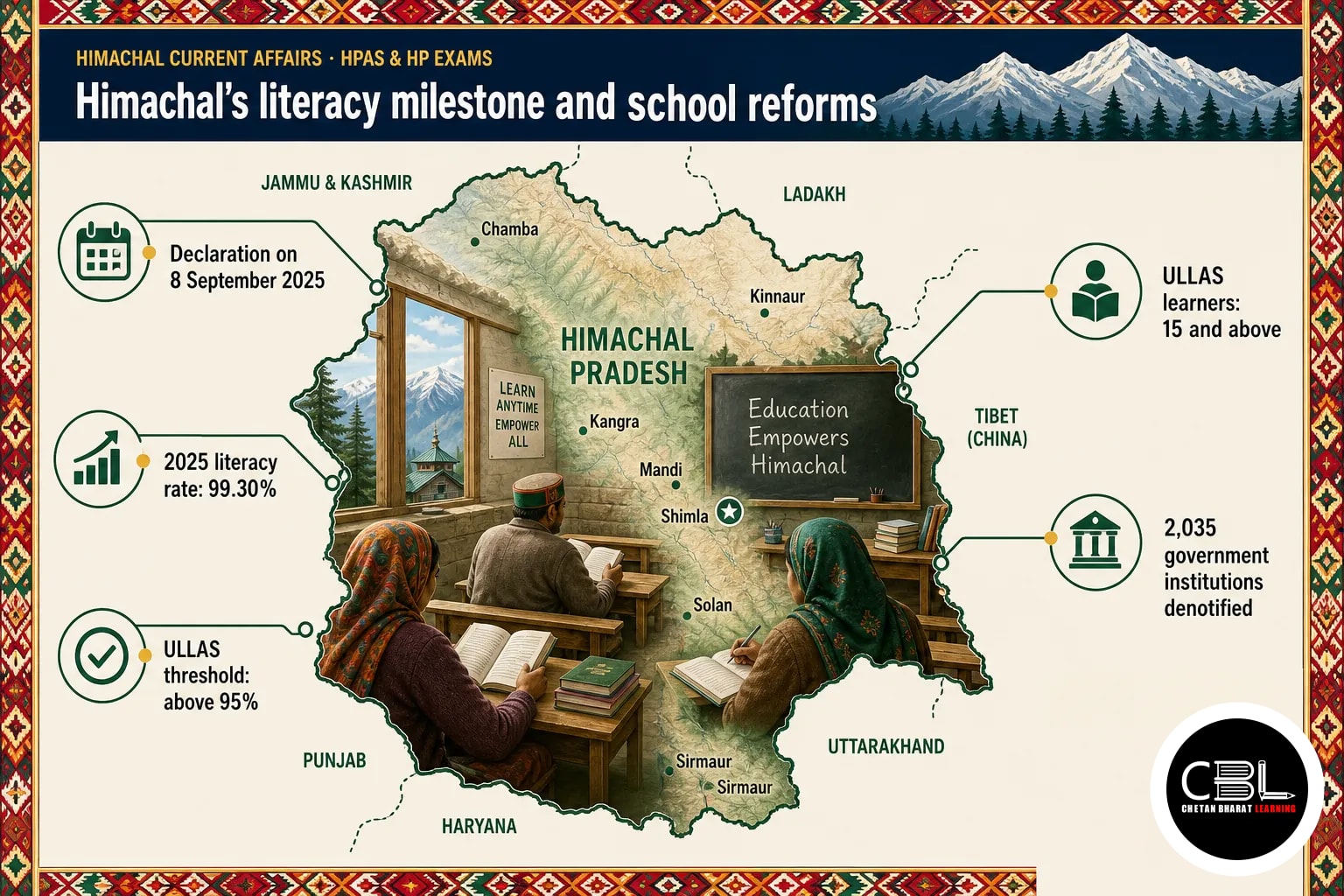
On 8 September 2025, Chief Minister Sukhvinder Singh Sukhu declared Himachal Pradesh a fully literate state, with 99.30% literacy. The declaration came under Understanding of Lifelong Learning for All in Society (ULLAS), which uses a threshold above 95%. Himachal was widely reported as the fourth state to reach the status. A later report put literacy at 99.55% by September 2026. School reforms include denotification of institutions and day boarding schools.
Timeline: the literacy journey
- 1948Early baselineStarting point
Himachal’s literacy was reported at about 7%.
- 2011CensusCensus count
The Census recorded Himachal’s literacy rate at 82.8%.
- 2022Programme startAdult learning
ULLAS, the New India Literacy Programme for adults aged 15 and above, began its 2022–27 period.
- 8 Sept2025Declaration
Himachal declared full-literacy status on International Literacy Day, reporting 99.30% literacy.
- Sept2026Later report
One report put the literacy rate at 99.55% by September 2026.
- Himachal declared full-literacy status on 8 September 2025.
- The declaration reported literacy at 99.30%.
- The ULLAS full-literacy threshold is above 95%.
- Himachal was widely reported as the fourth state to attain the status.
- ULLAS targets adults aged 15 and above.
What does fully literate mean under ULLAS?
Under ULLAS, a state qualifies as fully literate when its literacy rate exceeds 95%. The status therefore does not mean that every resident is literate. ULLAS, also called the New India Literacy Programme, runs from 2022 to 2027 for adults aged 15 and above.
Himachal’s 2011 Census literacy rate was 82.8%; the 2025 declaration reported 99.30%. The state has also denotified 2,035 government institutions, including schools with few students, citing staffing and infrastructure issues. Other reported reforms include Rajiv Gandhi Day Boarding Schools and Central Board of Secondary Education (CBSE) affiliation for some government schools.
Why it matters
Literacy can help adults read information and access services. ULLAS focuses on learners aged 15 and above.
School reorganisation can affect travel distances in mountainous areas. The state cited staffing and infrastructure issues when denotifying institutions.
Adult literacy and school education need distinct responses. Article 21A protects free and compulsory education for children aged 6–14.
- University: Himachal Pradesh University was established in 1970 in Shimla.
- District: Hamirpur is a district of Himachal Pradesh; its headquarters is Hamirpur.
- Capital: Shimla is the capital of Himachal Pradesh.
Key data
| Point | Details |
|---|---|
| 2011 Census literacy | 82.8% |
| Declaration | 8 September 2025; reported literacy of 99.30% |
| ULLAS threshold | Literacy above 95% |
| ULLAS period and group | 2022–27; adults aged 15 and above |
| Later reported rate | 99.55% by September 2026, according to one report |
| Institutions denotified | 2,035 government institutions |
| Constitutional provision | Article 21A: free and compulsory education for children aged 6–14 |
Way forward
- Reach remaining learners: Offer flexible adult learning opportunities suited to local needs.
- Protect school access: Assess travel time and safe routes before reorganising schools.
- Improve teaching: Match staff deployment and infrastructure to enrolment and learning needs.
- Track outcomes: Monitor literacy skills and school learning alongside enrolment.
- Plan for the hills: Consult communities and account for Himalayan terrain when locating facilities.
HPAS Mains practice questions
Explain the significance of Himachal’s full-literacy declaration and the role of ULLAS. (150 words)
Answer pointers:
- Introduce the 2025 declaration and 99.30% rate.
- Explain the above-95% threshold.
- Describe the programme’s focus on adults aged 15 and above.
- Conclude with the need to reach remaining learners.
Critically examine school reorganisation alongside Himachal’s literacy progress. (250 words)
Answer pointers:
- Introduce literacy gains and denotification of institutions.
- Discuss potential benefits of better staff and infrastructure use.
- Examine access, travel and learning concerns in hill areas.
- Conclude with consultation and outcome monitoring.
As Sub-Divisional Magistrate (SDM) of Hamirpur, how would you address access concerns during school reorganisation? (150 words)
Answer pointers:
- Begin with child access and safety.
- Map affected students, routes and travel times.
- Consult families, schools and education officials on practical arrangements.
- Monitor attendance and resolve grievances after changes.
Discuss how Article 21A and adult literacy programmes address different education needs in Himachal Pradesh. (150 words)
Answer pointers:
- Introduce education as a continuing public responsibility.
- Explain Article 21A for children aged 6–14.
- Contrast ULLAS support for adults aged 15 and above.
- Conclude with coordinated, age-appropriate access.
For Himachal Pradesh Administrative Service (HPAS) prelims and Himachal Pradesh Rajya Chayan Aayog (HPRCA) papers, memorise the declaration date, 99.30% rate and above-95% threshold. For mains, connect literacy to access and school governance.
MCQ Practice Corner
Q1. Consider the following statements about Himachal’s literacy declaration:
1. It was made on International Literacy Day in 2025.
2. ULLAS requires literacy to exceed 95% for full-literacy status.
3. The declaration reported a literacy rate of 82.8%.
Which statements are correct?
(a) 1 and 2 only (b) 2 and 3 only (c) 1 and 3 only (d) 1, 2 and 3
Show answer
Answer: (a) because the declaration reported 99.30%; 82.8% was the 2011 Census rate.
Q2. Which pairing correctly distinguishes Article 21A from ULLAS?
(a) Both cover only adults (b) Article 21A covers children aged 6–14; ULLAS targets adults aged 15 and above (c) Article 21A covers only university students (d) ULLAS is a constitutional article
Show answer
Answer: (b) because the constitutional provision and adult literacy programme address different age groups.
Q3. What literacy rate did Himachal report at its 2025 declaration?
(a) 82.8% (b) 95% (c) 99.30% (d) 99.55%
Show answer
Answer: (c) because the 8 September 2025 declaration reported 99.30%.
Q4. Himachal was widely reported as which state to attain full-literacy status?
(a) First (b) Second (c) Third (d) Fourth
Show answer
Answer: (d) because reports placed Himachal fourth after Mizoram, Goa and Tripura.
Frequently Asked Questions
When was Himachal Pradesh declared fully literate?
Himachal Pradesh declared the status on 8 September 2025. The declaration coincided with International Literacy Day.
Does fully literate mean 100% literacy under ULLAS?
No. The ULLAS threshold for full-literacy status is a literacy rate above 95%.
What school reforms are linked to Himachal’s literacy story?
They include denotification of government institutions, Rajiv Gandhi Day Boarding Schools and CBSE affiliation for some government schools. The state cited staffing and infrastructure issues in the denotification decision.
Sources: The Tribune: literacy declaration, The CSR Journal: ULLAS, The Tribune: institution denotification
Related Current Affairs
More Himachal topics for HPAS & HP exams
Preparing for UPSC, PCS or HCS?
Talk to a mentor at Chetan Bharat Learning, Chandigarh. Free guidance on choosing the right exam and building a study plan.
Chat on WhatsAppCall 97793 53345UPSC / IAS / PCS coaching in Chandigarh · Trusted by aspirants across Punjab & Haryana



Leave a Reply
You must be logged in to post a comment.