
Important for:
UPSC, Haryana HCS, Punjab PCS
Prelims: Sixth Schedule, Union Territories, Ladakh districts
Mains: GS Paper 2 — Polity, Governance, Federalism, Tribal Rights
Why in News?
Leaders of the Leh Apex Body (LAB), representing various socio-political and religious groups, have sought a meeting with Amit Shah to discuss demands for statehood and inclusion of Ladakh under the Sixth Schedule of the Constitution.
Background: Ladakh’s Status
- Became a Union Territory in 2019
- Formed after reorganisation of Jammu and Kashmir
- Does not have:
→ Legislative Assembly
What is the Sixth Schedule?
- Provides autonomous governance to tribal areas
Key Features:
- Autonomous District Councils (ADCs)
- Powers over:
- Land
- Forest
- Local governance
➤Currently applies to:
- Assam
- Meghalaya
- Tripura
- Mizoram
Why is Ladakh Demanding Sixth Schedule Status?
Key Reasons:
- Protection of:
- Tribal identity
- Culture
- Land rights
- Concerns over:
- Rapid development
- Demographic changes
Demand for Statehood
- Local groups want:
→ Full-fledged statehood
Reason:
- Greater political representation
- Legislative powers
- Administrative autonomy
Recent Developments
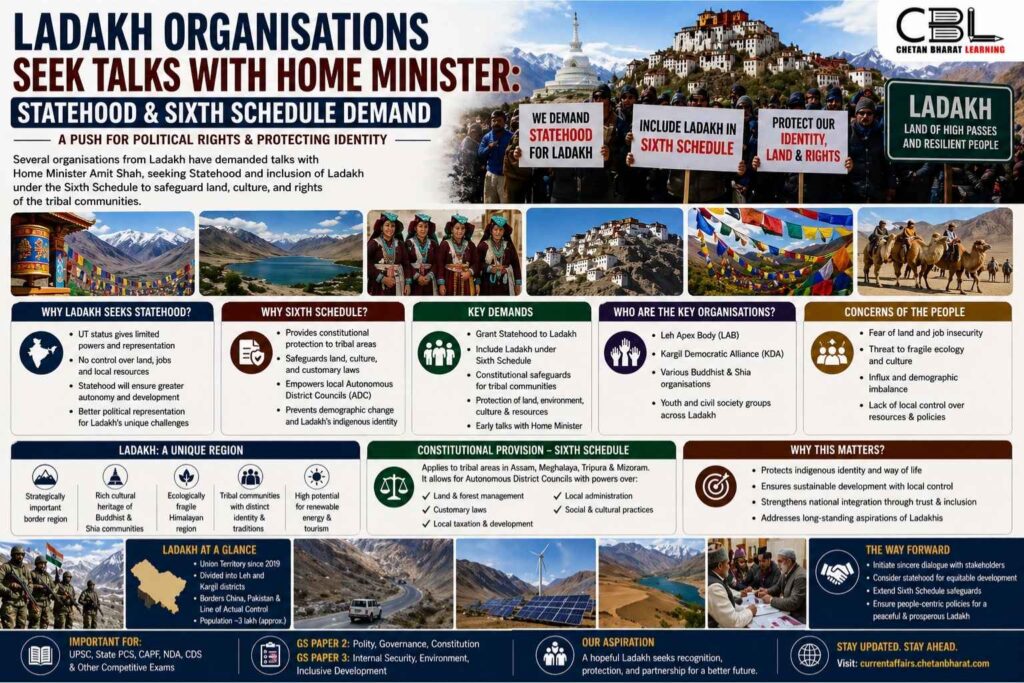
- Union Home Minister’s visit planned
- Dialogue process to resume
- Creation of 5 new districts:
- Nubra
- Sham
- Changthang
- Zanskar
- Drass
Governance Challenges in Ladakh
- Remote geography
- Sparse population
- Limited administrative reach
- Strategic border region
Broader Constitutional Issue
| Issue | Dimension |
|---|---|
| Sixth Schedule demand | Tribal autonomy |
| Statehood demand | Federal structure |
| UT status | Central control |
| Development vs identity | Governance challenge |
India-Specific Significance
- Raises questions about:
- Federalism
- Decentralisation
- Regional aspirations
- Similar demands seen in:
→ Other regions seeking autonomy
PRELIMS PRACTICE QUESTIONS
Q1. Sixth Schedule applies to:
A. All states
B. Only Union Territories
C. Selected tribal areas
D. Entire Northeast
✅ Answer: C
Q2. Which of the following states are covered under Sixth Schedule?
- Assam
- Meghalaya
- Nagaland
A. 1 and 2 only
B. 2 and 3 only
C. 1 only
D. 1, 2 and 3
✅ Answer: A
Q3. Ladakh became a Union Territory in:
A. 2014
B. 2016
C. 2019
D. 2020
✅ Answer: C
Q4. Union Territories are administered by:
A. Chief Minister
B. Governor
C. President through Administrator
D. Parliament only
✅ Answer: C
Q5. Sixth Schedule deals with:
A. Emergency provisions
B. Tribal governance
C. Election process
D. Judiciary
✅ Answer: B
CBL Mains Practice Question
“Demands for autonomy in regions like Ladakh highlight the tension between centralised governance and local aspirations.”
Discuss in the context of Sixth Schedule and statehood demands. (250 words)
FAQs
1. Why is Ladakh demanding Sixth Schedule status?
To protect tribal identity, land, and cultural rights.
2. What is the Sixth Schedule?
It provides autonomous governance to tribal areas.
3. Why is statehood being demanded?
For better political representation and administrative autonomy.
4. Which GS paper covers this topic?
GS Paper 2 — Polity and Governance.
5. What is the issue here?
Balancing development, identity, and federal structure.
Related Current Affairs
Preparing for UPSC, PCS or HCS?
Talk to a mentor at Chetan Bharat Learning, Chandigarh. Free guidance on choosing the right exam and building a study plan.
Chat on WhatsAppCall 97793 53345UPSC / IAS / PCS coaching in Chandigarh · Trusted by aspirants across Punjab & Haryana
Leave a Reply
You must be logged in to post a comment.