
LAC Border Management: UPSC Challenges & Way Forward
UPSC Mapping
| Prelims | Mains |
|---|---|
| International Relations | GS Paper 2 (IR) |
Quick Facts
| Recent Location | Taksing, Upper Subansiri |
|---|---|
| Core Mechanism | Corps Commander Talks |
| Primary Goal | Prevent unintended escalation |
The LAC border management framework represents a critical diplomatic and military priority for India. Recent Corps Commander-level talks in the Taksing area of Upper Subansiri district highlight ongoing efforts to stabilize the frontier. Aspirants must thoroughly understand this strategic paradigm for the upcoming civil services examination. You can explore more such vital topics in our daily current affairs archive. This engagement aims to prevent unintended escalation along the sensitive northern borders. It reflects a mature approach to handling complex geopolitical friction points.
What is LAC border management?
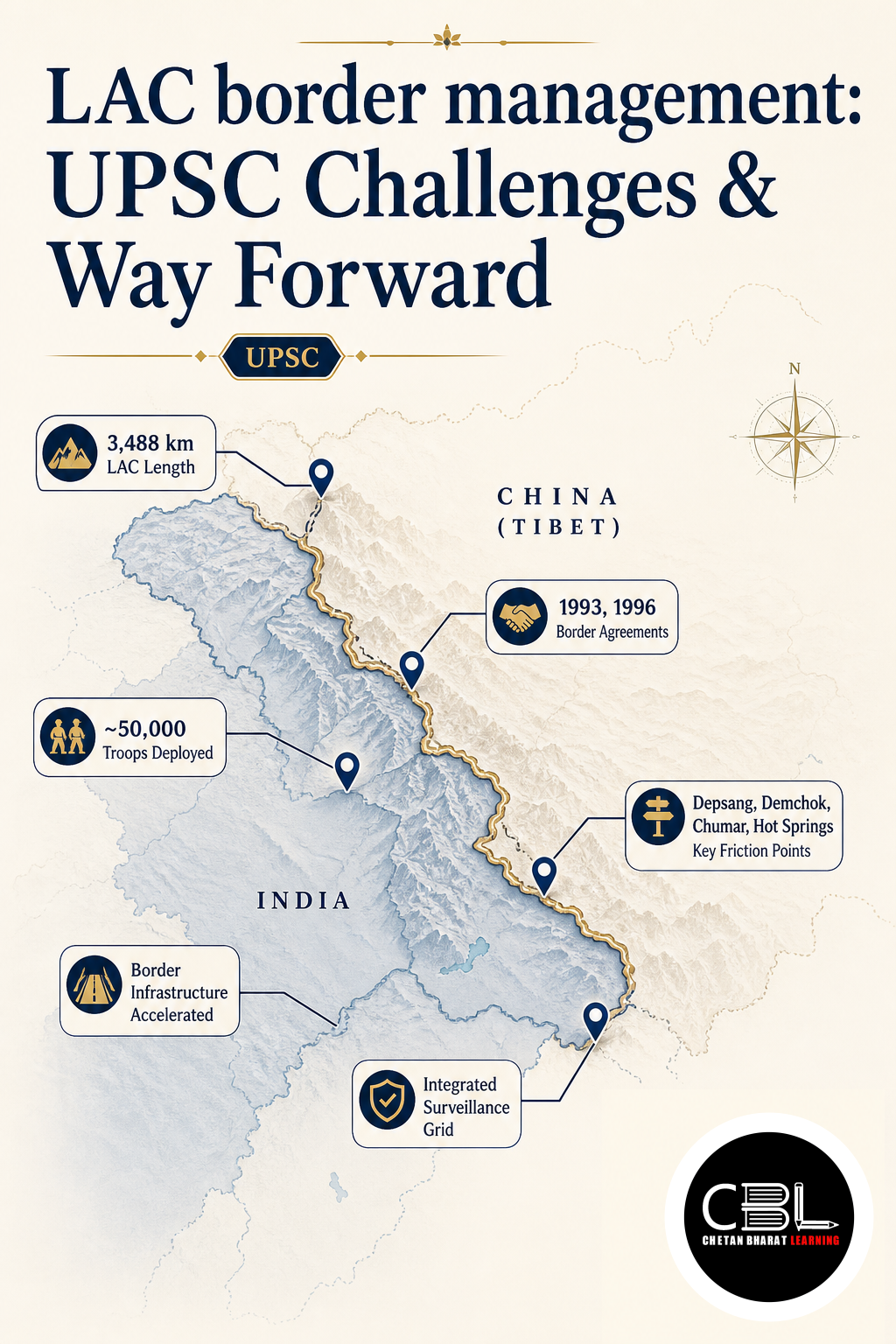
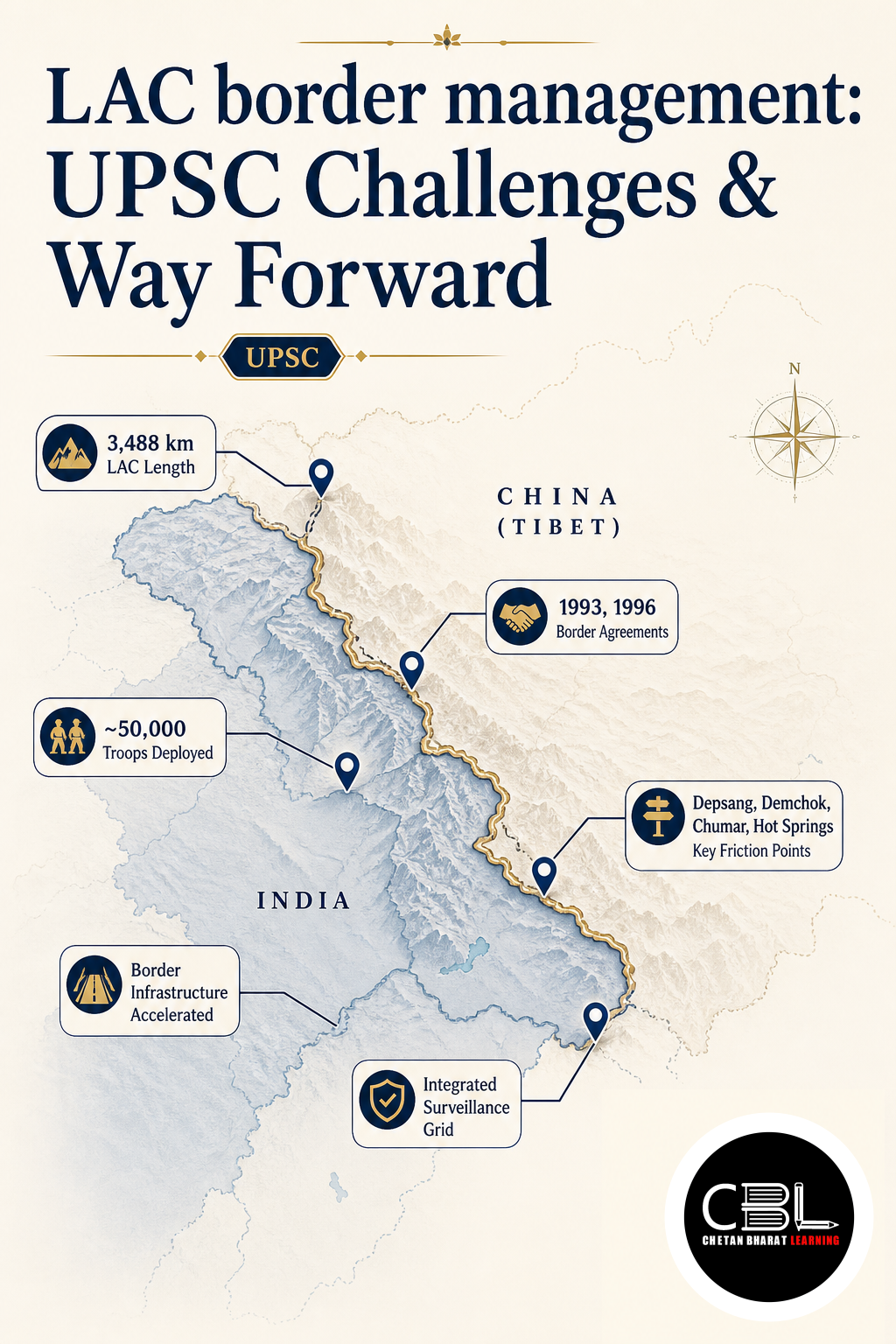
The LAC border management protocol governs military and diplomatic interactions along a de facto line of control. Unlike a formal international boundary, this line lacks mutually agreed demarcation on the ground. Different perceptions of the alignment often result in overlapping patrol routes. These differing perceptions frequently trigger periodic face-offs between border forces. The framework relies heavily on established confidence-building measures to maintain peace.
Historical agreements from 1993 and 1996 form the bedrock of this engagement strategy. These treaties explicitly mandate the maintenance of peace and tranquility along the Line of Actual Control. They prohibit the use of force and establish protocols for troop withdrawal during standoffs. The 2020 eastern Ladakh crisis marked a major change in India’s approach towards border management. New Delhi now strictly emphasizes respect for the LAC and adherence to existing bilateral agreements.
The institutional architecture involves multiple layers of communication. Local military commanders hold regular meetings to resolve minor friction points swiftly. Above them, Corps Commander-level talks address more complex disengagement issues. At the highest level, Special Representatives facilitate strategic dialogue to resolve broader boundary disputes. This multi-tiered system ensures that localized incidents do not spiral into broader conflicts.
Why is LAC border management in News?
The LAC border management strategy recently gained prominence following fresh military-level engagements in Arunachal Pradesh. Talks in the Taksing area of Upper Subansiri district followed high-level Special Representatives discussions between New Delhi and Beijing. You can verify the latest official diplomatic statements on the MEA portal. Both sides are actively attempting to strengthen existing mechanisms for border communication and crisis management. This renewed engagement signals a mutual desire to stabilize the frontier after years of heightened tension.
Furthermore, recent diplomatic outreach emphasizes the addition of military hotlines and local commander contacts. These communication channels are specifically intended to prevent unintended escalation during routine patrols. The engagement does not, however, amount to a final settlement of the boundary dispute. It merely represents a tactical pause to manage tensions and prevent accidental clashes. Policymakers view this as a necessary step to maintain regional stability while protecting national interests.
Recent developments in LAC border management highlight the delicate balance India maintains. The government continues to assert its territorial integrity while keeping diplomatic channels open. This dual approach of firmness and engagement defines contemporary Indian foreign policy. It ensures that border friction does not derail broader bilateral or multilateral objectives. The focus remains on de-escalation without compromising on sovereign claims.
Key Features
Effective LAC border management requires robust institutional mechanisms and clear operational protocols.
- Military Hotlines: Dedicated communication channels exist between local commanders to prevent unintended escalation during patrols.
- Special Representatives: High-level diplomatic talks run parallel to military engagements to resolve broader strategic and historical issues.
- Status Quo Adherence: India firmly insists on no unilateral alteration of the existing ground situation by either side.
- Crisis Management Protocols: Established guidelines direct disengagement and de-escalation procedures during localized friction points.
- Multi-tiered Engagement: The system utilizes local, corps, and diplomatic levels to ensure comprehensive conflict resolution.
This comprehensive structure ensures that various stakeholders can address issues at the appropriate level. The emphasis on localized dialogue distinguishes it from purely centralized diplomatic initiatives. By empowering field commanders with communication tools, the policy fosters rapid de-escalation. The institutional framework relies heavily on the strict adherence to the 1993 and 1996 agreements. These treaties provide the legal and procedural foundation for all current interactions. They also establish the Working Mechanism for Consultation and Coordination on India-China Border Affairs.
Challenges
Despite these mechanisms, LAC border management faces several structural and operational hurdles that require immediate attention.
- Overlapping Perceptions: Differing maps and historical claims create inherent ambiguity in patrol boundaries and jurisdictional limits.
- Harsh Terrain: Extreme altitudes and rugged geography complicate rapid deployment, logistics, and medical support for troops.
- Infrastructure Asymmetry: Rapid Chinese infrastructure development near the border continuously pressures Indian defensive capabilities.
- Escalation Risks: Minor localized incidents can quickly spiral into broader diplomatic crises without immediate and reliable communication.
- Ecological Sensitivities: Military construction in the fragile Himalayan ecosystem risks long-term environmental degradation and landslides.
Addressing these bottlenecks is crucial for the long-term credibility and safety of border personnel. Aspirants can study related geopolitical dynamics in our international relations updates. Policymakers must remain vigilant against the strategic implications of infrastructure asymmetry. The verification of ground realities in such remote areas remains a persistent intelligence challenge. Introducing advanced surveillance technologies could help alleviate some of these operational difficulties.
Critics also point out the psychological toll on troops deployed in these extreme conditions. Prolonged standoffs drain military resources and divert attention from other strategic priorities. Ensuring the well-being of border personnel requires deliberate policy interventions and improved living infrastructure. The government must actively bridge the logistical divide in these remote Himalayan sectors.
Way Forward
To maximize the efficacy of LAC border management, the government must prioritize comprehensive border infrastructure development. Completing strategic roads, tunnels, and surveillance networks in sensitive sectors is absolutely vital. Strengthening the technical capabilities of satellite monitoring will also ensure real-time awareness of adversary movements. The military must continue to modernize its high-altitude warfare equipment to maintain a credible deterrent.
Additionally, leveraging multilateral forums can help maintain broader bilateral stability despite border friction. Policymakers should establish clear guidelines to mandate transparent reporting of disengagement processes. For detailed parliamentary discussions on border infrastructure, refer to the PRS Legislative Research database. A robust, transparent, and inclusive system will ultimately drive India’s strategic autonomy forward.
Continuous academic research and independent strategic audits will further refine operational guidelines over time. The success of this initiative depends entirely on maintaining strict procedural integrity and military readiness. India has the opportunity to set a global benchmark for managing complex, undemarcated borders. Future iterations of the policy must remain adaptable to emerging geopolitical realities and technological advancements in surveillance.
Prelims Practice Questions
-
With reference to LAC border management, consider the following statements:
- The LAC is a mutually agreed and demarcated international boundary.
- Corps Commander-level talks are part of the mechanism to resolve friction.
- The 2020 eastern Ladakh crisis influenced India’s current border management approach.
Which of the statements given above is/are correct?
(a) 1 only (b) 2 and 3 only (c) 1 and 3 only (d) 1, 2 and 3
Answer: (b) Statement 1 is incorrect because the LAC is a de facto line without mutually agreed demarcation.
-
Recent military-level engagements to manage LAC tensions were held in the Taksing area, which is located in:
(a) Leh district, Ladakh (b) Upper Subansiri district, Arunachal Pradesh (c) Kinnaur district, Himachal Pradesh (d) Uttarkashi district, Uttarakhand
Answer: (b) The recent talks took place in the Taksing area of the Upper Subansiri district in Arunachal Pradesh.
-
Which of the following is a primary objective of adding military hotlines in LAC border management?
(a) To facilitate trade across the border (b) To prevent unintended escalation during patrols (c) To demarcate the boundary permanently (d) To coordinate joint military exercises
Answer: (b) Military hotlines are intended to prevent unintended escalation and manage localized crises swiftly.
-
Consider the following challenges in LAC border management:
- Overlapping perceptions of the alignment.
- Harsh terrain complicating logistics.
- Infrastructure asymmetry.
Which of the above are correct?
(a) 1 and 2 only (b) 2 and 3 only (c) 1 and 3 only (d) 1, 2 and 3
Answer: (d) All three are significant challenges in managing the undemarcated and high-altitude LAC.
-
India’s current approach to LAC border management post-2020 emphasizes:
(a) Unilateral alteration of the status quo (b) Respect for the LAC and adherence to existing agreements (c) Complete withdrawal of troops from all friction points (d) International arbitration of the boundary dispute
Answer: (b) India strictly emphasizes respect for the LAC, no unilateral alteration of the status quo, and adherence to existing agreements.
Mains Practice Questions
-
Q1. Discuss the significance of recent Corps Commander-level talks in LAC border management. What are the persistent challenges? (150 words, 10 marks)
Answer Structure
Intro: Contextualize the recent talks in Taksing and the multi-tiered engagement mechanism.
Body: Discuss significance (preventing escalation, maintaining communication) and challenges (overlapping perceptions, terrain, infrastructure asymmetry).
Conclusion: Suggest a balanced way forward focusing on infrastructure development and sustained diplomatic dialogue.
-
Q2. The 2020 eastern Ladakh crisis marked a paradigm shift in India’s approach to LAC border management. Critically analyze this statement. (250 words, 15 marks)
Answer Structure
Intro: Briefly describe the pre-2020 engagement model and the disruptive impact of the Galwan Valley clash.
Body: Analyze the shift towards stricter adherence to existing agreements, no unilateral alteration of the status quo, and the linking of border tranquility to broader bilateral relations. Discuss the challenges of implementing this firmer stance.
Conclusion: Conclude that while firmness is necessary, sustained diplomatic and military communication remains essential for long-term stability.
FAQs on LAC border management
Why is the LAC not considered an international boundary?
The LAC is a de facto line of control without mutually agreed demarcation on the ground. Both India and China have differing perceptions of its exact alignment, leading to overlapping claims.
What is the role of Special Representatives in border talks?
Special Representatives facilitate high-level strategic dialogue to resolve broader boundary disputes. Their talks run parallel to military-level engagements to address the root causes of friction.
How did the 2020 Ladakh crisis change India’s border management approach?
Post-2020, India strictly emphasizes respect for the LAC, no unilateral alteration of the status quo, and firm adherence to existing bilateral agreements, linking border tranquility to overall relations.
Related Current Affairs
Preparing for UPSC, PCS or HCS?
Talk to a mentor at Chetan Bharat Learning, Chandigarh. Free guidance on choosing the right exam and building a study plan.
Chat on WhatsAppCall 97793 53345UPSC / IAS / PCS coaching in Chandigarh · Trusted by aspirants across Punjab & Haryana
Leave a Reply
You must be logged in to post a comment.