
Important for:
UPSC, Haryana HCS, Punjab PCS
Prelims: Labour Codes, Trade Unions, Industrial Relations
Mains: GS Paper 2 & 3 — Labour Reforms, Governance, Economy
Why in News?
The Union Government has:
Operationalised the Labour Codes
by notifying rules for implementation.
However:
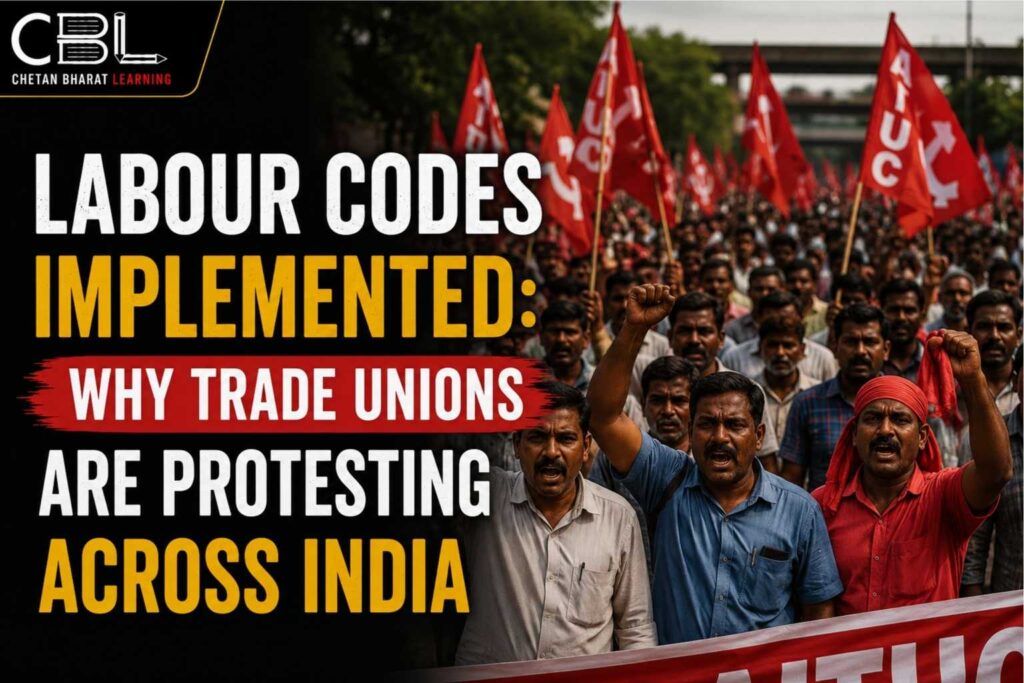
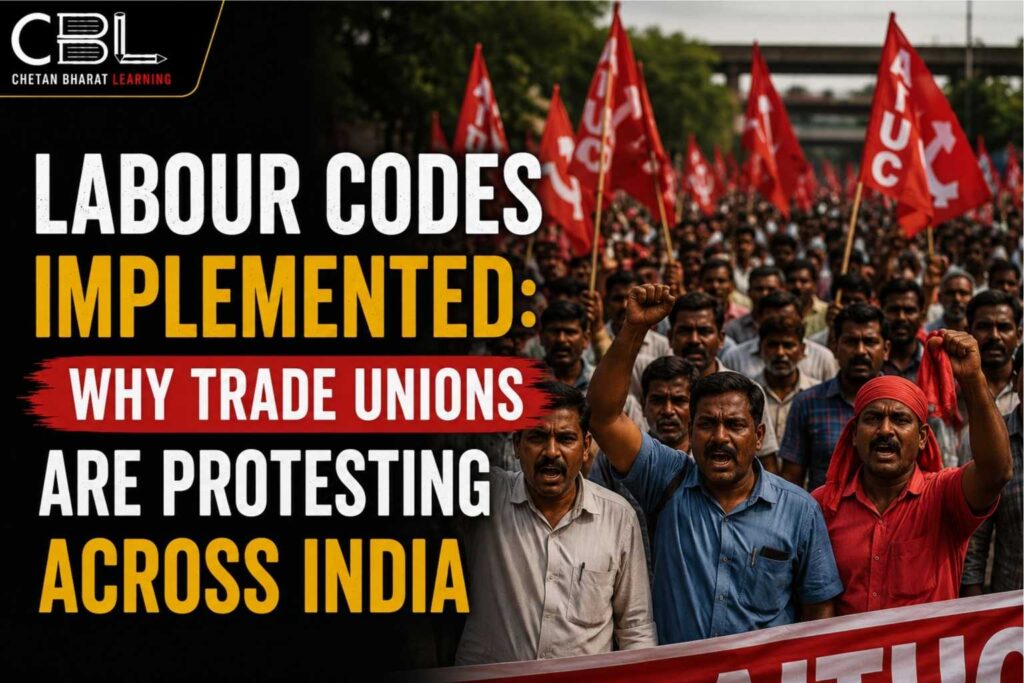
→ Several trade unions have launched protests against the move.
What Are Labour Codes?
India consolidated:
29 labour laws into 4 Labour Codes
to simplify labour regulations.
The Four Labour Codes
1. Code on Wages, 2019
Deals with:
✔ Minimum wages
✔ Equal remuneration
✔ Timely payment of wages
2. Industrial Relations Code, 2020
Deals with:
✔ Trade unions
✔ Strikes
✔ Industrial disputes
3. Occupational Safety, Health and Working Conditions Code, 2020
Deals with:
✔ Working hours
✔ Safety standards
✔ Employee welfare
4. Social Security Code, 2020
Deals with:
✔ Provident fund
✔ Pension
✔ Gig workers
✔ Social protection
Key Features of the New Rules
✔ Single registration system for businesses
✔ Fixed-term employment allowed
✔ Increased flexibility for employers
✔ Digital compliance mechanisms
✔ Wider social security coverage
Why Are Trade Unions Protesting?
Trade unions argue that:
❌ Workers’ rights may weaken
❌ Easier hiring and firing could increase insecurity
❌ Strike-related restrictions are stricter
❌ Working hours may become more flexible in favour of employers
Minimum Wages Provision
The:
Code on Wages
allows the government to fix:
→ Floor wages at national level.
States:
✔ Cannot set wages below the national floor wage.
Industrial Relations Concerns
Under the:
Industrial Relations Code
industries with fewer restrictions may:
✔ Hire workers more flexibly
✔ Face fewer procedural hurdles for layoffs
Trade unions fear:
→ This reduces collective bargaining power.
Why Did the Government Introduce Labour Codes?
The government says reforms will:
✔ Improve ease of doing business
✔ Simplify labour laws
✔ Increase formal employment
✔ Attract investment
✔ Reduce compliance burden
India-Specific Importance
Labour reforms are critical for:
✔ Manufacturing growth
✔ Industrial expansion
✔ Employment generation
✔ Economic competitiveness
Special Note for Aspirants
Students preparing through:
UPSC coaching Chandigarh
or
IAS coaching Chandigarh
should focus on:
✔ Labour reforms
✔ Trade union movements
✔ Industrial relations
✔ Worker rights
✔ Economic reforms in India
These are highly important for:
→ GS2 + GS3 + Essay + Interview.
Key Insight for UPSC
→ Labour reforms attempt to balance:
✔ Economic growth
and
✔ Worker protection
This remains one of India’s biggest policy debates.
PRELIMS PRACTICE QUESTIONS
Q1. Labour Codes replaced how many labour laws?
A. 10
B. 15
C. 29
D. 50
→ Answer: C
Q2. The Code on Wages was enacted in:
A. 2015
B. 2017
C. 2019
D. 2022
→ Answer: C
Q3. Which Labour Code deals with trade unions?
A. Social Security Code
B. Industrial Relations Code
C. Code on Wages
D. OSH Code
→ Answer: B
Q4. Labour reforms are mainly linked with:
A. Ease of doing business
B. Foreign policy
C. Agriculture subsidies
D. Judicial reforms
→ Answer: A
Q5. The Social Security Code includes provisions for:
A. Gig workers
B. Nuclear energy
C. Election reforms
D. River disputes
→ Answer: A
CBL Mains Practice Question
“Labour reforms are essential for economic growth but must balance worker welfare and industrial flexibility.”
Discuss in the context of India’s Labour Codes.
FAQs
1. What are Labour Codes?
They are consolidated labour laws replacing 29 old labour legislations.
2. How many Labour Codes are there?
There are four Labour Codes.
3. Why are trade unions protesting?
They fear weakening of workers’ rights and job security.
4. What is the purpose of Labour Codes?
To simplify labour laws and improve ease of doing business.
5. Which GS papers cover Labour Codes?
GS2 and GS3.
Related Current Affairs
Preparing for UPSC, PCS or HCS?
Talk to a mentor at Chetan Bharat Learning, Chandigarh. Free guidance on choosing the right exam and building a study plan.
Chat on WhatsAppCall 97793 53345UPSC / IAS / PCS coaching in Chandigarh · Trusted by aspirants across Punjab & Haryana
Leave a Reply
You must be logged in to post a comment.