
Important for:
UPSC, Haryana HCS, Punjab PCS
Prelims: Governor, Article 164, Floor Test, Constitutional conventions
Mains: GS Paper 2 — Centre-State Relations, Constitutional Offices, Federalism
Why in News?
A discussion has emerged over:
The Governor’s role in Tamil Nadu
particularly regarding:
→ Delay in constitutional decisions
→ Government formation
→ Floor test conventions
The debate highlights tensions between:
✔ Elected governments
✔ Constitutional offices
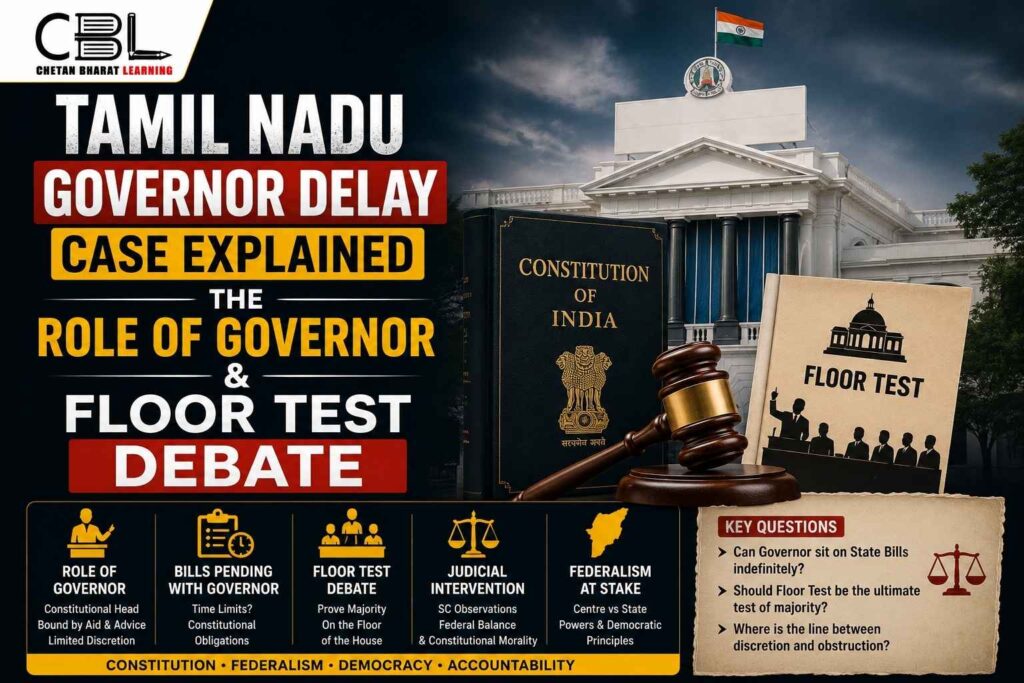
What Does the Constitution Say?
Article 164
States that:
→ Chief Minister is appointed by the Governor.
However:
✔ The CM must enjoy majority support in the Legislative Assembly.
Article 163
The Governor acts:
→ On the aid and advice of the Council of Ministers
except in certain discretionary situations.
What Is the Core Issue?
The controversy revolves around:
✔ Delay in inviting parties
✔ Testing majority support
✔ Role of constitutional conventions
Critics argue:
→ Governors should act neutrally and promptly.
What Is a Floor Test?
A:
Floor Test
is conducted in the Assembly to determine:
→ Whether a government has majority support.
It is considered:
✔ The most democratic method of proving majority.
Why Is Governor’s Role Sensitive?
Governors are:
✔ Appointed by the Centre
✔ Constitutional heads of states
Because of this:
→ Their actions are often politically scrutinised.
Important Supreme Court Judgments
1. S.R. Bommai Case (1994)
Established:
→ Majority should be tested on the Assembly floor.
2. Nabam Rebia Case (2016)
Limited discretionary powers of Governors.
3. Rameshwar Prasad Case
Focused on:
→ Constitutional morality and misuse of powers.
Why Is This Important for Federalism?
The issue raises concerns regarding:
✔ Centre-State relations
✔ Neutrality of constitutional offices
✔ Democratic accountability
✔ Constitutional conventions
India’s Constitutional Morality Debate
Experts argue:
→ Governors should follow:
✔ Democratic principles
✔ Constitutional ethics
✔ Political neutrality
rather than partisan considerations.
Special Note for Aspirants
Students preparing through:
UPSC coaching Chandigarh
or
IAS coaching Chandigarh
must prepare topics like:
✔ Governor’s discretionary powers
✔ Floor test mechanism
✔ Federalism
✔ Constitutional morality
✔ Centre-State relations
These are extremely important for:
→ GS2 + Essay + Interview.
Key Insight for UPSC
→ The Governor is a constitutional head,
but:
✔ Real executive power lies with the elected government enjoying Assembly confidence.
PRELIMS PRACTICE QUESTIONS
Q1. Article 164 of the Constitution deals with:
A. Finance Commission
B. Appointment of Chief Minister
C. Election Commission
D. Emergency provisions
→ Answer: B
Q2. A floor test is conducted to:
A. Pass Budget
B. Test legislative majority
C. Elect President
D. Amend Constitution
→ Answer: B
Q3. The S.R. Bommai case is associated with:
A. Fundamental Rights
B. Federalism and majority test
C. Election reforms
D. Emergency powers
→ Answer: B
Q4. Governors are appointed by:
A. Prime Minister
B. Parliament
C. President
D. Supreme Court
→ Answer: C
Q5. Constitutional morality mainly refers to:
A. Religious values
B. Political campaigning
C. Adherence to constitutional principles
D. Electoral speeches
→ Answer: C
CBL Mains Practice Question
“The office of Governor has often been at the centre of debates on constitutional morality and federalism.”
Discuss with suitable examples.
FAQs
1. What is a floor test?
A legislative process to check majority support of a government.
2. Which article deals with appointment of Chief Minister?
Article 164.
3. Why are Governors controversial at times?
Due to allegations of political bias and discretionary actions.
4. What did the S.R. Bommai judgment establish?
Majority must be tested on the Assembly floor.
5. Which GS paper covers this topic?
GS Paper 2.
Related Current Affairs
Preparing for UPSC, PCS or HCS?
Talk to a mentor at Chetan Bharat Learning, Chandigarh. Free guidance on choosing the right exam and building a study plan.
Chat on WhatsAppCall 97793 53345UPSC / IAS / PCS coaching in Chandigarh · Trusted by aspirants across Punjab & Haryana
Leave a Reply
You must be logged in to post a comment.