
Important for:
UPSC, Haryana HCS, Punjab PCS
Prelims: Fireworks industry, safety regulations, industrial hazards
Mains: GS Paper 3 — Disaster Management, Industrial Safety, Governance
Why in News?
A tragic explosion at a fireworks assembly unit in Thrissur during preparations for a temple festival has once again raised concerns about safety standards in hazardous industries.
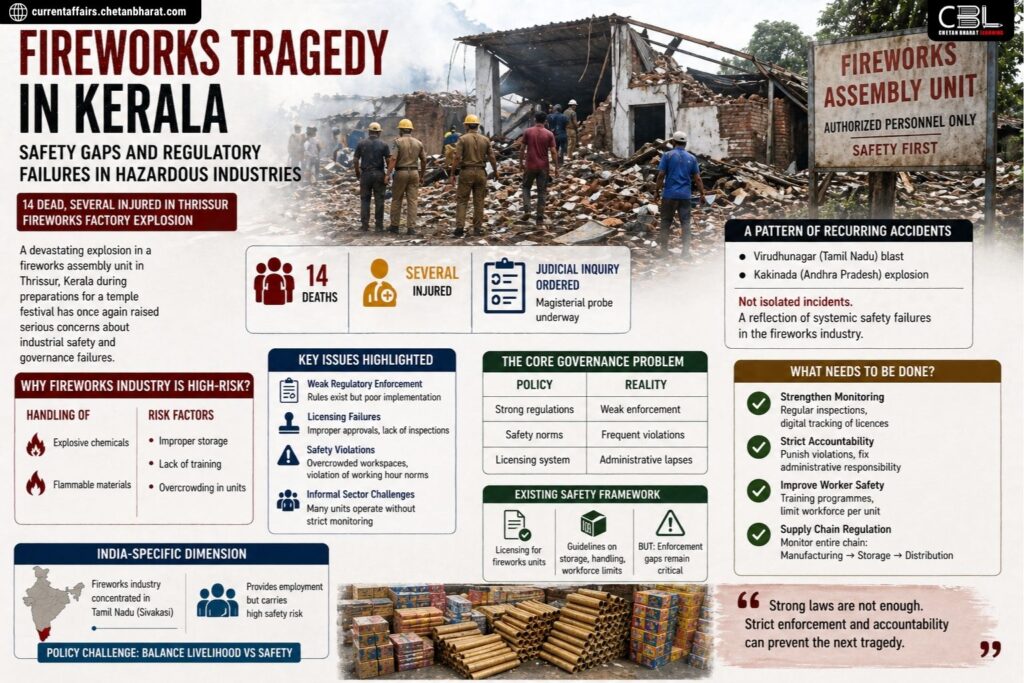
Background of the Incident
- Fireworks prepared for:
✔︎Temple festival display - Casualties:
- 14 deaths
- Multiple injuries
- Investigation:
- Judicial inquiry ordered
- Magistrial probe underway
Recent examples include:
- Virudhunagar (Tamil Nadu) blast
- Kakinada (Andhra Pradesh) explosion
✔️ Indicates:
- Not isolated incidents
- Systemic safety failures
Why Fireworks Industry is High-Risk?
- Handling of:
- Explosive chemicals
- Flammable materials
- Risk factors:
- Improper storage
- Lack of training
- Overcrowding in units
Key Issues Highlighted
1. Weak Regulatory Enforcement
- Rules exist but:
✔︎ Poor implementation
2. Licensing Failures
- Improper approvals
- Lack of inspections
3. Safety Violations
- Overcrowded workspaces
- Violation of working hour norms
4. Informal Sector Challenges
- Many units operate:
✔︎ Without strict monitoring
Core Governance Problem
| Policy | Reality |
|---|---|
| Strong regulations | Weak enforcement |
| Safety norms | Frequent violations |
| Licensing system | Administrative lapses |
Existing Safety Framework
- Licensing for fireworks units
- Guidelines on:
- Storage
- Handling
- Workforce limits
✔︎ BUT:
- Enforcement gaps remain critical
What Needs to be Done?
✔ Strengthen Monitoring
- Regular inspections
- Digital tracking of licences
✔ Strict Accountability
- Punish violations
- Fix administrative responsibility
✔ Improve Worker Safety
- Training programmes
- Limit workforce per unit
✔ Supply Chain Regulation
- Monitor entire chain:
✔️ Manufacturing → storage → distribution
India-Specific Dimension
- Fireworks industry concentrated in:
- Tamil Nadu (Sivakasi)
- Provides employment but:
✔︎ High safety risk
✔︎ Policy challenge:
- Balance livelihood vs safety
PRELIMS PRACTICE QUESTIONS
Q1. Fireworks industry is classified under:
A. Agriculture
B. Hazardous industry
C. IT sector
D. Service sector
✅ Answer: B
Q2. Which of the following states is known for fireworks production?
A. Punjab
B. Tamil Nadu
C. Gujarat
D. Odisha
✅ Answer: B
Q3. Industrial disasters are part of:
A. GS1
B. GS2
C. GS3
D. GS4
✅ Answer: C
Q4. Which of the following is a major cause of industrial accidents?
- Poor safety compliance
- Lack of regulation
- Improper storage
A. 1 and 3 only
B. 2 and 3 only
C. 1 and 2 only
D. 1, 2 and 3
✅ Answer: D
Q5. Which authority is generally responsible for industrial safety regulation?
A. RBI
B. Ministry of Labour
C. Election Commission
D. SEBI
✅ Answer: B
Q6. Fireworks involve:
A. Non-reactive chemicals
B. Explosive materials
C. Renewable resources
D. Biological agents
✅ Answer: B
CBL Mains Practice Question
“Recurring industrial accidents in India highlight gaps in regulatory enforcement rather than absence of laws.”
Discuss with reference to fireworks industry. (250 words)
FAQs
1. Why are fireworks industries risky?
Because they involve explosive chemicals and improper handling can lead to accidents.
2. What causes such accidents?
Weak enforcement, poor safety standards, and lack of monitoring.
3. Which GS paper covers this topic?
GS Paper 3 — Disaster Management.
4. What is the main issue highlighted?
Governance failure and safety lapses.
5. What is the solution?
Strict enforcement, monitoring, and accountability.
Preparing for UPSC, PCS or HCS?
Talk to a mentor at Chetan Bharat Learning, Chandigarh. Free guidance on choosing the right exam and building a study plan.
Chat on WhatsAppCall 97793 53345UPSC / IAS / PCS coaching in Chandigarh · Trusted by aspirants across Punjab & Haryana
Leave a Reply
You must be logged in to post a comment.