

UPSC Mapping
| Prelims | Indian Monsoon, El Niño, Low-Pressure Systems |
|---|---|
| Mains | GS Paper I – Physical Geography and Climatology |
Article
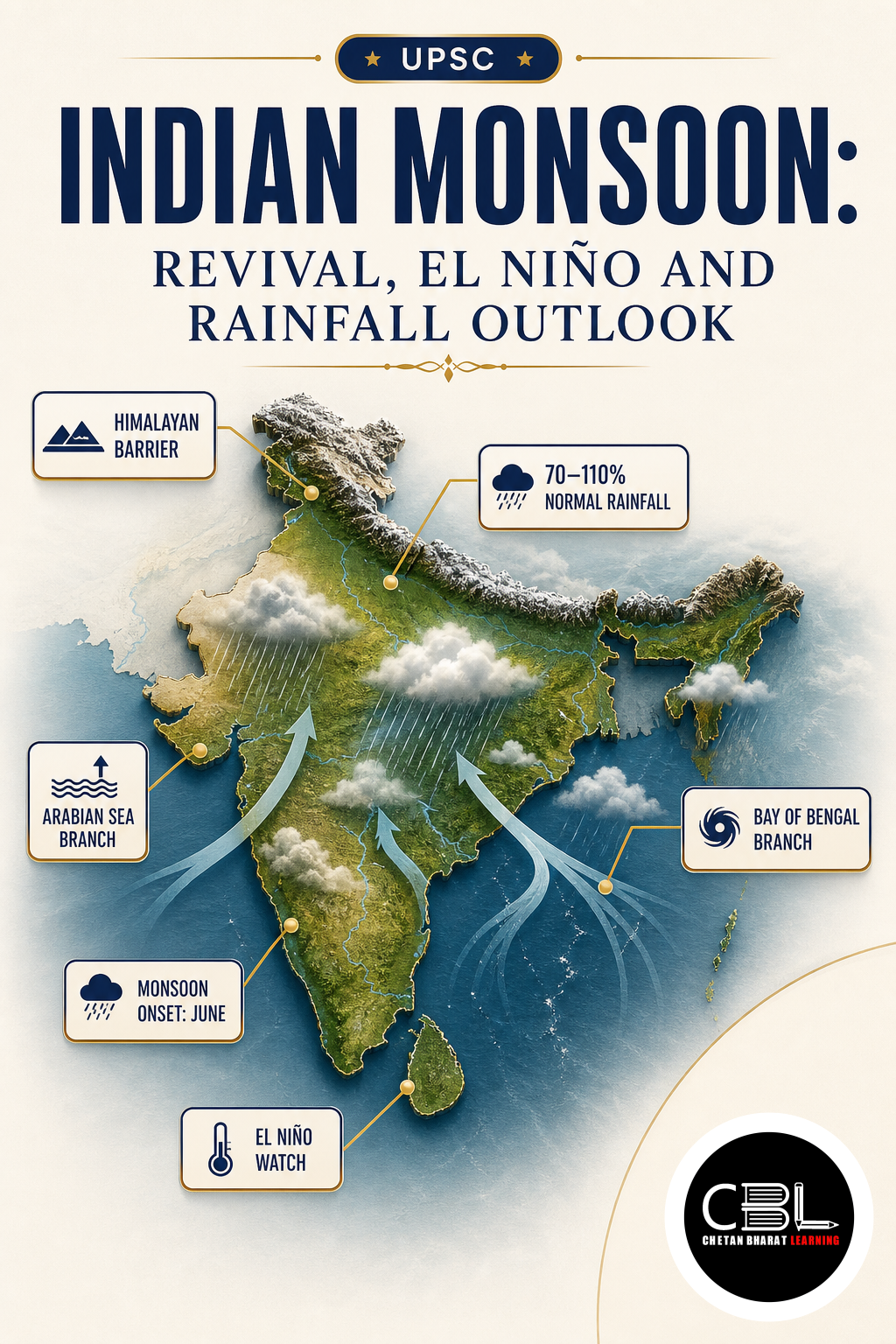
What is Indian Monsoon?
The Indian Monsoon is a seasonal wind system responsible for most of India’s annual rainfall. The southwest monsoon develops through large-scale changes in atmospheric circulation and carries moisture towards the Indian subcontinent.
The monsoon does not produce uniform rainfall throughout its season. Its activity can alternate between active phases and break phases, producing substantial variation in rainfall across time and regions.
The uploaded material also links monsoon activity with low-pressure systems and broader synoptic conditions. These systems influence the movement and concentration of rainfall over different parts of the country.
Understanding the monsoon therefore requires attention to both large-scale circulation and short-term weather systems. This distinction is important for interpreting seasonal rainfall forecasts and current weather developments.
Why is Indian Monsoon in News?
According to the uploaded material, monsoon activity has revived after a relatively weak phase. Fresh low-pressure systems and favourable atmospheric conditions contributed to stronger rainfall activity during the period discussed.
The report nevertheless advises continued monitoring because monsoon behaviour can change as the season progresses. Early or mid-season rainfall performance does not by itself determine the final seasonal outcome.
A major concern highlighted in the material is the possible emergence of El Niño later in the season. El Niño involves warming of the central and eastern Pacific Ocean and can influence atmospheric circulation over distant regions.
The uploaded material makes an important analytical distinction: El Niño can increase the possibility of weaker Indian rainfall, but it does not guarantee a weak monsoon. Other atmospheric and oceanic processes also influence the final rainfall pattern.
The issue is therefore relevant for UPSC because it combines physical geography with climate variability. It also demonstrates why seasonal forecasts must account for multiple interacting factors rather than relying on a single climate indicator.
Key Features
- Low-pressure systems: These systems generally develop over the Bay of Bengal and can move across India while supporting rainfall activity.
- Synoptic conditions: Large-scale atmospheric patterns influence the timing, intensity and distribution of rainfall during the season.
- Monsoon circulation: Moisture supply, convection and atmospheric circulation interact to determine rainfall activity.
- El Niño: Warming in the central and eastern Pacific can influence global atmospheric circulation and Indian rainfall prospects.
- Active-break cycle: The monsoon alternates between stronger rainfall phases and periods of reduced activity.
The role of low-pressure systems is especially important because they can organise rainfall over broad areas. Their formation, movement and persistence influence the spatial distribution of precipitation during the monsoon season.
The active-break cycle also explains why rainfall totals can vary significantly within a season. A period of heavy rainfall may be followed by a relatively dry phase without necessarily indicating that the entire monsoon season has failed.
For Prelims, candidates should distinguish between the general characteristics of the southwest monsoon and the individual weather systems that operate within it. For Mains, the interaction between these systems provides a useful framework for explaining rainfall variability.
The uploaded material also stresses that rainfall distribution matters alongside total seasonal rainfall. Two seasons with similar overall rainfall can have different agricultural and hydrological consequences if precipitation is distributed differently across time and regions.
Challenges
- Uneven rainfall: Active and break phases can create significant variation in rainfall distribution during the same season.
- Seasonal uncertainty: Rainfall during one part of the season cannot alone determine the final monsoon performance.
- El Niño influence: Pacific Ocean warming can alter atmospheric circulation and affect the probability of weaker rainfall conditions.
- Forecast complexity: Several oceanic and atmospheric processes operate simultaneously, making precise prediction difficult.
- Agricultural implications: Changes in rainfall timing and distribution can influence cropping decisions, soil moisture and water availability.
One major challenge is distinguishing between seasonal rainfall quantity and its distribution. Agriculture, reservoirs and local water systems depend not only on how much rain falls but also on when and where it arrives.
Forecasting also remains complex because atmospheric systems evolve continuously. A favourable rainfall pattern at one point in the season can change when the movement or strength of low-pressure systems changes.
El Niño adds another layer of uncertainty because its influence operates through wider ocean-atmosphere interactions. The uploaded material therefore treats it as a factor affecting probability rather than as a deterministic cause of monsoon failure.
For India, rainfall variability has implications beyond agriculture. Water availability, urban drainage, reservoir management and disaster preparedness can all be affected by the timing and intensity of monsoon rainfall.
Way Forward
The uploaded material emphasises continued monitoring of low-pressure systems, atmospheric circulation and Pacific Ocean conditions throughout the monsoon season. Continuous observation helps refine forecasts as weather systems evolve.
Monsoon assessment should also focus on rainfall distribution rather than relying exclusively on seasonal totals. Regional and temporal variations are important for agriculture, water management and disaster preparedness.
For policymakers, better weather information can support agricultural planning, reservoir operations and preparedness for periods of excessive or deficient rainfall. Early communication of changing forecasts can help exposed communities and local institutions respond more effectively.
For UPSC aspirants, the topic should be connected with ENSO, climatology, agriculture, water resources and disaster management. Official weather and monsoon information can be accessed through the India Meteorological Department.
The broader analytical approach should recognise that the Indian monsoon emerges from interacting oceanic and atmospheric processes. El Niño is significant, but its influence must be assessed alongside regional weather systems and evolving atmospheric circulation.
Prelims Practice Corner
- Q1. El Niño is associated with warming of which region? (a) Indian Ocean (b) Southern Ocean (c) Central and eastern Pacific Ocean (d) Arctic Ocean. Answer: (c) Central and eastern Pacific Ocean.
- Q2. According to the uploaded material, low-pressure systems affecting the Indian monsoon generally develop over which region? (a) Arabian Sea (b) Bay of Bengal (c) Mediterranean Sea (d) South Atlantic Ocean. Answer: (b) Bay of Bengal.
- Q3. Which statement best describes active and break phases of the monsoon? (a) Rainfall remains constant throughout the season (b) Rainfall activity varies during the season (c) Break phases occur only before monsoon onset (d) Active phases occur only after monsoon withdrawal. Answer: (b) Rainfall activity varies during the season.
- Q4. According to the uploaded material, El Niño: (a) Guarantees a weak Indian monsoon (b) Has no possible influence on Indian rainfall (c) Can increase the possibility of weaker rainfall but does not guarantee it (d) Always causes excessive rainfall in India. Answer: (c) Can increase the possibility of weaker rainfall but does not guarantee it.
- Q5. Rainfall distribution during the monsoon is influenced by: (a) Low-pressure systems only (b) Moisture supply only (c) Multiple atmospheric and oceanic processes (d) El Niño alone. Answer: (c) Multiple atmospheric and oceanic processes.
Mains Practice Questions
- Q1. Explain the factors responsible for variability in the Indian monsoon. (10 Marks)
- Intro: Define the Indian monsoon as a seasonal wind system responsible for most of India’s annual rainfall.
- Body: Cover low-pressure systems, active-break cycles, moisture supply, atmospheric circulation, ENSO and spatial-temporal rainfall variability.
- Conclusion: Continuous monitoring and improved forecasting can strengthen agricultural and water-management planning.
- Q2. Discuss the influence of El Niño on the Indian monsoon and explain why its impact is not always uniform. (15 Marks)
- Intro: Introduce El Niño as a Pacific Ocean warming phenomenon associated with changes in ocean-atmosphere circulation.
- Body: Explain atmospheric circulation changes, potential effects on Indian rainfall, interaction with other climate drivers and forecasting uncertainty.
- Conclusion: El Niño influences monsoon probabilities but does not alone determine India’s seasonal rainfall outcome.
FAQs
- Why can the monsoon weaken after a strong phase? The uploaded material explains that monsoon activity varies between active and break phases. Changes in atmospheric circulation and low-pressure systems can therefore alter rainfall intensity during the season.
- Does El Niño always cause a weak Indian monsoon? No. The uploaded material states that El Niño can increase the possibility of weaker rainfall but does not guarantee a weak monsoon. Other atmospheric and oceanic factors also influence seasonal performance.
- What role do low-pressure systems play? Low-pressure systems can organise and transport rainfall across different parts of India. The uploaded material identifies the Bay of Bengal as a common region where such systems develop.
- Why is rainfall distribution important? The timing and geographical distribution of rainfall affect agriculture, water availability and preparedness. Seasonal rainfall totals alone may not capture these regional and temporal differences.
- What are active and break phases? Active phases are periods of stronger monsoon rainfall activity, while break phases involve a relative reduction in rainfall over parts of the country. These alternating conditions contribute to monsoon variability.
- Why is El Niño relevant to UPSC geography? El Niño links Pacific Ocean conditions with global atmospheric circulation and possible changes in Indian rainfall. It is therefore important for understanding climatology, ENSO and monsoon variability.
- How does monsoon variability affect agriculture? Changes in rainfall timing and distribution can affect cropping decisions, soil moisture and water availability. Reliable forecasts can help improve agricultural planning and preparedness.
- Why is the Indian Monsoon important for UPSC? The topic connects physical geography, climatology, ENSO, agriculture and water management. It is particularly relevant to GS Paper I and can also support questions involving climate-related risks and policy planning.
Related Current Affairs
Preparing for UPSC, PCS or HCS?
Talk to a mentor at Chetan Bharat Learning, Chandigarh. Free guidance on choosing the right exam and building a study plan.
Chat on WhatsAppCall 97793 53345UPSC / IAS / PCS coaching in Chandigarh · Trusted by aspirants across Punjab & Haryana
Leave a Reply
You must be logged in to post a comment.