
India’s civilisational legacy is rooted in a rich and diverse knowledge tradition that has evolved over thousands of years. From philosophy and mathematics to medicine, linguistics, literature, and spirituality, India’s intellectual contributions have shaped not only the subcontinent but also global thought.
Recently, debates surrounding Indian Knowledge Systems (IKS) have gained attention in academic and policy circles. While some scholars argue that the revival of IKS is overly focused on ancient traditions, others believe it is an important effort to reconnect with India’s intellectual heritage. The discussion raises important questions about culture, education, identity, and knowledge production in modern India.
For UPSC aspirants, this topic is relevant from the perspectives of Indian Culture, Education, Society, and Intellectual Traditions.
Why Is Indian Knowledge Systems (IKS) in the News?
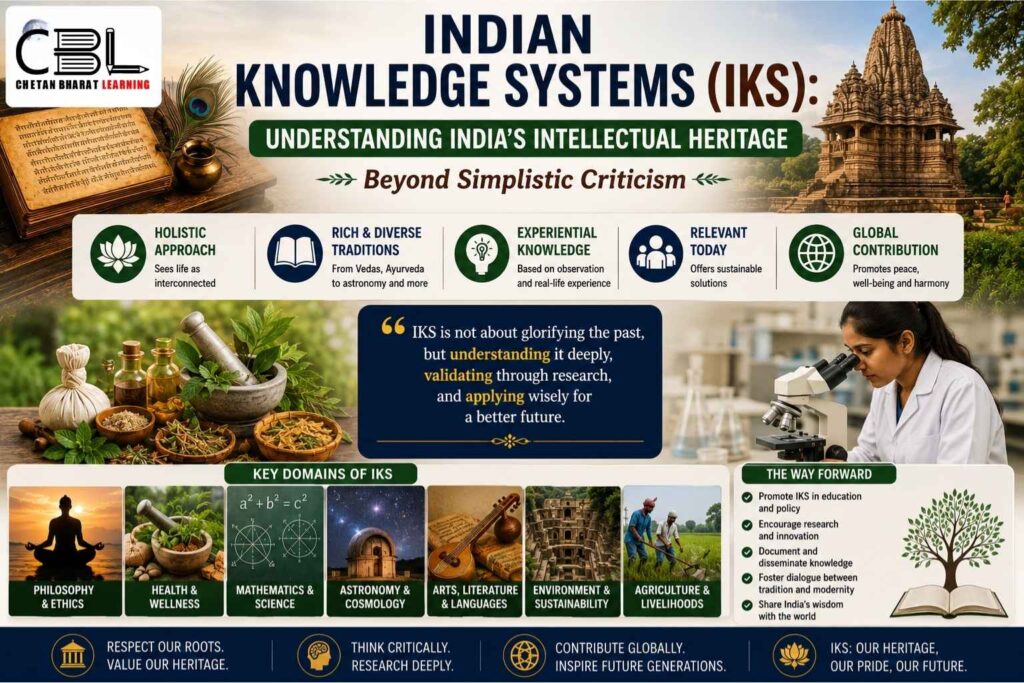
The debate emerged following discussions on the growing emphasis on Indian Knowledge Systems in educational institutions and policy frameworks.
Critics argue that IKS initiatives sometimes focus excessively on classical texts and Sanskrit traditions. Supporters, however, believe that India must rediscover and study its indigenous knowledge traditions while engaging with modern academic methods.
The discussion highlights broader questions regarding how societies preserve, interpret, and promote their intellectual heritage.
What Are Indian Knowledge Systems (IKS)?
Indian Knowledge Systems refer to the vast body of knowledge developed in India over centuries across different fields.
These include:
- Philosophy and spirituality
- Mathematics and astronomy
- Ayurveda and traditional medicine
- Literature and linguistics
- Art and architecture
- Agriculture and environmental practices
- Ethics and governance
IKS is not limited to a single language, region, or tradition. It encompasses contributions from Sanskrit, Tamil, Pali, Prakrit, Kannada, Telugu, Bengali, Persian, and many other intellectual traditions that flourished across India.
Why Is IKS Important?
Understanding indigenous knowledge systems helps societies appreciate their historical development and cultural identity.
India’s knowledge traditions have contributed significantly to:
- Scientific thinking
- Ethical frameworks
- Educational practices
- Literary achievements
- Social reform movements
The study of IKS can help create a more balanced understanding of history and encourage interdisciplinary research.
The Role of Sanskrit in Indian Knowledge Traditions
A major part of the debate revolves around the role of Sanskrit.
Many classical texts in philosophy, grammar, mathematics, astronomy, and medicine were written in Sanskrit. As a result, Sanskrit serves as an important source for understanding India’s intellectual history.
However, Indian knowledge traditions were never limited to Sanskrit alone.
Regional languages and local traditions also played a vital role in preserving knowledge and transmitting ideas across generations. Bhakti literature, Jain texts, Buddhist writings, and vernacular traditions contributed immensely to India’s intellectual landscape.
Therefore, a comprehensive understanding of IKS requires studying both Sanskrit and regional knowledge traditions.
Diversity Within Indian Knowledge Systems
One of the greatest strengths of Indian civilisation has been its diversity.
Indian intellectual traditions include:
- Vedic philosophy
- Buddhist thought
- Jain philosophy
- Bhakti movements
- Sufi traditions
- Regional literary cultures
- Folk knowledge systems
These traditions often debated with one another, leading to the development of rich intellectual exchanges.
This diversity demonstrates that Indian civilisation evolved through dialogue, adaptation, and continuous learning.
IKS and Modern Education
In recent years, educational institutions have shown greater interest in integrating Indian Knowledge Systems into academic curricula.
The objective is not to replace modern scientific education but to complement it by introducing students to India’s intellectual heritage.
Potential benefits include:
- Encouraging interdisciplinary learning
- Promoting cultural awareness
- Supporting indigenous research
- Preserving traditional knowledge
- Creating a balanced understanding of history
The challenge lies in ensuring that academic standards, critical inquiry, and evidence-based research remain central to the process.
Challenges in Reviving Indian Knowledge Systems
While the revival of IKS offers opportunities, several challenges remain.
Need for Rigorous Research
Traditional knowledge must be studied through scholarly methods and critical analysis.
Avoiding Oversimplification
India’s intellectual heritage is complex and cannot be reduced to simplistic narratives.
Balancing Tradition and Modernity
Educational institutions must ensure that traditional knowledge complements rather than conflicts with scientific inquiry.
Inclusive Representation
IKS should include contributions from all regions, languages, and communities to reflect India’s diversity.
Why This Debate Matters
The discussion around Indian Knowledge Systems is ultimately about how societies engage with their past.
Every civilisation studies its intellectual heritage while adapting it to contemporary needs. European societies continue to engage with Greek and Latin traditions, while East Asian nations study their classical philosophies alongside modern education.
Similarly, India faces the challenge of preserving its intellectual traditions while remaining open to global knowledge systems.
A balanced approach can help strengthen both cultural confidence and academic excellence.
Relevance for UPSC Aspirants
This topic is important for several sections of the UPSC syllabus.
GS Paper I
- Indian Culture
- Heritage and Society
- Philosophical Traditions
GS Paper II
- Education Policies
- Social Development
Essay Topics
- Education and Cultural Identity
- Knowledge Systems and Nation Building
- Preserving Heritage in a Modern World
Students preparing through UPSC Coaching in Chandigarh and IAS Coaching in Chandigarh should understand the broader significance of Indian Knowledge Systems in contemporary policy and educational debates.
FAQs
What are Indian Knowledge Systems (IKS)?
IKS refers to the body of knowledge developed in India across fields such as philosophy, science, medicine, literature, and culture.
Is IKS limited to Sanskrit texts?
No. IKS includes contributions from various languages, regions, and intellectual traditions across India.
Why is IKS important?
It helps preserve India’s intellectual heritage and promotes a deeper understanding of its cultural and scientific contributions.
What challenges exist in reviving IKS?
Challenges include ensuring academic rigour, avoiding oversimplification, and maintaining inclusivity.
Why is this topic important for UPSC?
It is relevant for Indian Culture, Education, Society, and Heritage-related topics in the UPSC syllabus.
Conclusion
The debate surrounding Indian Knowledge Systems reflects a larger conversation about culture, education, and intellectual heritage. India’s knowledge traditions are diverse, dynamic, and deeply interconnected with its civilisational history.
Rather than viewing IKS through simplistic binaries, a balanced approach that combines critical scholarship with cultural appreciation can help preserve and strengthen India’s intellectual legacy. Such an approach will allow future generations to engage meaningfully with both traditional wisdom and modern knowledge systems.
Related Current Affairs
Preparing for UPSC, PCS or HCS?
Talk to a mentor at Chetan Bharat Learning, Chandigarh. Free guidance on choosing the right exam and building a study plan.
Chat on WhatsAppCall 97793 53345UPSC / IAS / PCS coaching in Chandigarh · Trusted by aspirants across Punjab & Haryana
Leave a Reply
You must be logged in to post a comment.