
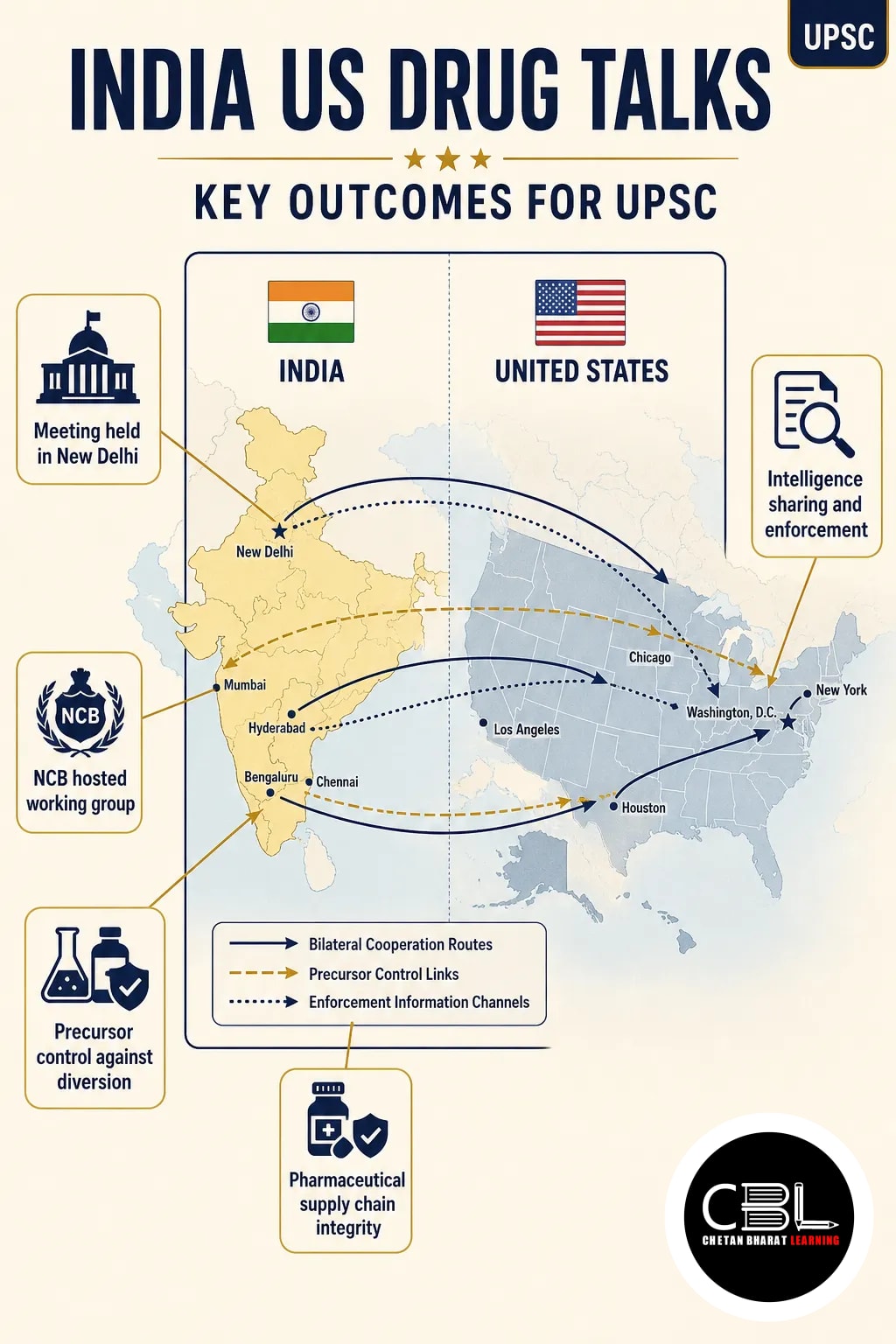
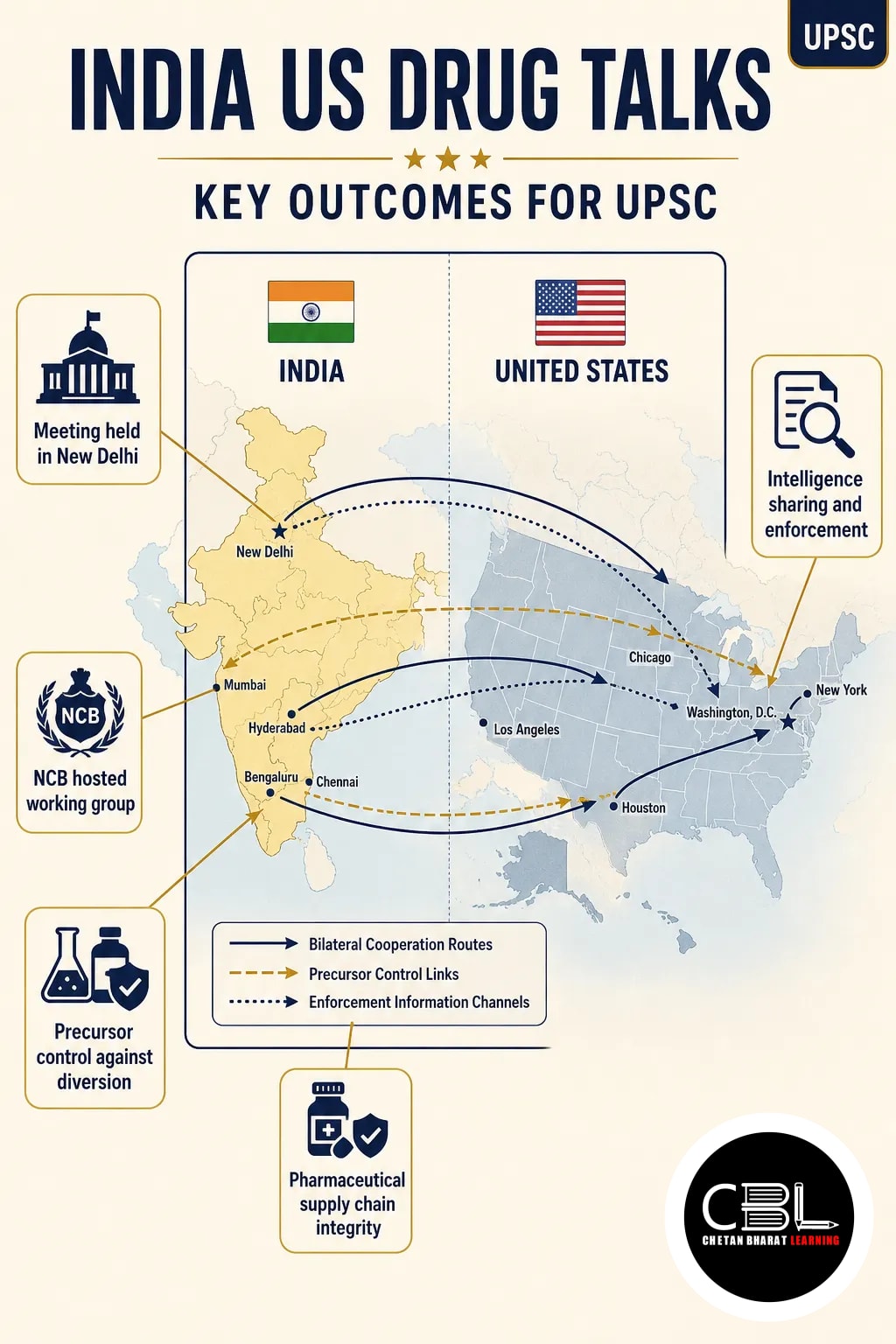
India US drug talks in New Delhi brought narcotics control and cross-border enforcement into focus. The meeting adds a security and public health dimension to India’s international relations.
Quick answer: The India US drug talks took place on 2–3 November 2026 in New Delhi. India’s Narcotics Control Bureau hosted the second Drug Policy Executive Working Group meeting. Both countries agreed to coordinated action against emerging drug threats, with emphasis on intelligence sharing, precursor control, supply chain integrity and demand reduction.
What happened at the India US drug talks?
India and the United States reviewed bilateral cooperation against illicit drug trafficking and identified areas for joint action. The Narcotics Control Bureau (NCB) announced the meeting’s outcome on 10 November 2026.
The meeting followed the terms of reference of the India-U.S. Drug Policy Framework. NCB Director General Anurag led the Indian delegation. Debbie Seguin, Acting Deputy Director of the U.S. Office of National Drug Control Policy (ONDCP), led the American side.
Additionally, Anurag highlighted India’s Vision Roadmap 2026–2029. The source does not specify the roadmap’s measures or a timetable for implementing the meeting’s priorities.
What were the key outcomes?
Both sides prioritised intelligence, enforcement, precursor control, pharmaceutical supply chains and drug demand reduction.
| Priority | Focus of cooperation |
|---|---|
| Intelligence | Timely exchange of information on emerging threats |
| Law enforcement | Coordinated action and sharing of targeted enforcement practices |
| Precursor control | Preventing diversion of chemicals used to manufacture drugs |
| Supply chains | Protecting the integrity of pharmaceutical distribution |
| Demand reduction | Addressing demand alongside action against supply |
The ONDCP Director, Sara Carter, emphasised disrupting transnational networks and preventing diversion of synthetic drugs and chemical precursors. However, the source does not specify individual seizures, joint operations or measurable targets arising from this meeting.
Why does this cooperation matter for India?
The cooperation connects India’s internal security, trade regulation and public health objectives with international enforcement.
Security and intelligence
Trafficking networks can move substances, money and information across jurisdictions. Therefore, timely intelligence can help agencies connect separate investigations and identify links across borders.
Coordinated action also matters because an arrest in one jurisdiction may not disable an entire network. However, information must reach investigators in a form that supports lawful evidence collection and prosecution.
Chemical and pharmaceutical regulation
Precursor chemicals are substances used in the manufacture of other chemicals, including illicit drugs. Because many chemicals also have legitimate uses, controls must distinguish lawful trade from diversion.
Similarly, pharmaceutical supply chain integrity requires attention to legitimate manufacturing and distribution. Diversion and counterfeiting are distinct problems, but both make supply chain oversight important. For context, see CBL’s coverage of a counterfeit medicines investigation.
Public health and federal governance
Demand reduction complements interdiction by addressing drug use rather than supply alone. For example, prevention, treatment and rehabilitation can form part of a health-centred response.
State agencies also matter because policing and health services require local implementation. Therefore, international cooperation must connect with domestic coordination rather than operate in isolation.
What challenges could limit implementation?
The main challenges are translating broad priorities into usable intelligence, lawful enforcement and balanced regulation.
- Information to evidence: Intelligence may require verification and collection under applicable procedures before it can support prosecution.
- Different jurisdictions: Agencies must coordinate across legal systems and administrative boundaries; otherwise, delays can weaken follow-up.
- Legitimate commerce: Excessively broad controls could disrupt lawful chemical and medicine supply, so risk-based scrutiny matters.
- Demand-side access: Enforcement alone cannot substitute for accessible treatment and rehabilitation; consequently, health services need attention too.
- Measuring progress: Meeting priorities do not by themselves establish outcomes, so implementation requires verifiable indicators.
What should the way forward include?
The way forward is to turn the meeting’s priorities into sustained, accountable cooperation without obstructing legitimate activities.
- Operational coordination: Establish clear channels for timely intelligence exchange and follow-up within applicable laws.
- Risk-based controls: Focus scrutiny on diversion risks while safeguarding access to legitimate chemicals and medicines.
- Centre–state coordination: Connect national agencies with state police, regulators and health departments for implementation.
- Public health: Pair supply-side action with prevention, treatment and rehabilitation; meanwhile, avoid treating all users solely as security threats.
- Review: Track agreed actions and their outcomes, rather than equating meetings with operational success.
Overall, the India US drug talks provide a framework for cooperation; their impact will depend on subsequent implementation and review.
Source: The Hindu, 10 November 2026
Asked in UPSC: Previous Year Questions
- UPSC CSE Mains 2018 (GS Paper III): Explain the links between drug trafficking, gunrunning, money laundering and human trafficking, and suggest countermeasures, considering India’s proximity to major illicit opium-growing states.
UPSC links narcotics trafficking with other security threats, so revise both the linkages and countermeasures.
Punjab PCS and Haryana HCS may test the roles of state police and health services in narcotics control. Therefore, connect border security and inter-agency coordination with prevention and rehabilitation.
Prelims Practice Corner
Mains Practice Questions
Frequently Asked Questions
When and where did the drug policy meeting take place?
It took place on 2–3 November 2026 in New Delhi. The NCB hosted the second executive working group meeting.
Who led the Indian and U.S. delegations?
Anurag led India’s delegation, while Debbie Seguin led the U.S. side. They represented the NCB and ONDCP, respectively.
Why is precursor control important?
It helps prevent chemicals from being diverted into illicit drug manufacture. However, controls must also account for legitimate chemical uses.
Did the meeting address drug demand as well as supply?
Yes, because demand reduction was among the identified priorities. The two sides also discussed enforcement, intelligence and supply chain integrity.
Related Current Affairs
Preparing for UPSC, PCS or HCS?
Talk to a mentor at Chetan Bharat Learning, Chandigarh. Free guidance on choosing the right exam and building a study plan.
Chat on WhatsAppCall 97793 53345UPSC / IAS / PCS coaching in Chandigarh · Trusted by aspirants across Punjab & Haryana

 Ananya RanaIAS · AIR 60
 Aditya SharmaIAS · AIR 70
 Ria Kaur SethiIPS · AIR 89
 Aman AloonIRS · AIR 295
 Sumer Singh VirkIRS · AIR 335
 Shivani PanchalIAS

Leave a Reply
You must be logged in to post a comment.