
UPSC Mapping
| Exam | Paper/Section |
|---|---|
| Prelims | Economy & Social Sector |
| Mains | GS Paper 3 (Economic Development & Social Justice) |
What is Global Youth Employment?
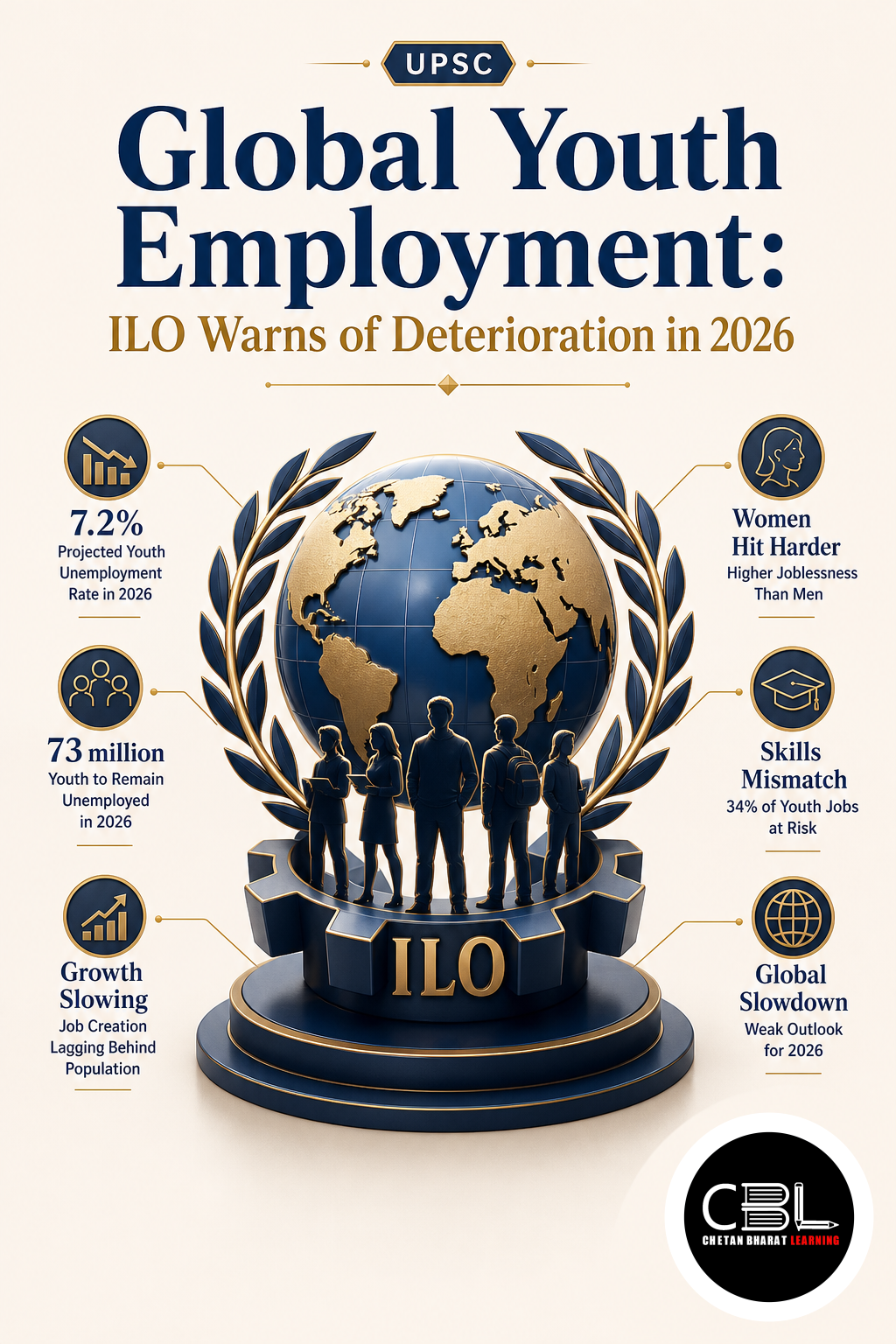
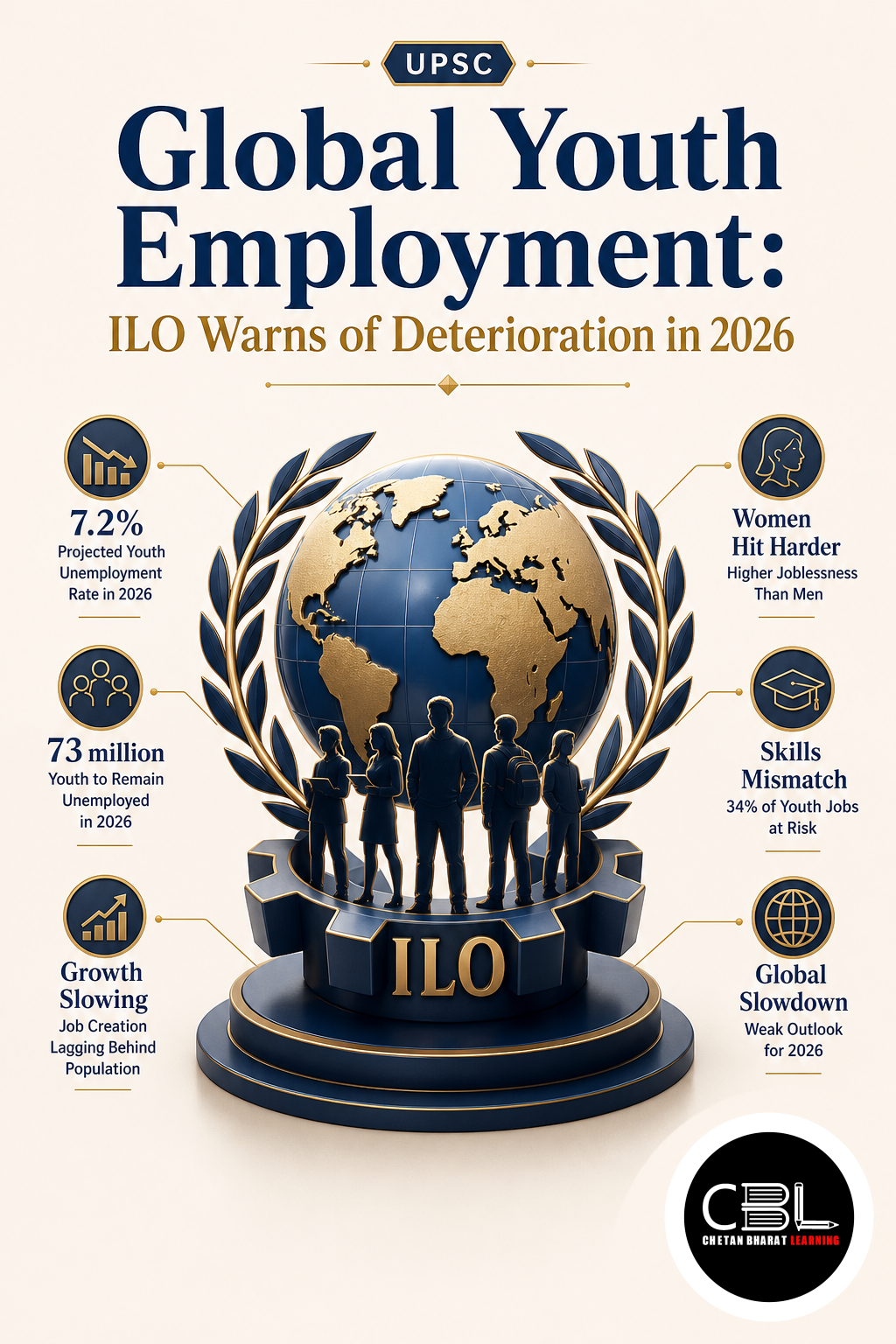
Global Youth Employment refers to the labour market participation and employment outcomes of young people aged 15–24. The ILO’s ‘Global Employment Trends for Youth 2026’ report warns of a deterioration, with unemployment rising to 12.4% in 2025, leaving 67 million young people jobless. The NEET population increased to 257 million (20%), up from 19.7% in 2023.
The gender gap is stark—the NEET rate of young women (27.4%) is more than double that of young men (13.1%). Nearly 9 in 10 young workers in low- and lower-middle-income countries work informally, often without social security or labour protection.
Why is Global Youth Employment in News?
Global Youth Employment is in the news following the ILO’s report, which highlights the worsening employment situation for young people globally. The report attributes the crisis to declining middle-skilled jobs (clerical work, administration, sales, manufacturing), the impact of AI (6.1% of jobs held by young workers face high AI vulnerability), and persistent gender barriers.
The report recommends human-centred AI governance, scaling up quality apprenticeships, and extending social protection to non-standard forms of work.
Key Features of Global Youth Employment
- Rising Unemployment: Global youth unemployment increased to 12.4% in 2025.
- NEET Population: 20% of young people (257 million) are not in employment, education, or training.
- Gender Disparity: Women’s NEET rate (27.4%) is double that of men (13.1%).
- Informality: 90% of young workers in low-income countries work informally.
- AI Impact: 6.1% of jobs held by youth face high AI vulnerability.
Challenges in Global Youth Employment
- Middle-Skilled Job Decline: Traditional entry-level jobs in clerical work, administration, sales, and manufacturing are shrinking.
- AI Vulnerability: Automation and AI are transforming tasks, displacing young workers in routine jobs.
- Gender Barriers: Unpaid care responsibilities, discrimination, and limited access to quality employment constrain young women.
- Skill Mismatch: Education and training systems often fail to equip youth with in-demand skills.
- Social Protection Gaps: Informal work lacks social security, leaving young workers vulnerable.
Way Forward for Global Youth Employment
To improve Global Youth Employment, governments should implement human-centred AI governance, ensuring technology adoption protects rather than displaces young workers. Scaling up quality apprenticeships, vocational training, and lifelong learning frameworks can bridge the skill gap.
Modernising public employment services and extending social protection to non-standard forms of work (gig, platform, informal) is essential. Addressing gender barriers through childcare support, safe transport, and anti-discrimination policies can increase women’s participation. International cooperation on labour standards and skills recognition can support youth mobility.
Prelims Practice Corner
Q1. What was the global youth unemployment rate in 2025?
- (a) 10.5%
- (b) 12.4%
- (c) 14.2%
- (d) 15.8%
Answer: (b) Youth unemployment was 12.4% in 2025.
Q2. How many young people are NEET globally?
- (a) 150 million
- (b) 200 million
- (c) 257 million
- (d) 300 million
Answer: (c) The NEET population is 257 million (20%).
Q3. What is the NEET rate for young women?
- (a) 13.1%
- (b) 20.5%
- (c) 27.4%
- (d) 35.2%
Answer: (c) The female NEET rate is 27.4%, more than double that of men.
Q4. What percentage of young workers in low-income countries work informally?
- (a) 60%
- (b) 70%
- (c) 80%
- (d) 90%
Answer: (d) Nearly 9 in 10 young workers in low-income countries work informally.
Q5. What percentage of youth jobs face high AI vulnerability?
- (a) 3.2%
- (b) 6.1%
- (c) 10.5%
- (d) 15.8%
Answer: (b) About 6.1% of jobs held by young workers face high AI vulnerability.
Mains Practice Questions
Q1. Discuss the key findings of the ILO’s Global Employment Trends for Youth 2026 report and the policy measures needed to address the youth employment crisis. (250 words, 15 marks)
Answer Structure
- Intro: Introduce the ILO report and its warnings.
- Body: Discuss key findings: unemployment, NEET, gender gap, informality, AI impact. Analyse causes: middle-skills decline, skill mismatch, gender barriers. Suggest solutions: human-centred AI, skilling, social protection.
- Conclusion: Emphasise the need for a comprehensive policy response.
Q2. What is the NEET population, and why is its rise a global concern? (150 words, 10 marks)
Answer Structure
- Intro: Define NEET as Not in Employment, Education, or Training.
- Body: Explain that the NEET population rose to 257 million (20%) in 2025, with a severe gender gap. Its rise indicates wasted human potential, reduced economic growth, and social unrest.
- Conclusion: Conclude that investing in skilling and employment generation is critical.
FAQs on Global Youth Employment
What is the ILO’s report on youth employment?
The ‘Global Employment Trends for Youth 2026’ report warns of rising youth unemployment, growing NEET populations, and AI-driven job displacement.
Why are young women more affected?
Persistent barriers like unpaid care responsibilities, discrimination, and limited access to quality employment constrain women’s participation.
How does AI affect youth employment?
About 6.1% of youth jobs face high AI vulnerability, as automation transforms tasks in administrative, sales, and manufacturing roles.
Related Current Affairs
Preparing for UPSC, PCS or HCS?
Talk to a mentor at Chetan Bharat Learning, Chandigarh. Free guidance on choosing the right exam and building a study plan.
Chat on WhatsAppCall 97793 53345UPSC / IAS / PCS coaching in Chandigarh · Trusted by aspirants across Punjab & Haryana
Leave a Reply
You must be logged in to post a comment.