
Important for:
UPSC, Haryana HCS, Punjab PCS
Prelims: Green Revolution, fertilisers, fossil fuels, MSP
Mains: GS Paper 3 — Agriculture, Economy, Energy Security
Why in News?
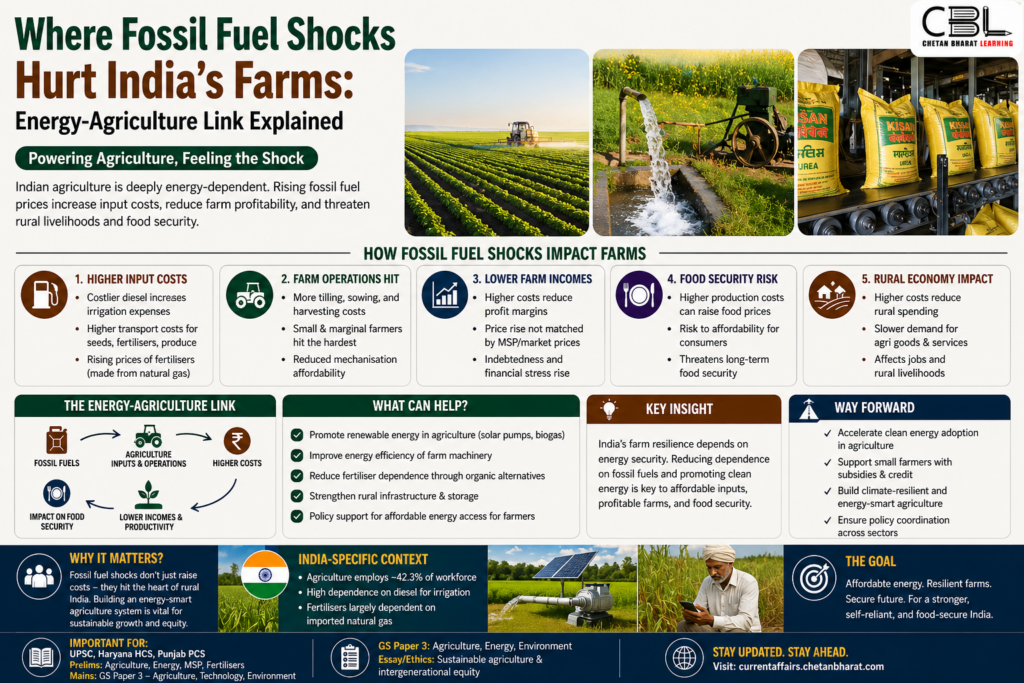
Recent analysis highlights how fluctuations in global fossil fuel prices are directly affecting Indian agriculture, especially through rising costs of fertilisers, irrigation, and mechanisation.
How Agriculture Depends on Fossil Fuels
Indian agriculture is deeply linked with fossil fuel-based systems:
1. Fertilisers
- Nitrogen fertilisers (urea) are produced using:
→ Natural gas - Phosphatic & potassic fertilisers:
→ Depend on imported raw materials
2. Irrigation
- Diesel and electricity power:
→ Tube wells and pumps - India’s irrigation shift:
→ From manual → mechanised pumping systems
3. Farm Machinery
- Tractors, harvesters:
→ Run on diesel - Mechanisation increased post-Green Revolution
Green Revolution & Energy Link
- Green Revolution success depended on:
- High-yield seeds
- Fertilisers
- Irrigation
→ All of these are:
Energy-intensive inputs
Key Findings from Article
- Farm power availability increased:
→ From manual labour → tractors & machines - Fertiliser consumption rose significantly
- Irrigation expanded:
→Through motorised pump sets
➤ Result:
Higher productivity but higher energy dependence
Impact of Fossil Fuel Price Shocks
Economic Effects:
- Rising input costs
- Reduced farmer income
- Increased subsidy burden
Agricultural Effects:
- Lower fertiliser use (in some cases)
- Impact on crop yields
Global Dimension
- India imports:
- Crude oil
- Natural gas
- Fertiliser inputs
➤ Global events (like conflicts or supply disruptions):
- Directly impact Indian agriculture
India-Specific Concerns
- Heavy dependence on imports
- Subsidy pressure on government
- Vulnerability to price fluctuations
Way Forward
- Promote:
- Renewable energy in agriculture (solar pumps)
- Organic farming
- Efficient fertiliser use
- Reduce dependence on:
➤ Fossil fuel-based inputs
PRELIMS PRACTICE QUESTIONS
Q1. Urea production primarily depends on:
A. Coal
B. Natural gas
C. Solar energy
D. Biomass
✅ Answer: B
Q2. Which of the following are fossil fuel-dependent?
- Tractors
- Tube wells
- Organic farming
A. 1 and 2 only
B. 2 only
C. 1 only
D. 1, 2 and 3
✅ Answer: A
Q3. Green Revolution mainly increased:
A. Organic farming
B. Traditional seeds
C. Input-intensive farming
D. Rain-fed agriculture
✅ Answer: C
Q4. MSP is related to:
A. Export policy
B. Minimum Support Price
C. Fertiliser subsidy
D. Irrigation
✅ Answer: B
Q5. Which factor links energy with agriculture?
A. Climate only
B. Fertiliser production
C. Trade policy
D. Labour
✅ Answer: B
CBL Mains Practice Question
“India’s agriculture is increasingly vulnerable to global energy shocks.”
Discuss with reference to fertilisers, irrigation, and mechanisation. (250 words)
FAQs
1. Why does agriculture depend on fossil fuels?
Because fertilisers, irrigation systems, and machinery rely on energy derived from fossil fuels.
2. How do fossil fuel price shocks affect farmers?
They increase input costs and reduce profitability.
3. What is the Green Revolution’s link with energy?
It increased dependence on fertilisers, irrigation, and mechanisation.
4. What is the solution?
Shift to renewable energy and sustainable farming practices.
5. Which GS paper covers this topic?
GS Paper 3 — Economy & Agriculture.
Related Current Affairs
Preparing for UPSC, PCS or HCS?
Talk to a mentor at Chetan Bharat Learning, Chandigarh. Free guidance on choosing the right exam and building a study plan.
Chat on WhatsAppCall 97793 53345UPSC / IAS / PCS coaching in Chandigarh · Trusted by aspirants across Punjab & Haryana
Leave a Reply
You must be logged in to post a comment.