
UPSC Syllabus Mapping
| GS Paper | GS-II |
|---|---|
| Subject | Indian Polity and Governance — Judiciary, Fundamental Rights and Administration of Justice |
What is Fast Track Courts?
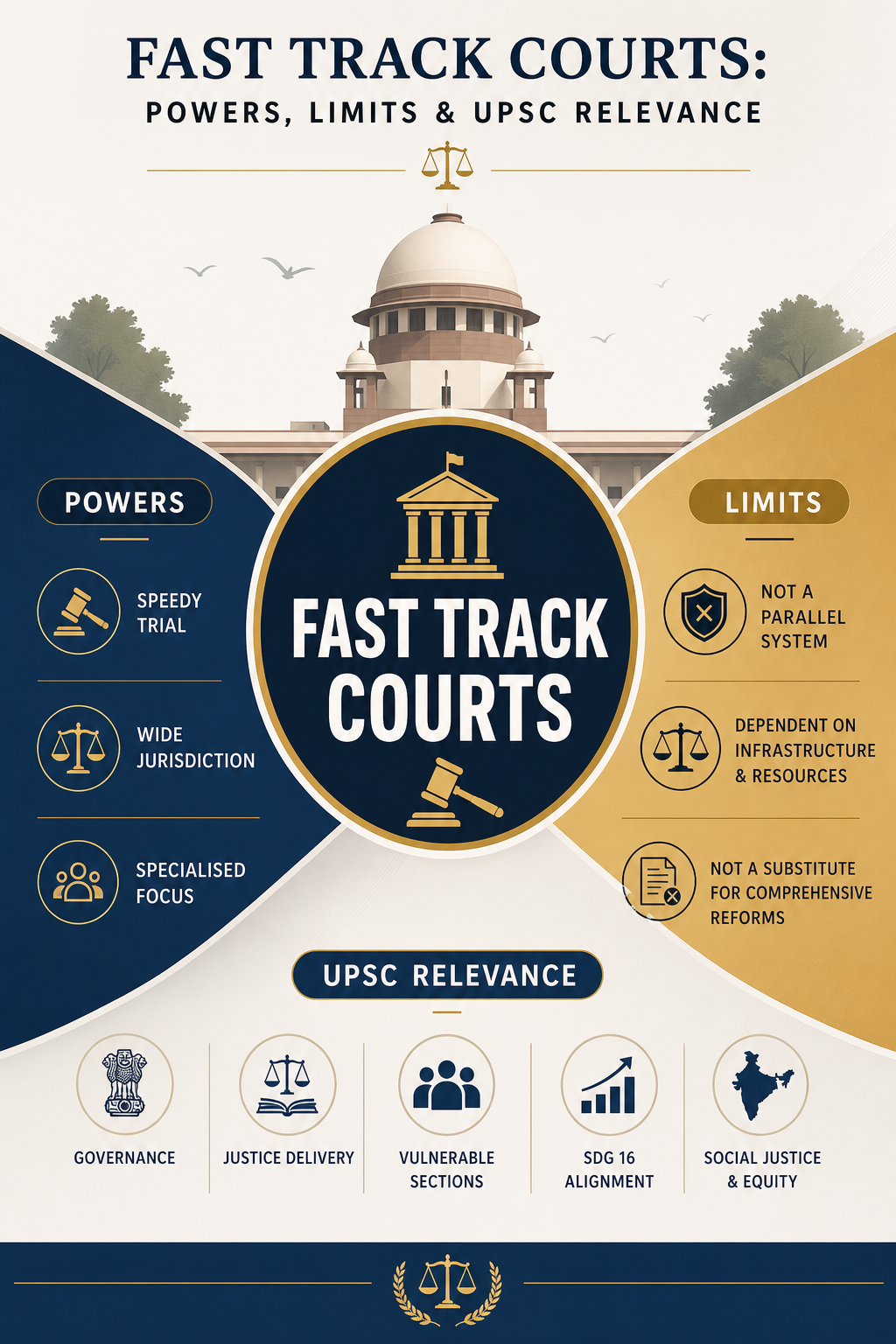
These are courts or designated judicial mechanisms aimed at disposing of specified categories of cases more quickly than the ordinary pace of litigation. Their central purpose is procedural acceleration: reducing delay, prioritising sensitive or long-pending matters and improving access to timely justice. They do not form a separate constitutional judiciary outside the regular judicial system. Their functioning remains subject to applicable laws, procedural safeguards and constitutional principles.
The idea gained institutional prominence around 2000 following recommendations associated with the Eleventh Finance Commission. Over time, different arrangements have been used to prioritise cases, including Fast Track Special Courts dealing particularly with sexual offences and cases under the Protection of Children from Sexual Offences Act, 2012. Such mechanisms should therefore be understood as administrative and judicial responses to pendency rather than as extraordinary tribunals free from ordinary constitutional restraints.
Why is Fast Track Courts in News?
The issue entered the news after discussion surrounding a demand for a special or fast-track mechanism in connection with the NEET paper leak matter. This raised a wider constitutional question: can the executive establish a special court merely because a particular controversy attracts exceptional public attention? The answer depends not on publicity surrounding the case but on the legal authority, institutional competence and constitutional basis for creating or designating such a mechanism.
The distinction is important. Governments may support special judicial arrangements for rationally defined categories of cases through lawful schemes, legislation or administrative coordination, but judicial independence prevents arbitrary executive control over adjudication. Article 14 also requires equality before law and equal protection of laws. A special classification must therefore rest on an intelligible and legitimate basis rather than media attention or political pressure.
Key Features of the Fast-Track Justice Mechanism
The defining feature is prioritised disposal rather than a different standard of justice. Cases may be assigned according to a legally or administratively identified category, while judges continue to apply substantive and procedural law. Speed cannot replace fairness, evidentiary standards or the rights of parties. The objective is to make the existing justice process more responsive without compromising due process.
- Priority listing: identified categories receive concentrated judicial attention.
- Speedier disposal: the mechanism seeks to reduce avoidable procedural delay and pendency.
- Category-based approach: special courts can address defined classes such as certain sexual offences rather than arbitrarily selected individuals.
- Fast Track Special Courts: these are distinct from the broader historical model and focus on specified sexual offences, including relevant POCSO cases.
- Constitutional safeguards: equality, judicial independence, natural justice and fair-trial requirements continue to apply.
Challenges Related to Judicial Fast-Tracking
Fast Track Courts can improve disposal, but they cannot by themselves remove the structural causes of judicial delay. Vacancies, inadequate court infrastructure, investigation delays, repeated adjournments, procedural complexity, uneven prosecution capacity and growing caseloads can continue to affect outcomes. If a fast-track designation merely shifts judges or cases from one docket to another, the system may redistribute pendency instead of reducing it.
There is also a tension between speed and quality. Excessive disposal pressure may affect the time available for evidence, arguments and reasoned judgments. Arbitrary selection of highly visible cases can create equality concerns and weaken public confidence. Sustainable reform therefore requires capacity building alongside prioritisation.
Way Forward for Speedy and Equal Justice
The policy objective should be timely justice across the judicial system rather than exceptional speed only in prominent disputes. Governments and courts can strengthen infrastructure, fill vacancies, improve case management, use technology appropriately and provide adequate prosecution and forensic capacity. Special mechanisms should operate through transparent criteria so that prioritisation serves an identifiable public purpose and remains consistent with Articles 14 and 21.
Reform must also preserve institutional boundaries. The executive can finance schemes and frame policy within its lawful competence, while adjudicatory independence must remain protected. Periodic evaluation should examine disposal rates, case quality, vacancies and whether dedicated courts genuinely reduce overall pendency. The broader goal is not speed at any cost, but accessible, fair and reasonably prompt justice.
Prelims Practice Corner
- 1. Consider the following statements:
- Fast-track mechanisms constitute a separate constitutional judiciary.
- Speedy trial has been recognised as part of Article 21 jurisprudence.
Answer: (b) 2 only.
- 2. Article 14 of the Constitution primarily guarantees equality before law and equal protection of laws. Answer: (b).
- 3. Fast Track Special Courts are particularly associated with sexual offences and relevant POCSO cases. Answer: (b).
- 4. The POCSO Act was enacted in 2012. Answer: (c).
- 5. Hussainara Khatoon is most closely associated with the principle of speedy trial. Answer: (b).
Mains Practice Questions
- 1. Speedy justice and equal justice must operate together in a constitutional democracy. Discuss with reference to special judicial mechanisms in India. (10 marks)
- 2. Special courts can improve judicial efficiency but cannot substitute structural judicial reform. Examine. (15 marks)
FAQs on Fast-Track Justice in India
Are special fast-track mechanisms separate from India’s judiciary?
No. Their purpose is to accelerate selected cases within the legal and judicial framework; they do not create an independent constitutional judicial system.
Can a special court be created merely because a case receives public attention?
Public attention alone is not a sound constitutional basis for arbitrary differential treatment. Any special classification or institutional arrangement must have lawful authority and satisfy applicable constitutional principles, including equality.
Why are these courts important for UPSC preparation?
The topic integrates dynamic developments with Article 14, Article 21, judicial independence, rational classification, pendency, POCSO-related institutions and the broader challenge of delivering speedy justice in India.
Related Current Affairs
Preparing for UPSC, PCS or HCS?
Talk to a mentor at Chetan Bharat Learning, Chandigarh. Free guidance on choosing the right exam and building a study plan.
Chat on WhatsAppCall 97793 53345UPSC / IAS / PCS coaching in Chandigarh · Trusted by aspirants across Punjab & Haryana
Leave a Reply
You must be logged in to post a comment.