
UPSC Mapping
| Prelims | Polity and Governance |
|---|---|
| Mains | GS Paper 2 (Polity) |
Quick Facts
| Developers | BEL and ECIL |
|---|---|
| Cluster Size | Approximately 14 polling booths |
| Primary Goal | Protect booth-wise voting secrecy |
Article
The proposed EVM totaliser represents a critical electoral reform designed to enhance voter anonymity. Recently, the Supreme Court directed the Central government to examine its introduction for counting votes. Aspirants must thoroughly understand this mechanism for the upcoming civil services examination. You can explore more such vital topics in our daily current affairs archive. This device aims to prevent booth-level victimisation and marks a significant technological shift in India’s electoral integrity framework.
What is the EVM totaliser?
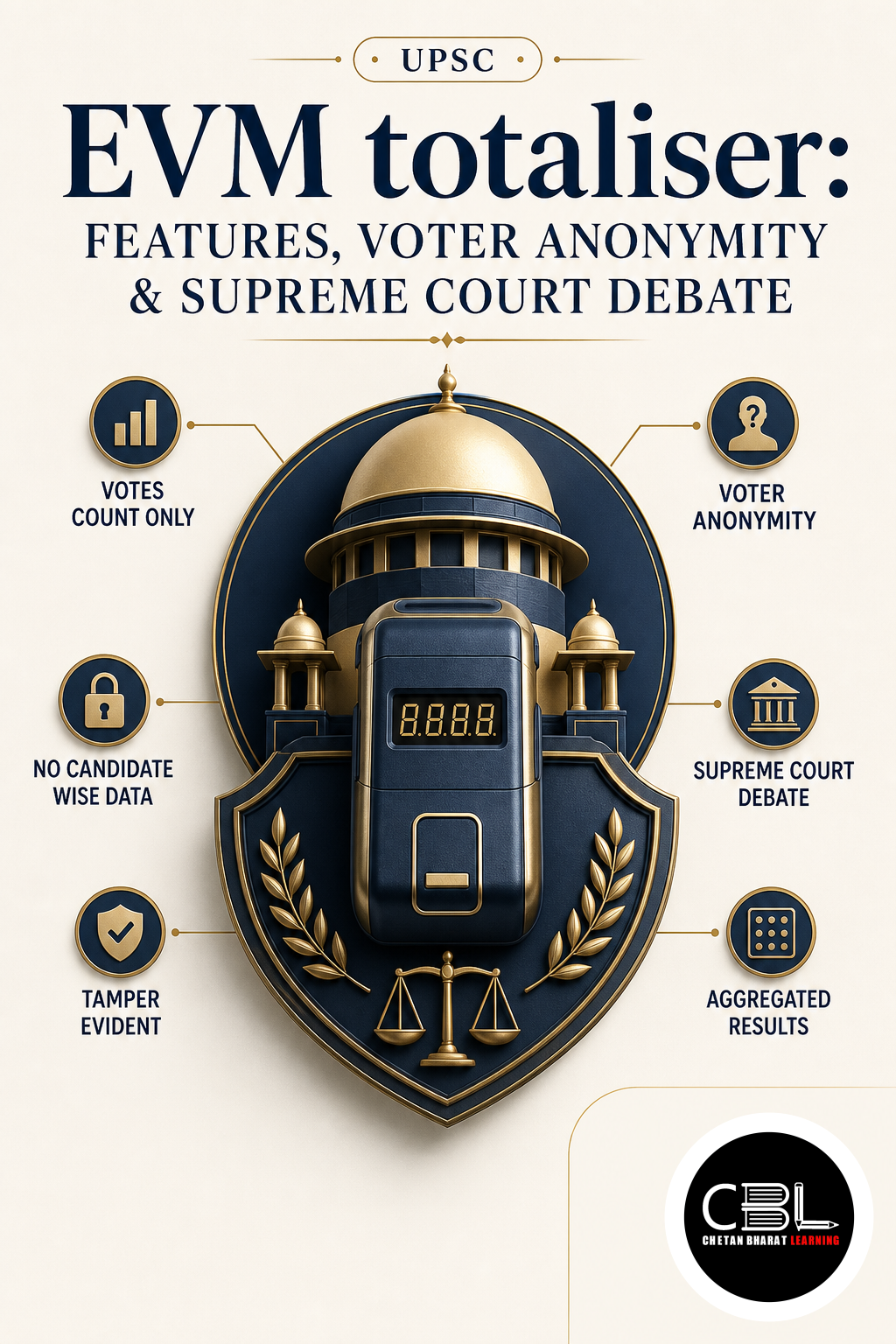
An EVM totaliser is an electronic device that aggregates votes from approximately 14 polling booths. Instead of tallying votes booth by booth, it provides a consolidated candidate-wise result for the entire cluster. This mechanism is developed jointly by Bharat Electronics Limited (Bengaluru) and Electronics Corporation of India Limited (Hyderabad), functioning as an interface connected to the main control unit of the clustered Electronic Voting Machines.
Pressing a single result button reveals the total votes without exposing individual booth-level patterns. This technological intervention specifically targets localized voter intimidation. Historically, candidates could identify anti-party voting trends in specific areas. The EVM totaliser effectively masks this granular data, ensuring the secrecy of the ballot remains absolute.
Why is the EVM totaliser in News?
The EVM totaliser recently gained prominence after a Supreme Court Bench directed the Central government to examine its implementation. The Court asked whether there are impediments or negative impacts to introducing such a system. This directive follows a public interest petition filed in 2014 by Yogesh Gupta and Imran Khan.
The petitioners cited alleged instances of voter intimidation, such as threats to cut off water supply in areas showing anti-party voting patterns. While the Election Commission has consistently supported the EVM totaliser since proposing it in 2008, the Centre has historically opposed it, arguing booth-wise data helps local outreach and that large-scale intimidation is unlikely today. Concerns about potential data breaches before counting have also been raised.
Key Features of the EVM totaliser
- Vote Aggregation: Combines votes from a cluster of about 14 polling stations into a single consolidated tally.
- Booth Anonymity: Masks booth-specific voting patterns, making it difficult to identify how individual localities voted.
- Indigenous Development: Jointly developed by BEL and ECIL, ensuring technological sovereignty.
- Simple Interface: A single result button provides the aggregated count, streamlining the counting process.
- ECI Support: The Election Commission of India has repeatedly advocated for its introduction to protect voter anonymity.
Challenges in EVM totaliser implementation
- Data Security Risks: Potential EVM data leaks even before the official counting begins.
- VVPAT Verification Complexity: Aggregating votes complicates existing booth-wise VVPAT verification mechanisms.
- Legal Ambiguity: Lack of explicit provisions authorizing the use of totalisers under current law.
- Administrative Resistance: Skepticism from the Central government regarding the necessity of booth-wise data.
- Transparency Trade-offs: Concealing booth-wise results may hinder analysis of legitimate electoral trends.
Way Forward
To maximise the benefits of the EVM totaliser, comprehensive legislative amendments are essential. Parliament should define conditions for deployment, possibly limiting use to officially notified sensitive constituencies. Clear statutory backing will eliminate legal ambiguities and prevent protracted judicial battles. Strengthening VVPAT verification protocols is also crucial to ensure aggregation does not compromise auditability.
Conducting limited pilot projects in identified sensitive constituencies could provide valuable empirical data. Policymakers should mandate transparent reporting of the grouping methodology during counting. A robust, legally sound system will strengthen India’s democratic framework, while public awareness campaigns will refine operational acceptance through strict procedural integrity.
Prelims Practice Corner
Q1. With reference to the EVM totaliser, consider the following statements:
- It aggregates votes from approximately 14 polling booths.
- It is jointly developed by BEL and ECIL.
- The Election Commission of India has historically opposed its introduction.
Options:
- (a) 1 only
- (b) 1 and 2 only
- (c) 2 and 3 only
- (d) 1, 2 and 3
Answer: (b) Statement 3 is incorrect because the Election Commission has consistently supported the introduction of the totaliser.
Q2. The primary objective of introducing an EVM totaliser is to:
- (a) Speed up the counting process significantly
- (b) Protect the secrecy of booth-wise voting patterns
- (c) Reduce the cost of conducting elections
- (d) Eliminate the need for VVPAT machines
Answer: (b) The main goal is to prevent voters at individual booths from being identified and potentially victimised.
Q3. Which of the following is a major concern raised by the Central government regarding the EVM totaliser?
- (a) It will increase the workload of polling officers
- (b) Potential data breaches before the counting begins
- (c) It is too expensive to manufacture domestically
- (d) It violates the Representation of the People Act, 1951
Answer: (b) The Centre has raised concerns about potential EVM data leaks even before the official counting begins.
Q4. The public interest petition demanding the mixing of votes across polling stations was filed in which year?
- (a) 2008
- (b) 2014
- (c) 2017
- (d) 2019
Answer: (b) The case dates back to 2014, when two individuals filed a petition asking the Election Commission to mix up votes.
Q5. Consider the following challenges associated with the EVM totaliser:
- VVPAT verification complexity
- Legal ambiguity
- Transparency trade-offs
- (a) 1 and 2 only
- (b) 2 and 3 only
- (c) 1 and 3 only
- (d) 1, 2 and 3
Answer: (d) All three are significant structural and operational hurdles facing the implementation of the totaliser.
Mains Practice Questions
Q1. Discuss the significance of the EVM totaliser in protecting voter anonymity. What are the operational challenges in its implementation? (150 words, 10 marks)
Answer Structure:
- Intro: Define the EVM totaliser and its core objective of aggregating EVM data to prevent booth-wise intimidation.
- Body: Discuss significance (protects vulnerable voters, aligns with secret ballot principles) and challenges (weakens booth verification, VVPAT complications, lack of statutory framework).
- Conclusion: Suggest a balanced way forward focusing on pilot testing and explicit legislative amendments.
Q2. The introduction of the EVM totaliser represents a conflict between electoral transparency and voter secrecy. Critically analyze this statement. (250 words, 15 marks)
Answer Structure:
- Intro: Contextualize the debate between the need for granular electoral data and the imperative of protecting voters from post-election retribution.
- Body: Analyze the transparency argument (booth-wise data helps parties analyze trends, ensures VVPAT auditability) versus the secrecy argument (prevents localized intimidation, protects minority voters, supported by ECI).
- Conclusion: Conclude that a calibrated approach, such as targeted deployment in sensitive areas backed by statutory clarity, can resolve this dilemma.
FAQs on EVM totaliser
What is the primary function of an EVM totaliser?
The primary function is to aggregate vote counts from approximately 14 Electronic Voting Machines before displaying the final tally. This prevents the disclosure of booth-wise voting patterns, thereby protecting voters from post-election intimidation.
Why has the Central government historically opposed the EVM totaliser?
The Centre has argued that booth-wise voting data helps candidates improve local outreach and that large-scale intimidation is unlikely in the current era of media activism. It has also raised concerns about potential data security risks.
How does the EVM totaliser affect VVPAT verification?
The totaliser complicates VVPAT verification because it aggregates data from multiple machines. This makes it difficult to match specific VVPAT slips to individual EVMs, potentially weakening the booth-wise audit trail.
Related Current Affairs
Preparing for UPSC, PCS or HCS?
Talk to a mentor at Chetan Bharat Learning, Chandigarh. Free guidance on choosing the right exam and building a study plan.
Chat on WhatsAppCall 97793 53345UPSC / IAS / PCS coaching in Chandigarh · Trusted by aspirants across Punjab & Haryana
Leave a Reply
You must be logged in to post a comment.