
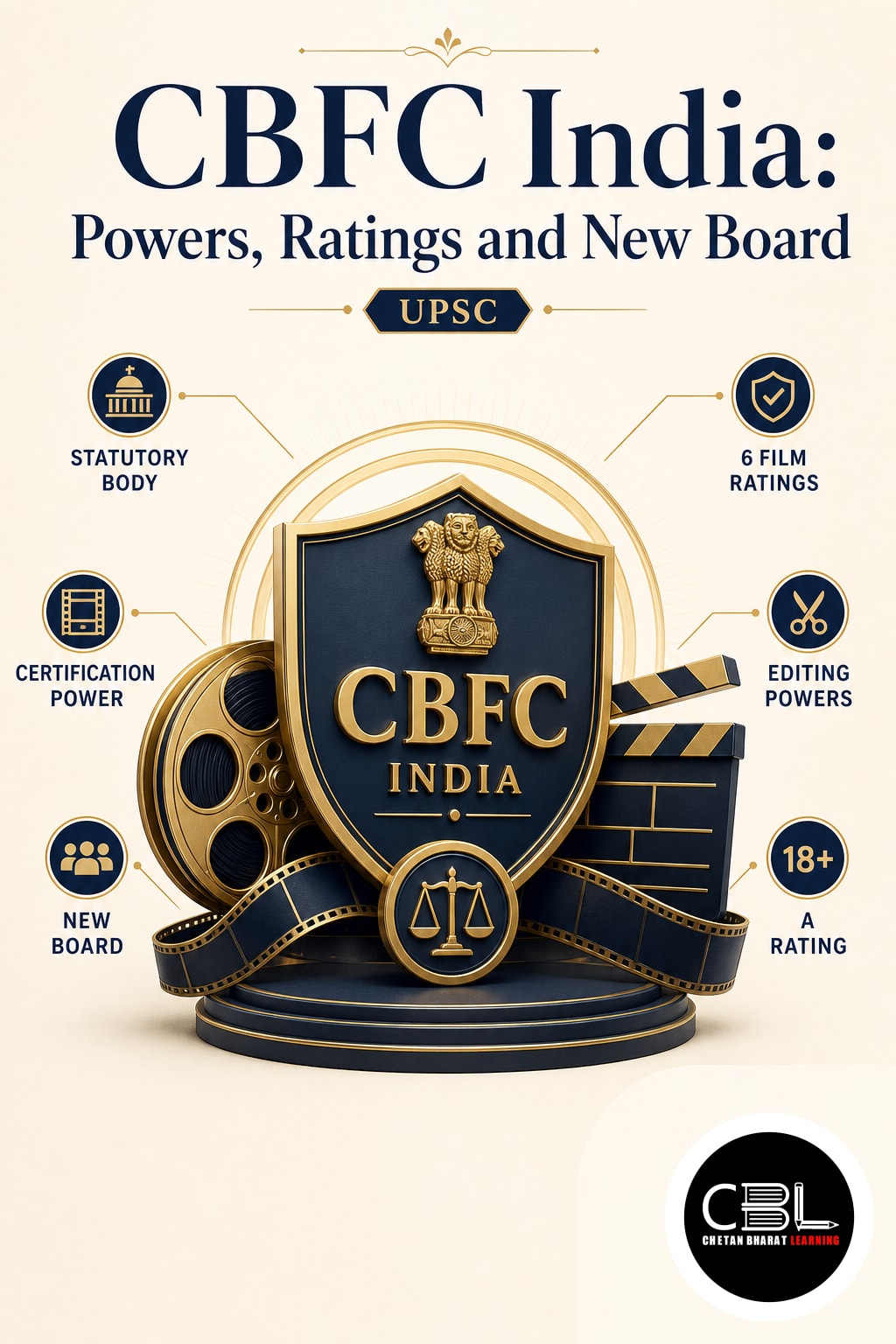

UPSC Mapping
Prelims
Statutory Bodies, Cinematograph Act and Film Categories
Mains
GS Paper II — Governance and Fundamental Rights
Quick Facts
| Established | 1951 |
|---|---|
| Type | Statutory certification body |
| Ministry | Information and Broadcasting |
| Governing Law | Cinematograph Act, 1952 |
| Headquarters | Mumbai |
What is CBFC India?
CBFC India is a statutory body functioning under the Union Ministry of Information and Broadcasting. The Central Government constitutes it under the Cinematograph Act, 1952, and appoints its chairperson and other members. The Board examines films before their public exhibition and grants certificates based on content, intended audiences and statutory guidelines.
The institution does not merely divide films into suitable age groups. It may require modifications or refuse certification when content violates the Act and applicable guidelines. Section 5B reflects grounds resembling the restrictions permitted by Article 19(2), including sovereignty, security, friendly relations with foreign states, public order, decency and morality. It also covers defamation, contempt of court and incitement to an offence. These standards require careful application because cinema enjoys protection as artistic and commercial expression under Article 19(1)(a).
Why is CBFC India in News?
CBFC India came into focus after the Union Government reconstituted the Board with a new group of members drawn from cinema, television, music and related cultural fields. The development renewed discussion about institutional diversity, professional expertise and consistency in certification decisions. It also highlighted how the Central Government shapes the Board through appointments made under the governing statute.
The reconstitution follows broader reforms introduced through the Cinematograph Amendment Act, 2023 and the Cinematograph Certification Rules, 2024. These reforms created graded UA markers, strengthened measures against film piracy and modernised certification procedures. Public debate continues over whether the system protects children and social interests without imposing disproportionate restrictions on creative work. Information about applications, certificates and institutional procedures remains available through the official certification portal.
Key Features
- Statutory composition: The Central Government appoints a chairperson and between twelve and twenty-five other Board members under the Cinematograph Act.
- Multiple certification categories: Films may receive U, UA with 7+, 13+ or 16+ indicators, A for adults, or S for specified professional classes.
- Regional examination system: Examining committees working through regional offices assess films in different languages and recommend certification, modification or refusal.
- Public-exhibition mandate: The Board certifies films intended for public exhibition, while digital streaming content operates under a separate regulatory framework.
- Legal accountability: Certification decisions remain subject to constitutional principles, statutory procedures and judicial review by the competent courts.
Challenges
- Certification versus censorship: Extensive cuts can convert an age-classification system into prior restraint, limiting expression beyond what audience protection requires.
- Subjective standards: Concepts such as decency, morality or public order may produce inconsistent decisions unless authorities publish clear and predictable reasoning.
- Institutional independence: Government appointments can create perceptions of political influence, making transparent selection and fixed procedures important for public confidence.
- Changing media environment: Separate rules for cinema theatres and online platforms can create regulatory differences despite audiences accessing similar audiovisual content.
- Procedural delays: Slow examination or litigation can disrupt release schedules, raise financial costs and reduce the practical value of later legal relief discussed in CBL’s governance analysis.
Way Forward
CBFC India should increasingly operate as a transparent classification institution focused on enabling informed audience choice. Detailed written reasons, predictable timelines and consistent standards would improve fairness for filmmakers and viewers. The Board can publish anonymised decision patterns and strengthen professional training for members of examining committees.
Appointments should reflect regional, linguistic, gender and professional diversity while protecting institutional autonomy. Age-based categories can reduce demands for blanket cuts when parental guidance adequately addresses the concern. Accessible certification information, effective appeals and judicial oversight can further protect procedural fairness. The Ministry of Information and Broadcasting should review implementation regularly and consult filmmakers, child-development experts, disability groups and civil-society organisations. Such reforms can reconcile constitutional freedom with legitimate audience protection.
Prelims Practice Corner
Q1. The Central Board of Film Certification functions under which Union ministry?
- (a) Ministry of Culture
- (b) Ministry of Information and Broadcasting
- (c) Ministry of Home Affairs
- (d) Ministry of Education
Answer: (b) The Board functions under the Ministry of Information and Broadcasting.
Q2. Which certification category restricts a film’s public exhibition to adults?
- (a) U
- (b) UA 7+
- (c) A
- (d) S
Answer: (c) An A certificate restricts public exhibition to adult viewers.
Q3. The grounds guiding film certification under Section 5B broadly correspond with restrictions under which constitutional provision?
- (a) Article 14
- (b) Article 19(2)
- (c) Article 21A
- (d) Article 32
Answer: (b) Article 19(2) permits reasonable restrictions on freedom of speech and expression.
Q4. Consider the following statements: 1. The Board certifies films for public exhibition. 2. The Central Government appoints its members. 3. The S category concerns specified professional classes. Which statements are correct?
- (a) 1 only
- (b) 1 and 2 only
- (c) 2 and 3 only
- (d) 1, 2 and 3
Answer: (d) All three statements correctly describe the statutory certification framework.
Q5. Which reform followed the Cinematograph Amendment Act, 2023?
- (a) Abolition of all age ratings
- (b) Perpetual validity of film certificates
- (c) Transfer of certification to states
- (d) Removal of anti-piracy provisions
Answer: (b) The amendment provided perpetual validity for certificates and introduced other certification and anti-piracy reforms.
Mains Practice Questions
Q1. Film certification requires a careful balance between creative freedom and legitimate public interest. Discuss. (10 marks)
- Intro: Connect cinematic expression with Article 19(1)(a) and reasonable restrictions under Article 19(2).
- Body: Examine audience protection, age ratings, subjective standards, prior restraint, institutional independence and judicial review.
- Conclusion: Support transparent classification that uses proportionate restrictions and protects artistic liberty.
Q2. Evaluate the institutional and regulatory reforms required to modernise India’s film-certification framework. (15 marks)
- Intro: Mention the statutory framework and changing audiovisual-media environment.
- Body: Cover graded ratings, appointment transparency, reasoned decisions, timely appeals, digital processes, accessibility and stakeholder consultation.
- Conclusion: Recommend an independent, predictable and rights-based certification system suited to contemporary media.
FAQs on CBFC India
Is CBFC India a statutory body?
Yes. The Central Government constitutes the Board under the Cinematograph Act, 1952. It functions under the Union Ministry of Information and Broadcasting.
What are the main film-certification categories?
The categories include U, graded UA markers of 7+, 13+ and 16+, A for adults and S for specified professional classes. The UA markers guide parents about age-appropriate viewing.
Does the Board regulate online streaming content?
Its central statutory role concerns films submitted for public exhibition. Online curated content follows a separate framework under the Information Technology Rules, including platform-level age classification.
Related Current Affairs
Preparing for UPSC, PCS or HCS?
Talk to a mentor at Chetan Bharat Learning, Chandigarh. Free guidance on choosing the right exam and building a study plan.
Chat on WhatsAppCall 97793 53345UPSC / IAS / PCS coaching in Chandigarh · Trusted by aspirants across Punjab & Haryana
Leave a Reply
You must be logged in to post a comment.