
Category: Science & Tech
-
Indira Point: Protecting India’s Southernmost Landmark
The Union Government has proposed protecting and strengthening the historic Indira Point lighthouse while developing tourism infrastructure. The proposal raises important questions about coastal conservation, disaster resilience and sustainable development.
-
Trump Declares Iran Ceasefire Accord Over After Fresh Strikes Escalate Gulf Tensions
US President Donald Trump announced that the interim understanding aimed at ending the conflict with Iran had effectively collapsed after renewed Iranian attacks on US military facilities. The development marks another phase of escalation in West Asia with implications for global oil markets, maritime security and India’s strategic interests.
-
India–Indonesia Strategic Partnership Deepens: Defence, Critical Minerals and Indo-Pacific Cooperation
UPSC Mapping Component Details GS Paper GS-II Subject International Relations Prelims ASEAN, BrahMos, Indo-Pacific, Indonesia Mains India’s Act East Policy and strategic partnerships Static Linkage ASEAN, Indian Ocean Region, Maritime Security, SAGAR, Act East Policy Institutions ASEAN, Indian Navy, DRDO, BrahMos Aerospace International Concepts Indo-Pacific, Freedom of Navigation, Maritime Security Article Why in News? Prime…
-
India’s Renewable Energy Revolution: Why Storage Holds the Key
Why Renewable Energy Alone Is Not Enough India is rapidly emerging as one of the world’s leading renewable energy producers. Massive investments in solar and wind energy have strengthened the country’s clean energy transition and reduced dependence on fossil fuels. However, renewable energy faces a fundamental challenge: it is not always available when electricity is…
-

Ebola Outbreak in Congo and Uganda: Why Global Health Security Matters More Than Ever
Why the Ebola Outbreak Is a Global Concern The recent Ebola outbreak in the Democratic Republic of Congo (DRC) and Uganda has once again highlighted the vulnerability of the global health system to infectious disease outbreaks. The World Health Organization (WHO) has described the situation as an “emergency of global concern” because of: Although Ebola…
-
The SHANTI Act, 2025: A New Era for India’s Nuclear Energy
The Sustainable Harnessing and Advancement of Nuclear Energy for Transforming India (SHANTI) Act, 2025, represents the most significant overhaul of India’s nuclear governance framework since Independence. By repealing: The SHANTI Act establishes a modern and consolidated legal framework aimed at expanding India’s nuclear energy capacity to 100 GW by 2047. The legislation reflects India’s broader…
-
Data and Justice: How AI & Digital Courts Can Transform India’s Judiciary
Important For: UPSC / HCS / PCS Aspirants GS Paper 2: Judiciary, Governance, E-GovernanceGS Paper 3: Technology & AI ApplicationsEssay Topics: AI in Governance, Judicial Reforms, Digital India Why in News? The Supreme Court of India announced initiatives involving: ➤ Open Courts Data➤ Artificial Intelligence (AI)➤ Digital judicial records to improve: The discussion focused on…
-
India Gets Its First Alzheimer’s Therapy Explained
Important for: UPSC, Haryana HCS, Punjab PCS Prelims: Alzheimer’s disease, monoclonal antibodies, FDA approvalMains: GS Paper 2 & 3 — Public Health, Biotechnology, Healthcare Accessibility Why in News? India has approved its first treatment for Alzheimer’s disease with the launch of Donanemab, a breakthrough therapy aimed at slowing cognitive decline in early-stage patients. The therapy…
-
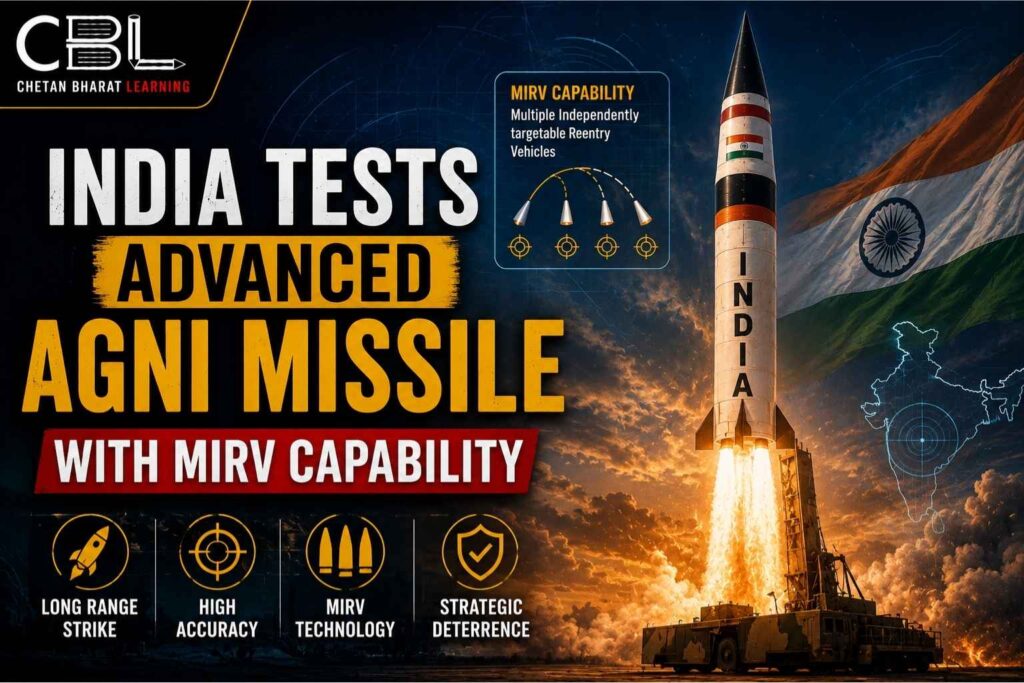
India Tests Advanced Agni Missile with MIRV Capability
Important for: UPSC, Haryana HCS, Punjab PCSPrelims: Agni Missile, MIRV Technology, DRDOMains: GS Paper 3 — Defence Technology, Internal Security, Strategic Capabilities Why in News? India successfully tested an: Advanced Agni missile equipped with MIRV technology marking a major milestone in India’s strategic defence capability. The missile can:→ Deploy multiple warheads at different targets simultaneously.…
-
‘Made in India’ Cloud Push: Govt Plans Data Sovereignty in Critical Sectors
Important for: UPSC, Haryana HCS, Punjab PCSPrelims: Cloud computing, data sovereignty, cybersecurityMains: GS Paper 3 — Economy, Science & Technology, Internal Security Why in News? The government is considering mandating the use of ‘Made in India’ cloud systems in critical sectors to reduce reliance on foreign providers and ensure data security. What is Cloud Computing?…
Recent Posts
- Retail Inflation Rises: August 2026 Price Pressures
- Circular Economy Forum 2026: India Leads Transition
- Copper Prices Surge: Tariffs and Stockpiling
- New Development Bank: India’s BRICS Strategy
- PACT Platform: India’s Electric Freight Push
- UN General Assembly: 81st Session and India’s Priorities
- TRISHNA Mission: Mapping Earth’s Heat and Water Stress
- Cell Broadcast System: India’s Emergency Alert Network
- FCNR Deposits: Who Bears Currency Risk?
- Informal Economy: What ASUSE 2025 Reveals
Related Tags